Serial: Yuki Tsukada | Tactile Botany of Greenery, Part 8: Depression, Transition, Reality
Yukiari Tsukada | The Tactile Study of Greenery
Part 8: Utsu, Utsurohi, Utsutsu
This year, I was able to witness the transition from the rainy season to high summer in Kyoto. That afternoon, thunder rumbled and a downpour quickly soaked the asphalt. But eventually, the thick clouds broke apart, and the rain subsided. Sunlight streamed through the gaps, and in the eastern sky, the retreating rainy season hurried away, still carrying its clouds.
Text and photos by Yukiari Tsukada (Representative, Onshitsu LLC)
Memories of the Road
When the rain began, we were on the second floor of a gallery renovated from a dyeing factory. It's called 'taka ishii gallery,' with spaces in both Kiyosumi, Tokyo, and here in Kyoto. Both spaces have been designed to retain their former 'memories,' making them places where the 'present' can evoke 'unknown memories.' The sound of rain on the corrugated roof, thunder rumbling in the distance, shaking the air. Amidst this, we viewed the works. The entire space.
White
This was my first time seeing Naoko Tamura's photographs. They are part of a series titled 'The Forest of Sologne - La Borde Hospital,' which I've been following in the medical journal 'Psychiatric Nursing' published by Igakushoin.
On the enclosed, white-painted walls, even whiter (brighter) photographs are displayed. I don't understand the technical aspects, but she has captured the dazzling light from beyond onto photographic paper. Towards that light, the patients at this psychiatric hospital cycle their bicycles. Or they are absorbed in something within that light. Photos of patients smiling warmly against the light. Innocent, exposed faces, their expressions unclear in the backlight. Pain and tenderness, and distance. A dreamscape? A scene that makes you want to cry out, 'Don't go!' Kenji wrote, 'Oh, dazzling light, I run towards you,' and it reminded me of my grandmother, when she was hovering on the brink of death several times, opening her eyes, reaching out her hands, and saying, 'The sun...!'
Moon
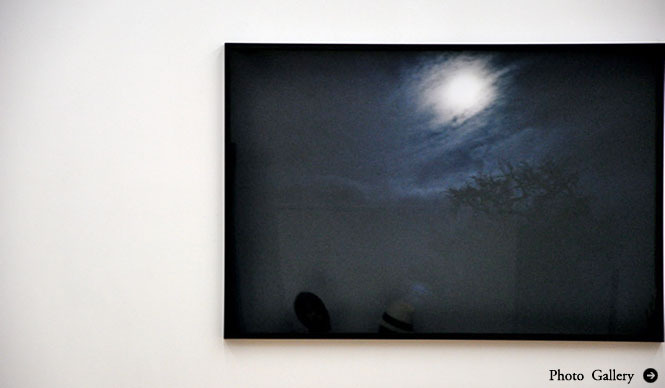
Among this series of photographs, there was a single night shot. A photograph of a moonlit silhouette against a dark blue sky. The blurred outline of the moon made me feel restless. A full moon in the night sky over the Forest of Sologne. Hung alone, slightly off-center. While many photos were taken outside the grounds, this one appears to have been taken from within the property, behind the building.
Day, sun, outside, white (light): moon, night, inside, blue…
In any case, the world of 'there' exists on both sides of what is called the mind—in the light, and in the moon and night—and they are interconnected. Dazzlement and illusion. In terms of the number of works, it's 'many to one.' An opposing unity. Sadness = beauty is captured, crossing the boundary between here and there, spreading even into my inner self. What exactly is madness? Is it the hidden truth that is madness? Perhaps this forest, this castle-like mansion, is what separates and simultaneously protects society from it.
Love
As in Chinese characters, the word 'love' (愛) originally depicted 'a person about to leave, with their heart lingering behind,' and is a word that refers to an unsettled, hazy state. 'Ambiguous' (曖) is the same; this character can also mean 'to shadow' or 'dark,' and '薆' (ài), with the grass radical, refers to plants growing thickly and obscuring things. For La Borde Hospital, the Forest of Sologne was '薆,' and what the photographer captured was precisely this 'love.' Perhaps that is why it feels so poignant and out of reach.
After
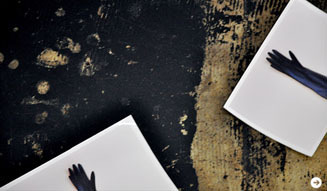
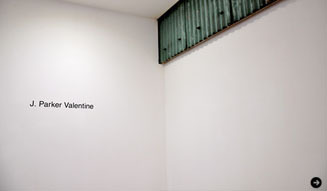
Valentine's works have a 'just as it is' feel. They are traces of the past, and also paths to the future, drawings that connect to the unknown. All the works, created during her first stay in Kyoto, show her enjoying her encounters with Kyoto's culture and landscape with fresh eyes. Her light traces seem closer to insects or spirits than to humans. A prelude to something appearing in this world? Like a preparatory run, or a fledgling repeatedly practicing its takeoffs, lines. Various fragile lines shift and disappear (or remain). Her memories, Kyoto's memories, this building's memories ebb and flow.
Emptiness
Both artists are very interested in the 'utsurohi' within the Japanese words 'utsu'—'utsurohi'—'utsutsu,' finding it ephemeral and beautiful.
'Utsu' is 'utsuro,' which is 'utsuwa' (vessel), meaning something comes to it, that is, it is 'utsurotte' (filled). The old lunar calendar's Tanabata is approaching, and setting up bamboo as a 'yorishiro' (object of worship) is seen nationwide. When the wind blows and the bamboo rustles, people sensitively perceive the presence and believe that the gods have heard and visited. Bamboo with a hollow interior is chosen as a yorishiro for this reason. That is, as an 'utsuro.' It is through hearing the sound that human ears become 'utsutsu' (aware, conscious).
When arranging flowers, or standing in the garden, watching the sunlight graze the petals or the dappled light endlessly sway, one does feel a sense of something entering and leaving.
Summer
After the rainy season pushed and shoved its way through summer, a hot summer arrived, shining opulently with its cumulonimbus clouds. The borrowed umbrella, left behind by someone at the gallery, was already starting to dry. The sound of the 'shō' drum grew steadily closer. The 'otabisho' (temporary resting place for a deity) came into view, and ah, it was bustling.
Naoko Tamura / Jay Parker Valentine
Taka Ishii Gallery Kyoto
483 Nishigawa-cho, Shimogyo-ku, Kyoto (Southwest corner of the intersection of Nishi-toin and Shin-hanayacho streets)
Exhibition Period | Until Saturday, July 31
Opening Hours | 11:00–19:00
Closed | Sundays, Mondays, and National Holidays
Tel. 075-353-9807
www.takaishiigallery.com