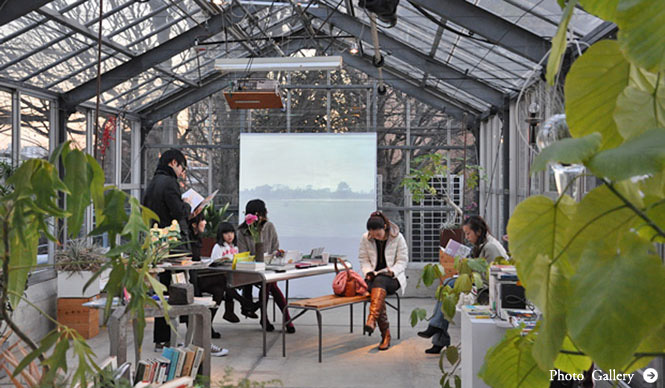
Series: Yuichi Tsukada | Haptic Botany, Part 10: "Reading Room Under the Moonlit Night," "Reading Room in Midwinter," and...
Closer to the sky than a tea room, nearer the treetops.
Part 10: 'Moonlit Reading Room,' 'Midwinter Reading Room,' and… (1)
A tea ceremony involves setting the stage within defined boundaries, infusing the atmosphere with a specific mood, and enjoying the performance of host and guest. For our two reading room events, we approached them with the spirit of a tea ceremony, requesting curated selections of books, arranging them with plants and interior decor.
Text and photos by Yuji Tsukada (Representative, Onshitsu Inc.)
Boundaries, Limits, Definitions
A glass box on the rooftop, closer to the sky than a tea room, nearer the treetops. The narrow spiral staircase leading up could be seen as the 'roji' (garden path), and the space that unfolds beyond the 'nijiriguchi' (crawl-through entrance) as the glass box. In terms of being a different realm, it's the same. Preferences are also conveyed. While it may be limited by what's available, this is all we have right now – a sentiment echoed in wabi-cha. These acts of 'drawing in' and 'shrinking landscapes' are said to be Japanese strengths, evident in both flowers and gardens.
By defining, dividing, and limiting, things expand.
For instance, in 'Midwinter Reading Room,' by limiting the season to 'winter,' we selected books to be read during winter, under winter skies, or on long winter nights. Each person brought their own 'winter mood' to the books they chose.
Early winter and late winter must differ from midwinter, and associations like 'When you think of winter, it's 〇〇, isn't it?' can be quite universal: cold, snow, darkness, or in life, perhaps old age, the color black, or withered plants. Sometimes, because it's cold, we choose books that evoke a sense of spring. Books to be read tucked under a warm futon on a cold winter night, books tracing the etymology of 'winter,' books about snowflakes, winter constellations, or even books about rabbits and bears. There are books about winter sounds, collections of works by artists who create winter-themed pieces, biographies of people associated with winter, or even the raw intensity of events that occurred in winter. The crucial part is deciding where to draw the line for the endlessly expanding concept of winter.
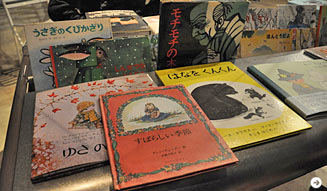
Picture book from 'Midwinter Reading Room'
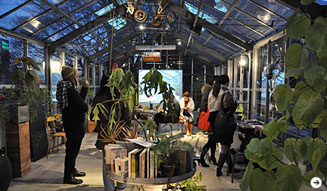
Evening view of 'Midwinter Reading Room'
Illuminated by the Moon, Lunar
By dividing, and by seeing each way of dividing, one's own divisions multiply. In 'Moonlit Reading Room,' there were Romantic texts, books on minerals, books about moon goddesses, moon photography collections, and books exploring the moon's connection to night, the sea, water, the mystical world, or other realms, including picture books and manga that evoked childhood memories. A variety of 'moon-like' things were arranged, illuminated by moonlight. When picking up a book that catches your eye, the moon is surely involved.
Coincidentally, the first day was a full moon, and soon the moon peeked out from between the buildings. When we turned off the lights in the greenhouse, the moonlight cast shadows. The lunar mood within the world of books and the actual moonlit scenery alternated.
What happens in this space, between the words printed in books and the celestial body floating in the sky, leaves a trace. Kenji Miyazawa, who wrote, 'Ferns turn silver steel in the moonlight,' said, 'Only this bumpy road right here is the future itself.'
Season and reading, plants and books, nature and books; holding that book in that place, in that season.
'Spring Haze Reading Room' will be held on Sunday, March 20th, and Monday, March 21st (Vernal Equinox Day).
Part 10: 'Moonlit Reading Room,' 'Midwinter Reading Room,' and… (2)
A glimpse from 'Midwinter Reading Room'
Since the venue is 'Onshitsu' (Greenhouse) and it reflects my work, plants naturally found their way into the reading room. This time, we tried placing plants among the books. This seems to be forbidden in regular bookstores and libraries. Water is the enemy of paper books and can cause moisture and dirt. However, this is a greenhouse, and it's partly outdoors, exposed to the sun. I figured that unless they were particularly valuable or borrowed items, most would be fine.
What became clear is that plants and books are an excellent match. Moreover, with living plants nearby, the books themselves seemed more alive, as if they were conversing.
Just as we write 'words,' words can be likened to plant leaves. These are fixed as characters in books. The shape of a leaf resembles a book. Or rather, perhaps books imitate them. Leaves fold and unfold, overlap and close, forming a book. In ancient India, it is said that letters were written on the leaves of a tree called 'taruyō.' Much of the raw material for paper also comes from plants. It's no wonder they get along so well.
It's so natural that plants begin to look like books. Yes. Perhaps they too are a kind of book. The more you open them, the more you turn their pages, the more stories and information are written within. They wait as they are, holding stories yet to be told. It all depends on whether we can listen – to their words, their voices, their expressions, their textures. That might be all there is.
Potted plants, in their portability, also approach the nature of books. Unlike those planted in the ground, we can take these with us. Though not as much as with books, they allow us to travel.
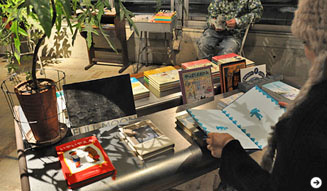
Scene from 'Moonlit Reading Room'
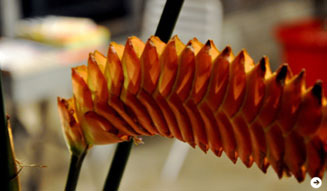
Flowers from 'Moonlit Reading Room'
'Spring Haze Reading Room'
It will be held on Sunday, March 20th, and Monday, March 21st.
The title is 'Spring Haze Reading Room.' The book selections are by Maha Harada (novelist), Takumi Akaba (photographer), Kenji Nagata (tax accountant), and myself, Yuji Tsukada, along with other staff from Onshitsu.
As the cherry blossom front races up the Japanese archipelago. What will happen on a hazy moonlit night?
Spring Haze Reading Room
March 20th is the waning crescent moon.
The 21st is the Vernal Equinox, the start of the equinoctial week.
Is it true that day and night are of equal length?
Here and there, free to come and go.
The cherry blossoms will bloom soon, too.
Spring Haze Reading Room.
A hazy, lingering reading room.
'Spring Haze Reading Room'
Date: March 21, 2011 (Mon) 3:00 PM - 9:00 PM
March 22 (Tue, Holiday) 3:00 PM - 9:00 PM
Location: Rooftop, Annex B, Hillside Terrace, 30-2 Sarugaku-cho, Shibuya-ku
Book Selection: Maha Harada (Novelist), Takumi Akaba (Photographer), Kenji Nagata (Tax Accountant), Onshitsu
Fee: 500 yen
Planning: Onshitsu
Cooperation: Lim Green, Tenjindo Kojima Inbo
Inquiries: 090-3420-3514 (Tsukada)