
Yuichi Tsukada | Haptic Botany, Part 2: The Scorched Mark of Indigo
Yukiari Tsukada | Tactile Botany: Green
Part 2: The Scorched Traces of Indigo
Indigo Flowers
The variety I grow is Japanese indigo, famous in regions like Tokushima. Its small, rice-grain-like flowers, a mix of pale pink and white that bloom this time of year, possess a maidenly modesty.
Later, from autumn into winter, the leaves turn yellow. Around Christmas, the hidden red within the indigo emerges with humidity, and the stems turn a deep crimson. Though called crimson, it's a hue like a deep blue giving birth to red. By then, the seeds also ripen.
Text and Photos by Yukiari Tsukada (Representative, Greenhouse Co., Ltd.)
This Summer Too—
We held four or five workshops this summer at the "Setagaya Monozukuri Gakko" (Setagaya Craft School), where our field is located, and at "Akasaka Hikawa Shrine."
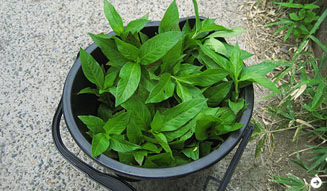
What we do is "fresh leaf dyeing" with indigo. During the hot summer months, we pick the fully grown indigo leaves, pluck them from their stems, add a suitable amount of water, and blend them into a juice in a mixer. Next, we strain it through a cheesecloth. As it’s squeezed, a thick, viscous texture emerges, and from this soft, mud-like sensation, I truly feel we are receiving something precious.
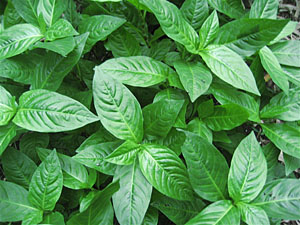
Indigo leaves just before picking
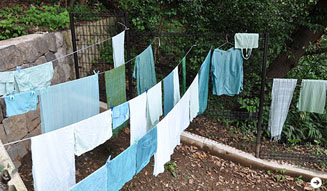
We then immerse silk or linen fabric into the resulting dye liquid and begin the dyeing process. When lifted from the greenish liquid, which resembles a vegetable juice, and flapped in the sunlight, the color changes visibly before your eyes.
The colors vary depending on the fabric, but it's not the deep blue worn by gardeners. Especially with silk, a transparent, vibrant blue appears. This overflowing transformation of color. Even within a single shade of blue, one can witness an infinity of colors in its transition.
Children and adults alike enjoy this dramatic color change, but through their own bodies, they also touch upon the wonders of plants and the wisdom humanity has developed to obtain "color" from them. The kanji character for "color" (彩) is itself a pictogram representing the extraction of color from plants.
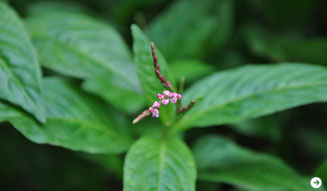
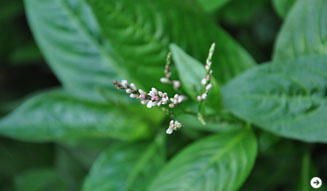
Vibrant, Seasonal Blue
There is a specific "season" for obtaining this color from indigo leaves; once the flowers bloom, a good blue can no longer be harvested.
"Sukumo" is made by fermenting leaves picked and dried during the period when the color is most developed in the indigo plant, treating it like compost. Extracting the pigment by re-activating it with ash, sake, and bran was a method developed to draw out a deeper blue from Japanese indigo, which has a lower indigo content compared to other dye plants.
It was also a technique born out of the need to dye regardless of the season. As indigo production was encouraged, particularly in the Edo period, it became a major industry centered in Awa. On the other hand, when dyeing with fresh leaves, the vibrant, deep green season yields the most beautiful colors.
When indigo leaves are dried or damaged, blue seeps out. They hold blue within them. Around this time, pale pink and white appear as flowers, as seen in the photo. Soon, yellow will gradually emerge on the leaves, and as they fall, a strong red will appear on the stems. It is a powerful red, imbued with blue. Observing these color transitions makes the very idea of drawing a line between what is blue and what is red seem absurd.
Once the plant produces seeds, its life departs. "To wither" (枯れる, kareru) can also mean "to depart" (離れる, hanareru). And the indigo plant's body quietly becomes a place to nurture new life.
Ao and Shiro
While "indigo" (藍) is also "blue" (青), "ao"), "ao" was originally a word that contrasted with "shiro" (white). In Yin-Yang Five Elements theory, blue is associated with the East and Spring. It's also called "seishun" (youth), and the guardian deity of the East is the "Azure Dragon." The opposite is white, associated with the West and Autumn. There is a term "hakushu" (white autumn), and the "White Tiger" guards the West. In reality, both "ao" and "shiro" seem to have been broader concepts than the literal colors "blue" and "white." Another pair is "black" for the North and "red" for the South, based on the concepts of "darkness" and "brightness."
"Shiro" is the "shiro" of blank space, the color beyond what light appears as, essentially light itself. In contrast, "ao" appears to have been a broad concept encompassing colors other than "shiro." Given that "awa" in "awai" (pale) and the character "監" in the kanji for "indigo" (藍), which also means "water mirror," it's likely related to the colors of water and the sea. I believe "ao" was a term used to collectively describe things that were slightly colored, as opposed to the transparent color of light itself. When we think of "blue," "red," or "yellow," we immediately picture the colors of paints or colored pencils, but there must be a much richer, deeper world. As I explore and seek to understand the relationship between plants and humans, plants gradually reveal their secrets in this way. This happens often.
Touching the Memory of Blue
The Mid-Autumn Festival has passed, and autumn deepens.
It's also called "White Dew," and with the chirping of autumn insects, the moon shines ever brighter.
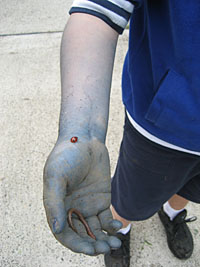
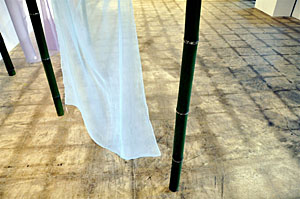
At this time of year, deliberately recalling the season of vibrant blue brings back memories of pale blue fabric fluttering in the sky, hands dyed a deep blue, and the fragrant scent of indigo.
I see. By continuing fresh leaf indigo dyeing, by using our "bodies"—the blue-dyed skin, the blue-stained fingernails, the aroma like freshly roasted tea with a hint of bitterness, the warm dampness when squeezing the leaves, the various emotions felt when picking them—our "bodies" come to remember. Like "blue scorched marks" that resurface with the memories of that place, triggered by something.
Information
On October 25th (Sunday), we will hold "Choyo no Sekku Celebrated by the Old Calendar: Autumn Dreams with Kise-gawata and Ai Pillow" at IID (Setagaya Monozukuri Gakko).
http://www.r-school.net/program/workshop/post_483.html
The following week, on the 31st (Saturday), we will hold the third "Komamidori Project" titled "Thirteenth Night: Maple and Ivy Turn Yellow" at the Advanced Research Center Cafe, 1st Floor, Building 14, The University of Tokyo's Research Center for Advanced Science and Technology. This time, focusing on moon viewing, after discussing autumn events and plants associated with the moon, we will go out onto campus to create a map of Komaba's greenery.
http://komamidori.org/index.html