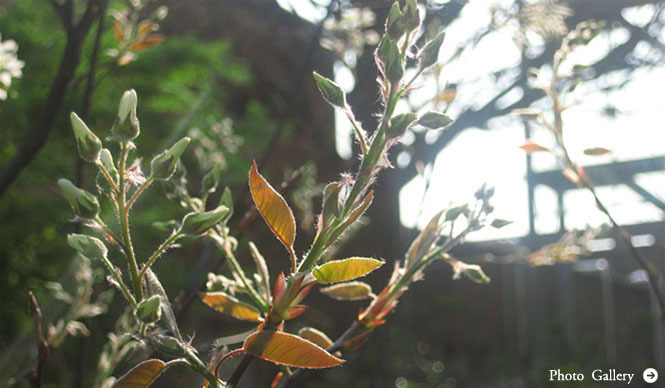
Yuki Tsukada | Tactile Botany ~Field of Sky Edition~, Episode 7: A "Tactile Botany" Workshop Begins
Yuki Tsukada | Tactile Botany of Green – Field of Sky Edition
Part 7: The "Tactile Botany of Green" Workshop Begins
The workshop, held for four consecutive years at "Setagaya Monozukuri Gakko (IID)," is called "Gakuen" (School Garden). As the name suggests, we borrow a space that was formerly a school vegetable patch. We primarily grow indigo there, and when I think about why indigo, it was purely a matter of "preference" and "connection." Perhaps that's what sustains things the longest. However, in a school named "Monozukuri" (craftsmanship), I felt it was important to understand the blessings of nature (in indigo's case, the color blue) through one's "body"—starting with soil preparation and continuing through observation and work over the seasons. This feeling is only growing stronger.
The University of Tokyo's Research Center for Advanced Science and Technology and Akasaka Hikawa Shrine
For the past two years, I've also been planning workshops in other locations, creating spaces together with the people there.
One of these is at the "Research Center for Advanced Science and Technology" at the University of Tokyo in Komaba. Here, I'm renovating and tending to the garden (I am a garden designer), hoping to connect academic knowledge with the traditional wisdom found in seasonal festivals. Together with professors, administrative staff, and students, we are aiming for a circular garden that utilizes the campus, and with the participation of many local residents, various diagonals are being drawn across the campus.
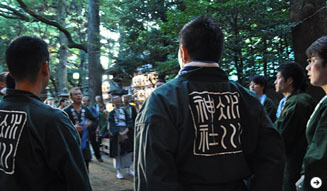
Another is at "Akasaka Hikawa Shrine." In the shrine grounds, which were originally a community hub, I've been cultivating an indigo field and, in sync with the shrine's events, am advancing workshops with the chief priest, the assistant priest, and the local community to explore the origins of these events. It's fascinating to begin to understand what the Shinto prayers are actually saying, and why we pass through the 'chinowa' ring.
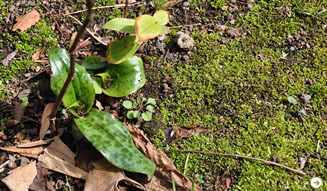
Course Name: "Tactile Botany of Green – Field of Sky Edition"
I will be leading a new course starting this spring at "Ikebukuro Community College."
This is a pioneering community course, celebrating its 30th anniversary since its opening. The rooftop has tennis courts and a tennis school, but there's also an unused sub-court. The idea is to transform a corner of this half-sized court into a wild-style vegetable garden, where participants can each tend to their own small plot (just 1 square meter, but still!) during the course. We'll grow plants, focusing on those used in seasonal offerings and festivals. While there's a slight possibility of a ball flying in occasionally, don't worry.
We will learn about the origins of seasonal offerings and festivals, do a bit of gardening, and then arrange, arrange, and decorate with the plants we harvest. The festivals are observed according to the old lunar calendar, and it's interesting that we can experience this by reversing between the new and old calendars during each monthly session.
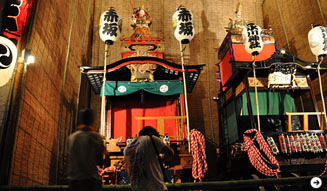
Seasonal offerings and festivals often give an impression of grandeur, of 'hare' (special, festive) occasions, but they are actually deeply intertwined with daily life. That's probably the key difference from mere events. While people often seek fleeting dreams in events, and that's fine, on festive days, we express gratitude for unseen forces.
The Rooftop: An Uncultivated Land
My aim is to establish a satoyama-like meadow there, inviting familiar plants and creatures. Rooftops generally have ample sunlight. The challenges are likely reflected heat, wind, the harshness of midwinter, and soil nutrients. Then there's the issue of water. I believe a system for effectively utilizing rainwater is necessary. If we can achieve this, the rooftop could once again become a source, like the headwaters of a mountain stream, bringing nature back into the city and our lives.
A rooftop is a place with a good view. A place from which you can see far into the distance. A place where you see a different landscape than usual. I wonder if there aren't surprisingly many people, whether in high school, middle school, or even after starting their careers, who have gone up to the rooftop alone to daydream or to cry?
Most importantly, the rooftop is close to the sky. The sky stretches endlessly. The feeling of climbing the narrow stairs and emerging onto the rooftop under the vast sky is, in fact, similar to the structure of a shrine, where you pass through the sacred grove and arrive before the open main hall.
In this way, I am filling the workshop content with various ideas.
If you are interested, please join us and play along on the evening of the second or third weekend of each month, in a room bathed in the setting sun.
http://www.7cn.co.jp/cc/topics/index2.html