Yuki Tsukada | Tactile Botany, Episode 6: BMW Studio ONE = On Greenhouses
Yukiya Tsukada | Tactile Botany
Part 6: On BMW Studio ONE – The Greenhouse
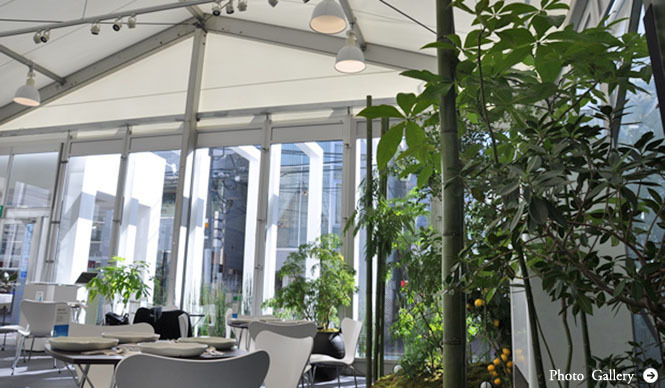
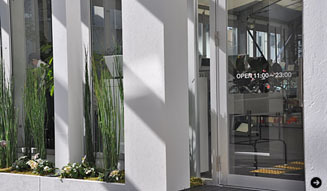
The “BMW Studio ONE,” for which I oversaw the green design, is a “greenhouse.” A greenhouse that has appeared just off Omotesando. What will be nurtured there, and what will begin from it?
Text and Photos by Yukiya Tsukada (Representative, Greenhouse Inc.)
A Culture of “Drawing In” Nature for Appreciation
When one hears “greenhouse,” some might picture a large glass-and-steel structure, a glasshouse, or perhaps a polytunnel. As the characters literally mean “warm room,” the earliest form was likely a “muro” (room) to protect and preserve food from the cold. Perhaps this is the archetype of the greenhouse.
In Europe, these were called “orangeries.” After the Age of Discovery, enclosures to protect citrus trees like oranges and lemons from the winter cold are said to be the origin of the “greenhouse.” (This is why there are lemons at BMW Studio One; they are turning yellow.)
During the colonial era, Japan, facing domestic stagnation, turned its gaze overseas. While the colonized regions likely suffered greatly, curiosity about the ends of the earth was insatiable, and many plants and animals were brought back. Greenhouse technology developed as a means to preserve them. It is said that aristocrats eagerly built large greenhouses to collect rare plants. (This explains why various plants are displayed at BMW Studio One.)
As a culture of “drawing in” nature for appreciation, the meaning of the greenhouse continues into the present day. Or perhaps, now more than ever, it is an opportunity to re-examine its significance.

Greenery Like a Tsubo-niwa in a Machiya
The challenge here was to connect BMW’s concepts of “sustainability” and “future-proof” with the Japanese “forest” within the space of a “greenhouse” that suddenly appeared in the city center.
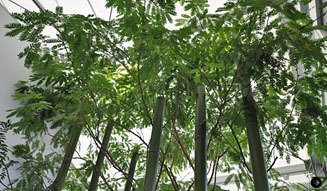
When speaking of forests in the context of sustainability, the image of “satoyama”—the areas familiar to people’s lives—is perhaps the closest. Satoyama lie between the mountains and the villages. However, the trees in Japan’s “mixed forests,” along with the bamboo requested later, would not thrive in a greenhouse, and many are deciduous given the season. I thought the best approach would be to find and combine foliage plants with attractive branching and soft leaves, and evergreens with smaller foliage.
Therefore, I selected foliage plants that seemed to fit the concept from the greenhouse of Greenwise, with whom we collaborated for this project. Leguminous plants like *Acacia* and *Calliandra*, relatives of the Albizia tree that grow wild in Japanese mountains and fields and bloom with dreamlike pale pink flowers; *Cleyera japonica*, a relative of the Tamarix tree that also grows wild; and various plants from the Araliaceae family, such as those resembling *Camellia* or members of the fig family like the rubber plant, and *Fatsia japonica*. For shrubs, there were plants like *Schefflera* with slender leaves. By moving away from overtly “tropical jungle” aesthetics like large-leaved plants such as bananas and palms, or those with numerous aerial roots like the rubber tree’s trunk, we could surprisingly achieve a mixed-forest feel. Combining tall trees, medium and low shrubs, and ground cover plants in a naturalistic manner would likely create the desired effect. I realized that Greenwise is a company with a long history, carefully managing its fine trees.
I felt that mixing the requested bamboo directly in would make the space cluttered, so we decided to use it as a “divider” after consultation. In other words, if the cafe space and lounge are envisioned as a living room, the bamboo would serve as a boundary, creating a fresh, tsubo-niwa-like greenery reminiscent of a traditional machiya townhouse. Like yoshizu screens or sudare blinds. Like a hedge.

The Meaning of a “Greenhouse” in the Heart of the City
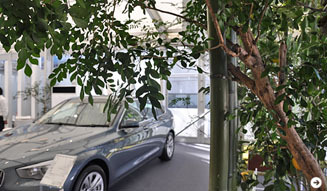
Planters were arranged around the cafe and lounge areas, which serve as the “living room” of the space. These were also selected from a sustainability perspective. Two types of planters, designed by my other company, Rim Green, were used. Both were designed with an emphasis on how to enjoy “drainage,” encouraging interaction with plants, soil, and water. We placed the “drawer,” which allows drainage through a pull-out section, and the “slope,” which has a water gradient and drains through a valve or cork at the end. Japanese gardens are masters of water usage. I strive to reflect the emotions derived from water—listening to the sounds of diverse streams and downspouts, or the beauty of ripples—in my product designs. In these planters, we used succulents like *Kalanchoe* from the Crassulaceae family and *Haworthia* from the Liliaceae family, as well as *Yucca*, also from the Liliaceae family. While many plants used in the tsubo-niwa area originate from Monsoon Asia, we incorporated plants from different regions. Other planter options included used tire covers connected to the car.
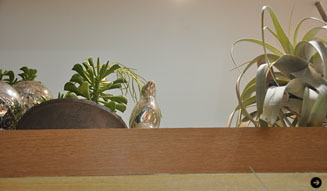
A shelf was installed above the cafe counter, displaying a variety of plants with diverse origins: Araceae, Asclepiadaceae, Bromeliaceae, Orchidaceae, and more. Tracing their origins reveals a miniature world map here. Plants gather from all over the world. This is perhaps one of the fascinations of the modern city. It might also be the meaning of a “greenhouse” in the heart of the city. This is, in a way, also about urban life itself.
The Synergy Between a “Greenhouse” and a “Car,” Packed with Excitement
“BMW Studio ONE” also features a cafe serving dishes made with organic ingredients, and hosts a market. There are also books selected to suit the guests. In nature, eating is inherently cyclical. What is excreted nourishes other life. The vegetables and fruits used are cultural assets, refined by humans over long periods. What journeys have they taken? We can let our imaginations wander. Plants are the same. There is nothing in our food that is not connected to plants, and observing the plants within the greenhouse closely will reveal many wonders. Furthermore, the items guests symbolically choose have various stories, and the books placed alongside them are true “travel vessels.” Opening a book can instantly transport you away. Just as greenhouses of the past did, when intellectual curiosity and a spirit of adventure are piqued, people naturally want to travel. Will modern urban adventurers then quickly get into their cars? To embark on a journey as a real experience. There is much that can only be understood by immersing oneself in an unfamiliar place and feeling the journey with one's own body.
A car is a private space. It is a mobile space for experiencing various things, whether you are going out with fun companions, heading somewhere unknown alone, or visiting someone you miss. It is the “in-between” where you feel many things.
I believe the synergy between a “greenhouse” and a “car,” both packed with various forms of excitement, turned out to be quite good.