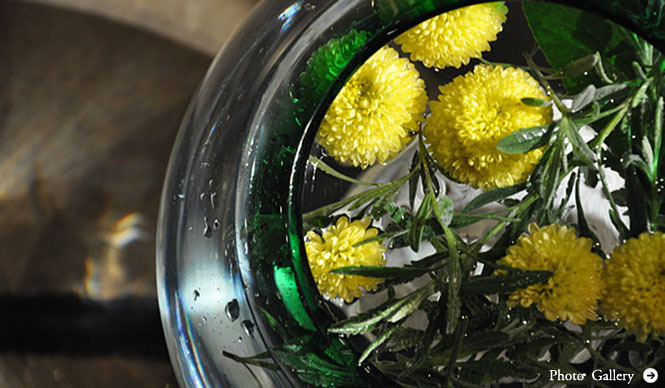
Yuki Tsukada | Tactile Botany, Episode 4: To the Winter Sun
Yuki Tsukada | The Tactile Study of Greenery
Part 4: To the Winter Sun
When I see flowers that hold the morning dew and glisten in the winter sun, I feel I must write about 'chrysanthemums.' The chrysanthemums of this season are called 'late blooms' or 'autumn blooms,' and they are mostly wild, small-flowered varieties. I also love the rustic charm of withered chrysanthemums enduring the midwinter cold.
Text and Photos by Yuki Tsukada (Representative, Greenhouse Co., Ltd.)
Yellow Gleaming in the Cold Sky
In kanji, it's '菊.' The character combines a radical meaning 'grass' with a pictogram depicting gathering or tying small things together. Similar characters include '鞠' (mari, ball), '麹' (koji, malted rice), and '掬' (sukuu, to scoop). The idea of 'tying' or 'wrapping' seems related.
Chrysanthemums are said to have been introduced from China to Japan during the Heian period for medicinal purposes. The Sino-Japanese pronunciation was 'kiuk,' which eventually evolved into 'kuku' and then 'kiku.' Their radial petals, enduring the deepening cold, are seen as a metaphor for the sun. Their color is often yellow, which in Yin-Yang Five Element theory is associated with the center. Their high fragrance likely contributed to their status as the most noble flower.
Although often associated with funerals and perceived as somber, chrysanthemums are the most fitting flower to offer to the deceased, given their noble status. This is not without reason. Their fragrance and medicinal properties eventually became linked to 'immortality and longevity,' giving rise to legends like the one in the Noh play 'Kikujido' (The Chrysanthemum Boy).
The Double Ninth Festival
'Chōyō' (Double Ninth) comes from the repetition of 'nine,' the largest odd number, representing Yang. In China, days where Yang numbers coincided were considered auspicious.
In 2009, October 26th was the ninth day of the ninth lunar month. In the lunar calendar, wild chrysanthemums are in bloom. Their fragrance is strong because they are in season. Chrysanthemum exhibitions are also held in various places around this time. During the Double Ninth Festival, customs included 'kiku no kase-wat' (chrysanthemum-clad cotton), 'kiku-zake' (chrysanthemum sake), and 'kiku-awase' (chrysanthemum matching). Chrysanthemums were also displayed in alcoves and rooms to fill the space with Yang energy. It is said that dried chrysanthemums from this time were used to make 'kiku makura' (chrysanthemum pillows) during the winter, to be used the following spring along with grains like rice or adzuki beans.
'Kase-wat' involved placing fine silk floss (unwound from a single cocoon, i.e., silk) like a hat over chrysanthemums blooming in the garden the night before the Double Ninth. The flower's spiritual power and fragrance were absorbed by the night dew. On the day of the festival, this cotton was tucked into the sleeves of one's kimono or used to wipe the body, thereby partaking in the chrysanthemum's spiritual power. When I actually tried 'kase-wat,' a faint fragrance transferred, and the soft texture of the silk floss was comforting. A 'kiku makura' also refreshes the head and eyes, inviting peaceful sleep. In traditional Chinese medicine, chrysanthemums are beneficial for eye strain, so they might be effective for our current lifestyles, where many of us can't step away from our PCs. In fact, sleeping with an eye pillow made by sewing dried chrysanthemum flowers into a cloth allows one to fall asleep almost instantly.
Festivals involved various ingenious methods to gently stimulate the five senses while incorporating the power of plants into the body, methods that have been passed down. In essence, this was 'natural aromatherapy.' The seasonal festivals were likely also a time of quiet richness, spent in harmony with nature's deities.
The Appeal of Cut Flowers
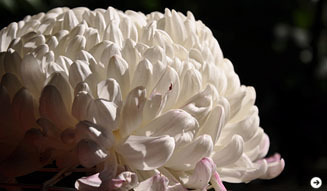
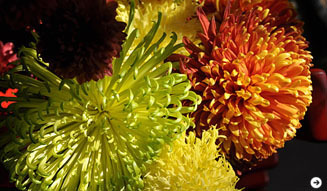
Some magazines have dubbed the colorful and varied chrysanthemums of today 'Stylish Mums.' Recently, there has been a remarkable increase in cut chrysanthemums available in the market with subtle nuances in color and form. Along with carnations and dahlias, they are invigorating the market. While I am not knowledgeable about cultivation techniques, I can imagine the immense effort producers put in. Indeed, cut flowers represent the culmination of human endeavor and passion. There are the adventures of plant hunters, the dreams of nursery growers, and the lives of those who arrange and enjoy them, reflecting global trends.
During Japan's Edo period, horticulture boomed, and a great many varieties of chrysanthemums were developed. It seems that in addition to thick-petaled, tubular, and cascading forms, various uniquely blooming varieties were also created. These techniques are likely still alive today.
Horticultural varieties are the most direct reflection of trends. With such diversity and availability of chrysanthemum cultivars, I felt it was a wonderful opportunity to connect the wisdom of the festivals to the present day. That's why I have been continuously holding workshops on seasonal festivals based on the old lunar calendar.
Cities are places where all sorts of plants from around the world are gathered. Each plant has a name, a story, an origin, and is unique. To bind them together, create arrangements, or bring them to life. This is incredibly exciting. Because it means creating a new, never-before-seen world. For example, if there were two warring nations, even flowers from those opposing sides, when brought together in a single bouquet, would coexist peacefully. Flowers from all nations find harmony within ikebana and flower arrangements. Combining them for a space or for someone. To me, this seems truly wonderful. It also allows us to re-examine various aspects of human society.
We can also create 'a world that exists nowhere else' by combining horticultural varieties with plants growing wild on roadsides or in vacant lots. Within these hands. In the past and present, east and west, weeds and cultivated varieties, nature and artifice – it is better not to distinguish too much between them.
We have, at some point, left behind something that felt like a place we longed for, something distant, something we couldn't touch. Plants beckon us back to that place. I want to continue relentlessly feeling through color, form, scent, taste, and touch. And today, the winter light in the sky is clear, and the moonlit night bestows dew upon the chrysanthemums.