Yuki Tsukada | Tactile Botany, Episode 3: Safflower, Bright Crimson, and Sasa-beni
Yuki Tsukada | The Tactile Study of Green
Part 3: Safflower, Utsushibeni, and Sasabeni
Shichi-Go-San. A celebration for children turning three. Girls put on makeup for the first time. It is said that mothers would gently apply rouge to their daughters' lips with a fine brush. This autumn, I had the opportunity to experience the beauty of true rouge. Following indigo, this time I write about beni.
Text and photos by Yuki Tsukada (Representative, Greenhouse Co., Ltd.)
Autumn Colors and Iridescent Rouge
The air has become crisp, and there are many cold days now.
It seems that in ancient times, people believed that the cold rain known as 'shigure' deepened the colors of the autumn leaves.
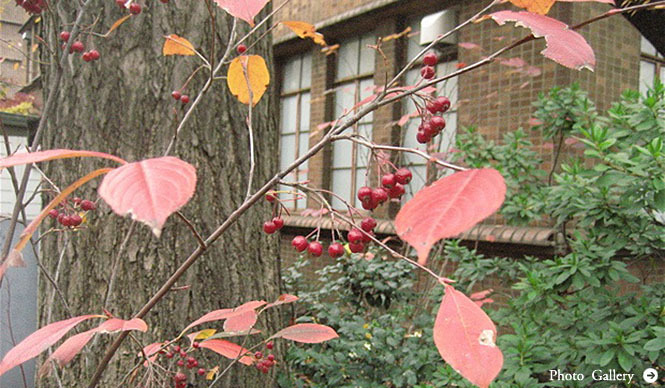
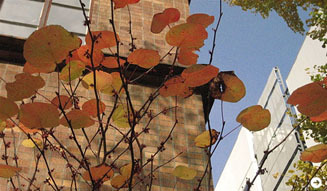
The etymology of 'momiji' (autumn leaves) is 'momi izuru,' meaning 'to emerge in color.' Perhaps it looked as if red and yellow hues were emerging from the leaves. The term 'momijigari' (autumn leaf viewing) even carries a somewhat mystical impression. The autumn foliage descending from the peaks to the foothills is said to be the brocade woven by the mountain goddess. I feel a nostalgic fondness for these words that convey the physical sensations of people from long ago, and I am reminded anew that words, when savored, reveal their taste and aroma.
While the autumn leaves of maple and ivy are, of course, beautiful, I am also very fond of the way weeds like foxtail grass (nekojyarashi) and knotweed (tade) turn color along the roadside. They are collectively called 'kusabeni' (grass autumn colors), and I enjoy arranging them in bunches or ikebana with plants like thin-leaved sunflowers and wild chrysanthemums. Foxtail grass turns golden at the head, reddish-purple in the leaves, and a reddish-brown in the stem.
Now, red has been a color of warding off evil since ancient times, but today, inspired by autumn leaves, I want to write about 'beni.' The 'beni' that is gently applied to the lips with a ring finger. 'Honbeni' (also called 'tsuyabeni') is made from safflower. It is said that safflower contains only about 1% red pigment, with the rest being mostly yellow pigment. To extract that deep red from it, it was, and still is, a very expensive substance.
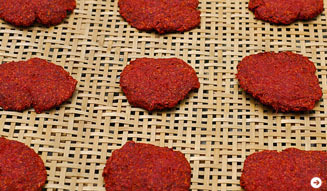
Tsuyabeni(Hikari-beni, Tsuyabeni) is a pigment made by separating the pigment from safflower with plum vinegar. It is also called Honbeni. Historically, it was used as lipstick, and particularly high-quality beni, refined in Kyoto, was also called 'Kyobeni.'
The pigment solution separated from safflower was sold in a dried state, applied multiple times to white ceramic bowls with lids or small sake cups (which prevented light from entering when inverted), or even seashells, to prevent fading. High-quality beni was extremely expensive, with the saying 'one monme of gold for one monme of beni' suggesting it was worth as much as gold by weight. It is said that the containers were sometimes returned to the beni shop to be refilled when purchasing more.
Due to its high purity red pigment, it absorbs red light and emits a greenish iridescence, its complementary color, making it appear iridescent when dry. It turns red when moistened, but when applied to the lips, it also takes on an iridescent hue.
When using it, one would gradually dissolve the beni with a fine cosmetic brush moistened with water and apply it to the lips, or sometimes take the beni directly with a finger. For this reason, the ring finger was sometimes called the 'beni-sashi yubi' (rouge-applying finger). (From Wikipedia)
The History of Beni, and More
Perhaps because stick rouge (what we call 'lipstick,' 'lip,' or 'rouge') offers advantages in terms of moisture, color variety, shine, and portability, there are very few companies left that produce the labor-intensive honbeni. Recently, glosses and products with glitter have become popular, and an iridescent effect can be achieved somewhat easily.
However, the beauty, transience, and allure of honbeni are truly indescribable. And there are certain gestures that we should preserve.
The word 'kurenai' originally referred to indigo from the state of Wu, and was called 'kurenai' (Wu indigo). This is how it became 'kurenai' (crimson). According to Shizuka Shirakawa's 'Jito,' '"Kurenai" is a relatively new character; "Shuon Kaiji" states it is "a reddish-white color of silk," meaning a whitish red, or peach red.' I always thought 'kurenai' simply meant deep red.
In the Kofun period, before beni was introduced to Japan, the red used to adorn the body was mineral pigment called 'tan' or 'shu.' It was often applied to the face and body by high-ranking men to enhance their vitality. After beni was introduced from China, its vivid red began to color the lips of court ladies, and applying beni became considered an essential part of a woman's grooming.
During the Heian period, a makeup style that involved covering the entire face with white powder to stand out in dimly lit interiors was prevalent. A small dot of lipstick was applied to the lips to create a 'chobo-guchi' (small, pursed mouth) appearance, and a light blush was added to the cheeks. In the Edo period, high-quality 'Kyobeni' shipped from Kyoto became the object of desire for Edo women. Makeup that generously used beautiful beni was the aspiration for women. Courtesans, who earned substantial incomes, would apply a hint of beni to their fingernails and toenails, a practice called 'tsumabeni,' and also lightly color their earlobes to enhance their allure. In the late Edo period, courtesans, who were trendsetters at the time, popularized 'sasabeni,' a makeup style where beni was repeatedly applied to the lower lip to create an iridescent sheen. However, due to the high cost of beni, it is said that except for popular courtesans, ink was applied as a base to conserve beni.
Green and Red
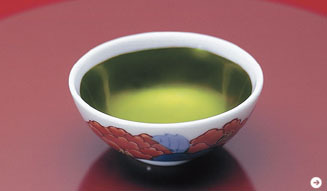
The first thing that deeply impressed me when I saw honbeni was the iridescence that appeared on the surface of the honbeni swept into a small sake cup. This iridescent 'green' is also a color seen in indigo dyeing. When I say indigo dyeing, what we do is 'nama-ha-zome' (raw leaf dyeing). When I pulled the skein of yarn dipped in the liquid dye, which had been made into juice, and checked its color, the edges of the yarn, bathed in light, shimmered with iridescence, like a rainbow snake. 'Midori' (green) is the color of the boundary where light and darkness meet. That is why words like 'tsuyatsuya shita' (shiny) or 'born anew' use 'midori,' as in 'midori no kurokami' (glossy black hair) or 'midorigo' (infant). 'Midori' was also a color that possessed an iridescent sheen.
And that color appeared on the surface of the dried honbeni!
Because the particles are fine, they absorb red light, and the complementary color 'green' appears. I imagine this is because the beni is in a state of suspended animation. Is it sleeping? So, when a fine brush is moistened and applied, the iridescence dissolves in an instant, and the crimson color awakens. How fragile! The secret of the color extracted from flower petals is also hidden within this.
Beni as Medicine
Beni has a very deep connection with a woman's life.
From the obi-iwai (waist-wrapping ceremony), omiyamairi (shrine visit for newborns), Shichi-Go-San, Hina Matsuri (Doll Festival), coming-of-age ceremony, marriage, childbirth, to the sixtieth birthday celebration.
Beni is also said to ward off evil and purify the blood. Furthermore, it is believed to warm the body and be effective for cold sensitivity. Therefore, a part of the swaddling cloth was dyed with beni, and when wiping the baby's body, that part was used. The baby's first garment was also a pale crimson, dyed with safflower. For the omiyamairi, characters were drawn on the forehead with beni. At Shichi-Go-San, rouge is applied to the lips for the first time. For the kanreki celebration, there is the chan-chan-ko jacket. Okakura Kakuzo is said to have stated, 'Color is life born from medicine.' Perhaps color is a 'medicine' that allows us to embody the life of plants.
Beni and Lips
Compared to modern lipsticks, the advantage is that it is harmless. Safflower is said to be good for cold sensitivity, and even if licked, it acts as medicine and causes no harm. It is also used as food coloring, for example, in 'hanabira mochi' (flower petal mochi). It is said that most confectioneries today use cochineal, derived from scale insects, as food coloring.
Although it is water-soluble and might be thought to fade easily, 'beni' is 100% red pigment, so it is said to be difficult to remove once dry. Once dry, it is said to be more long-lasting than regular lipstick.
The color of beni can be adjusted by layering, and it is said to reflect the color of the wearer's lips, so it develops differently for each person; it does not produce the same color. The fact that it dyes to match the wearer's lips seems suitable for natural makeup, and it is good for the body even if licked. Layering it creates a formal look, while a light application can be casual.
A slight disadvantage is that it is expensive due to the time and effort required for production. As the saying 'one monme of gold for one monme of beni' suggests, the higher the quality of the beni, the higher the price.
Since beni contains only pure red pigment and no oil, some people find their lips become chapped. In such cases, applying lip balm before applying beni allows one to enjoy the color of beni while preventing lip irritation.
Beni and Water
To extract good beni, cold, pure water is said to be best. Beni production begins before dawn, around 3 AM in summer and 4 AM in winter. This is to avoid light, which beni dislikes, and to use the cold water of midwinter to produce higher quality beni. In the past, water collected during the cold season was used for manufacturing around the 'ushimitsu-doki' (the hour of the ox, typically 1-3 AM). This too has an alluring, almost supernatural quality.
While 'oneesan yubi' (big sister's finger) is cute, 'beni-sashi yubi' or 'kusuriyubi' (ring finger) sounds more demure. 'Lip' and 'rouge' are fine, but 'sasabeni' and 'tsuyabeni' are undeniably more alluring.
A mother applying genuine beni with a brush to her daughter for Shichi-Go-San. Isn't this a scene we wish to see continue and be passed down through generations?
In Aoyama, there is the 'Beni Museum' by 'Isehan Honten,' which continues to produce this 'beni.' They are currently holding a special exhibition titled 'Red of Edo.'
http://www.isehan.co.jp/archive/archivedata/index.html
http://openers.jp/interior_exterior/news/isehan.html
Yuki Tsukada
School Workshop
Toka Ya http://www.r-school.net/program/workshop/vol37.html
Toji http://www.r-school.net/program/workshop/vol38.html