Shinichiro Nakahara's also craft 08 | The Work of Masanori Oji
also craft #08 Hand to Hand
From Maker to User: The Work of Masanori Oji
While researching cleaning tools, I came across "Sojirushi."
This was my first encounter with Masanori Oji's design. I remember being impressed by the concept, which reminded me of Italian designer Castiglioni. Since then, I've frequently come across designs that caught my eye, only to find they were by Masanori Oji. This led me to want to meet him, and we decided to feature him in a dialogue.
Text by NAKAHARA Shinichiro
It's deeply gratifying when people recognize my designs through their use (Oji)
NAKAHARA Shinichiro
I've always found many of Oji's designs to be excellent, so he's been a designer I've kept an eye on. His work has a Castiglioni-esque feel, and I've wanted to meet him.
MASANORI OJI
It's deeply gratifying when people recognize my designs through their use. I knew that my "Sojirushi" project with Shirakiyadenbei, a long-established broom maker, was being handled at your "Playmountain" store. I've also visited your shop since my days in Hiroshima, so it's an honor to meet you.
Nakahara
Are you originally from Hiroshima?
Oji
Yes, I'm from Hiroshima. Before moving to Tokyo, I ran a graphic design office there. I relocated my base to Tokyo five years ago.
Nakahara
So you started as a graphic designer.
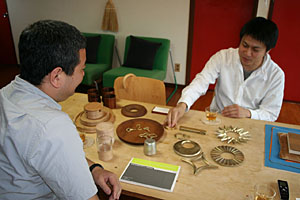
Oji
I originally studied architecture, and after graduating, I joined an architectural firm in Tokyo. However, I realized it wasn't for me and quit soon after. I returned to Hiroshima and started working part-time at a graphic design office. That was in the late 90s.
Around that time, it was popular for designers to form units and collaborate. I also started a graphic design office with a partner. However, I felt that just doing graphic design lacked a certain edge, so I began making and wholesaling notebooks and notepads. That turned out to be surprisingly enjoyable.
Nakahara
I remember this notebook (with a pen holder). You designed this too?
Oji
I heard that the interior stylist Michiko Iwadate (deceased) would be coming to a general store in Hiroshima for a meeting. I asked the store owner to please let her use this notebook during the meeting (laughs).
She liked it and introduced me to stores in Tokyo, and the notebooks sold quite well. After that, I started designing things like hangers and kendama, and I began to want to focus on "product design," which led me to move to Tokyo.
I hadn't studied product design, nor did I have any experience in it. In that sense, this notebook served as my business card.
You've designed products for manufacturers across Japan (Nakahara)
Nakahara
What about these brass products?
Oji
These will be released this June. We created them with a casting manufacturer in Takaoka, Toyama. It started with a request to "create daily necessities." It's a workshop with about ten people, and they had been working as subcontractors for wholesalers. As orders for Buddhist altar fittings decreased, this proposal came from the manufacturer's side. These brass pieces are in their raw, cast state.
Nakahara
Does that simplify the process?
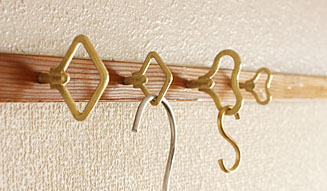
The "Spring Hook," a screw-in hook shaped like a spring.
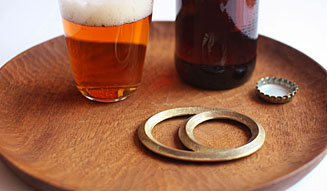
The bottle opener "Nisshoku." It fits perfectly in the palm of your hand and can also hook onto a beer bottle.
Oji
Yes. Because they are in their raw cast state, they develop character over time with use. This is a bottle opener, but I realized I didn't have one readily available. It's now one of the small pleasures of my evening drink.
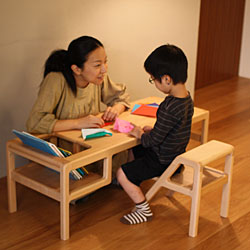
A magazine rack that can also serve as a place for a baby to sit.
Nakahara
(Looking at the products displayed on the table) You've designed products for manufacturers across Japan. Does being born and raised in Hiroshima influence your design process?
Oji
I grew up in the central part of Hiroshima, so there weren't many old things or traditional crafts nearby. In my hometown, there's a region for wood turning near Miyajima. Manufacturing in Hiroshima is more active towards the east. Come to think of it, I was quite a modernist in my student days and couldn't accept old things. I disliked items that showed signs of handcraftsmanship.
After moving to Tokyo and encountering various people and things, I began to find meaning in old objects and traditional craft finishes, and I became more accepting of them.
Since I jumped into product design from a different field, I don't have the typical "product designer'sこだわり (kodawari -こだわり means a strong commitment or obsession with something)." This allows me to view situations more objectively. I find myself drawn to designs that do as little as possible, rather than overtly "designed" designs. I want to create new things using traditional techniques as they are. And I want to create things that will endure through long cycles. To achieve that, I want to utilize the wisdom of design.
Nakahara
I feel the same way. Design is just one means to an end.
I can't create artistic designs even if asked (Oji)
Oji
I can't create designs purely for expression. Last year, I often pondered, "What is design to me?" The answer that came to me was, "A means to foster connection." To help people who make things and people who use them connect. If they are already connected, then design isn't necessary.
Nakahara
You can't design if there's no problem to solve, right?
Oji
If there's no problem, you don't feel the need to solve it. That's why I can't create artistic designs even if asked.
Nakahara
Getting back to the beginning, what sparked your interest in design, Oji?
Oji
I was in the calligraphy club in high school. If I hadn't met my calligraphy teacher then, I don't think I would have entered this field. At first, I thought calligraphy was just about copying models. But my teacher always asked, "What do you want to write?" "Where do you want to display it?" He made me think about the final outcome. He taught me that calligraphy encompasses everything: understanding poetry, using the tools, writing, and arranging the final piece.
The influence of calligraphy has significantly impacted my graphic design and other design work. When creating a logo, I approach it like making a seal (tenkoku), and when designing packaging, I think about the frame and mounting.
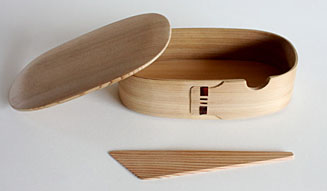
"Butter Case Large." Akita cedar, grown in the snowy region of Akita, adapts to cold environments like a refrigerator, keeping butter at the perfect firmness.
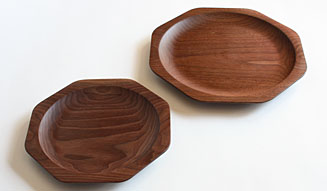
Takahashi Kogei (http://www.takahashikougei.com) kakudo series "kakudo Dish"
Nakahara
I see. When you design, Oji, what do you focus on first? Is it the material?
Oji
Basically, I listen to what the manufacturers and workshops can do. I aim for designs that utilize the material as it is, like lightly seared bonito (tataki) in cooking – not overcooked, but not raw like sashimi either. I can't do heavily simmered designs. Even after much thought, the ideas often come to me on the plane ride home after visiting a manufacturer. That's why I call myself a "half-cooked designer" (laughs).
After the dialogue (NAKAHARA Shinichiro)
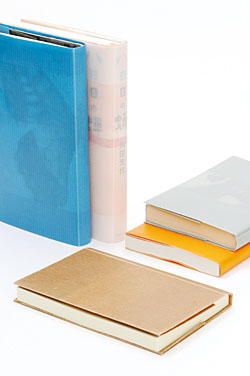
"Wax Paper Book Cover." Made of wax paper.
Book cover. Coming soon.
Kaminokousakujo (http://www.kaminokousakujo.jp)
Meeting and talking with someone in person, as expected, leads to a deeper understanding and appreciation of their designs. My meeting with Oji this time allowed me to glimpse his philosophy of making things, his discoveries in daily life, and his design principles. Perhaps because he's from Hiroshima, a city that rebuilt from nothing, he brings forth new ideas born from that experience. His designs, which evoke the joy of using one's hands, are continuously being created.
He also worked as a graphic designer, and his ingenuity is evident not only in product design but also in packaging and logos. The new series of trivets and bottle openers he showed me during my visit, upon closer inspection, have very graphical elements that visually delight the user. I'm increasingly looking forward to what he will create as he encounters new materials and techniques.
He shyly admitted, "It's deeply gratifying when people recognize my designs through their use." In recent years, a designer's name has often been a selling point. However, his designs transcend such trends, demonstrating his unique dedication to functional beauty. He reminds us that the joy of use is far more important than the joy of ownership.
MASANORI OJI
Designer
Born in Hiroshima in 1974. Graduated from the Department of Environmental Design, Faculty of Environmental Design, Hiroshima Institute of Technology in 1997. After working at an architectural firm and a graphic design office, he established "msg." in 1999. In 2004, he moved his base to Tokyo and changed the company name to "Oji & Design" in 2007.
I focus on designing daily necessities. I strive every day to create designs that foster gentle, pleasant connections between things.
http://www.o-ji.jp