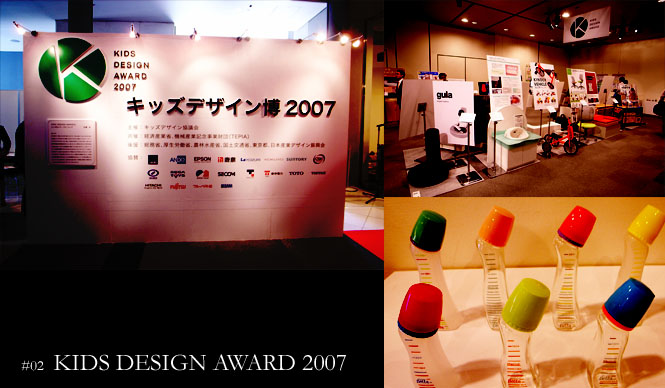
also craft #02 "KIDS DESIGN AWARD 2007"
also craft #02 KIDS DESIGN AWARD 2007
also craft, a series introducing various encounters centered on craftsmanship, by Shinichiro Nakamura of Landscape Products.
The second installment introduces the "KIDS DESIGN Expo" held at TEPIA in Jingumae.
First KIDS DESIGN Award Decided
This year marks the inauguration of the KIDS DESIGN Expo, which determines the KIDS DESIGN Award. It was held for three days from August 9th at TEPIA in North Aoyama, Tokyo.
It might be easier to understand if described as a children's version of the GOOD DESIGN Award (G Mark).
A key feature of this inaugural KIDS DESIGN Expo was that awards were given not only for products but also for initiatives by facilities, local governments, and companies, covering a wide range of categories.

Child Safety and Risk Avoidance
A total of 121 entries were selected. Concurrently with this event, August 8th was designated as KIDS DESIGN Day by the Ministry of Economy, Trade and Industry.
Regarding the selected entries, the majority seemed to be corporate activities and products. While the methods of announcement are unclear, it felt as though there were fewer participants from other companies and organizations engaged in beneficial products or activities. Given that this was the first year, the application period and methods likely require further refinement.
The first KIDS DESIGN Grand Prize was awarded to the "Initiative for a Safe Children's Environment" by the Jacs Group. This initiative involves collecting information on accidents that occur in kindergartens and daycare centers to provide information that prevents similar incidents from recurring.
Other divisional awards were presented to CSK Group for its social contribution activities (workshops for children), Morisawa for its academic font, SECOM for its system combining location tracking technology with human emergency response services to protect children's safety, FUJITSU for its school commute notification service, Sekisui House for its Kids Design "Home that Nurtures Children's Vitality," and Fuji Kindergarten, whose logo design was handled by Kashiwa Sato and architectural design by Takaharu + Yui Tezuka.
Looking at these award recipients, it's notable that many were developed from the perspective of child safety and risk avoidance, reflecting the viewpoint of parents. In particular, the Jacs Group's "Initiative for a Safe Children's Environment," which won the Grand Prize, truly symbolized the excellence of Japanese research and design.
The first Good Design Award, held in 1958, took place when the term "design" was not yet common in Japan. Award-winning works from that era included Toshiba's electric rice cooker, Fuji Electric's small desk fan, Sony's transistor radio, and Hakusan Pottery's G-type soy sauce dispenser.
Last year marked the 50th anniversary of the Good Design Award. Now that the word "design" is commonly used in various fields in Japan, we hope that better products and activities, leveraging the strengths of Japan's traditions and climate, will emerge in the KIDS DESIGN field as well. We look forward to even more diverse submissions in the future.
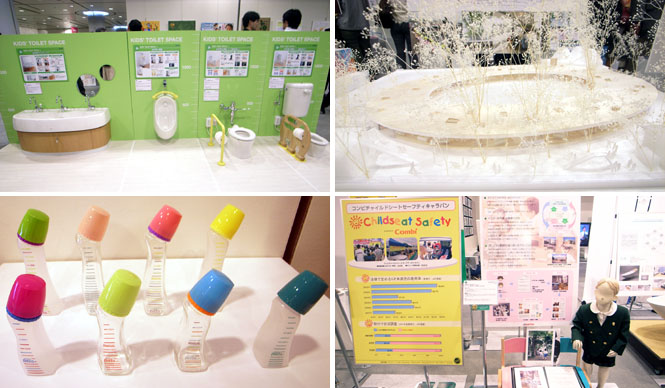
 K Mark Designed by Taku Satoh
This year marks the first event, and the K Mark, the equivalent of the GOOD DESIGN G Mark, was designed by Taku Satoh (Note 1), also known for 21_21 DESIGN SIGHT located within the MIDTOWN complex.
Incidentally, the GOOD DESIGN G Mark was designed by the late Yusaku Kamekura (Note 2) in 1958.
While it is commendable that this activity has commenced in Japan, a country still developing in this area, more ingenuity in promotional activities will be necessary in the coming years to foster the creation of superior programs and products.
For instance, recruitment efforts should extend beyond public spaces to include interior design shops, department stores, and children's clothing stores nationwide, places where consumers' eyes are drawn.
It is crucial for those who handle these products to be aware of this initiative. Furthermore, individuals in these retail environments are likely the most attuned to the desire for excellent products.
(Note 1)
Taku Satoh
Born in Tokyo in 1955. Graduated from the Department of Design at Tokyo University of the Arts in 1979, completed his master's degree there in 1981. After working at Dentsu Inc., he established Taku Satoh Design Office in 1984.
His representative works include the "Lotte Mint Gum Series," "Lotte Xylitol Gum," "Taisho Pharmaceutical Zena," and "Meiji Oishii Milk." He also handled VI design for "BS Asahi" and "21st Century Museum of Contemporary Art, Kanazawa," and served as a planning member and art director for NHK Educational's "Nihongo de Asobo."
His books include "SKELETON" (Roku-yo Sha) and the "Anatomy of Design" series (Bijutsu Shuppan).
(Note 2)
Yusaku Kamekura
A leading graphic designer of the Showa era. Born in Niigata Prefecture, he studied at the Shin-Kenchiku Koge Gakuin before joining Nippon Kobo.
After participating in the establishment of the Japan Design Center, he founded Kamekura Design Laboratory in 1962. His representative works include the Tokyo Olympics poster and the logos for NTT and Nikon. He passed away in 1997.