March 18, 2015
Saruyama | "Ceramic Wax for Table + ryo Spoon and Fork" Exhibition
Ceramic Works for Table + ryo Spoon and Fork Exhibition
Two New Projects Launch
We are pleased to announce the exhibition of "Ceramic Works for Table," a reimagined series from the Yamaguchi Oya Kiln, and our new cutlery series, "ryo Spoon and Fork." The exhibition will be held at Guillemets Layout Studio + Saruyama from October 8th to 16th.
Text by Shu Saruyama (Saruyama)
First Release: Salad-Sized Spoons and Forks Only
Ceramic Works for Table
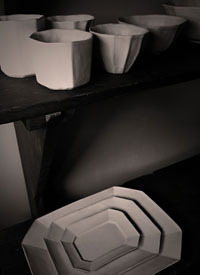
About Ceramic Works for Table
A tableware series first presented in 2003 by Mikiko Iyama and Shu Saruyama. They considered the tableware each other needed, with Iyama handling the production. In 2011, the original molds were recreated at the Yamaguchi Hagi Oya Kiln, led by Shiro Hamanaka, and the manufacturing of new "Ceramic Works for Table" using Hagi clay and its glazes began.
About ryo
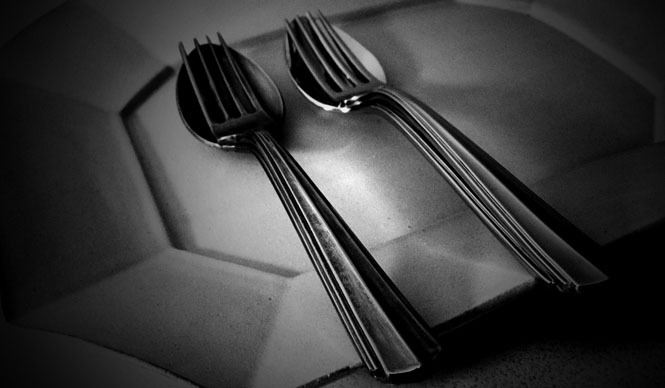
A cutlery series designed by Shu Saruyama, supervised and finished by Yuichi Takemata, a metalworker in Kanazawa, and produced by Tosan Metal Manufacturing, a cutlery maker in Tsubame, Niigata. The first release features spoons and forks in salad size only. Chinatsu Yamamoto of Gallery Yamamoto addresses the intention behind this seemingly unusual size choice in her essay, "The Reason for Smallness," summarized below.
The Reason for Smallness
Consider a four-and-a-half-mat tatami room. It remains a four-and-a-half-mat room, yet it can transform into a reception room for guests, a place to lie down and read, or a simple dining space. After overeating, one can do stretching exercises, and at the end of the day, it becomes a bedroom with the laying out of futons. Beyond being a four-and-a-half-mat space, there are no fixed uses. The tatami room has a powerful ally in the oshiire (closet), where anything can be stored when not in use, returning the space to its neutral state. This freedom allows for anything to be done there.
Consider slightly smaller spoons and forks. In Europe and America, this is the size used for salads; the ones for main courses are larger. For us in Japan, with our limited space, dining tables, hands, and mouths, things are not so large. We have various dishes, diverse cuisine, and varied ways of eating. Many are not easily categorized by cuisine or style. We love to improvise. There should be cutlery suited for us. In our daily meals, dishes are not served sequentially. Several small bowls might be arranged, or large dishes shared, allowing us to eat various foods simultaneously. Typically, we use a single pair of chopsticks during a meal. Chopsticks are not designated for a specific purpose. Such should be the nature of this cutlery. It should pair harmoniously with Japanese, Western, or even indefinable tableware, and not be obtrusive on the dining table. If there is room, it can even be used for dessert. Upon actually using them, you will realize with surprise that this size is perfectly adequate. While our dishes and their arrangements are in our own style, there is no need for our cutlery to be the same as in Europe and America.
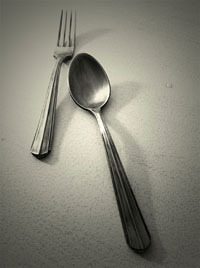
The essence of Japan. The structure remains unchanged, yet its function evolves.
Objects that allow for the application of ingenuity. Not given for a specific purpose, but rather, how to use what is available.
Behind smallness lies a world of rich possibilities.
Slightly smaller cutlery pairs well with a four-and-a-half-mat tatami room.
Ceramic Works for Table + ryo Spoon and Fork Exhibition
Dates: October 8 (Sat) - 16 (Sun), 2011
Saruyama
Wako Mansion 101, 3-12-46 Moto-Azabu, Minato-ku, Tokyo
Hours: 13:00 - 18:00 (Closed during the exhibition)
Tel. 03-3401-5935
http://guillemets.net/