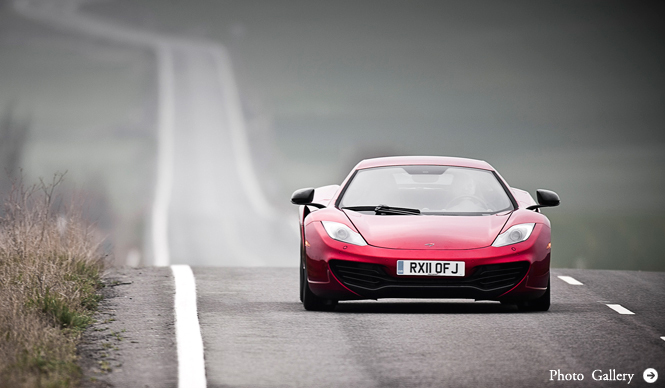
What is the MP4-12C? An explanation by Satoshi Watanabe | McLaren MP4-12C
McLaren MP4-12C | McLaren MP4-12C
An Innovative Supercar with Hidden Ambitions (1)
The McLaren MP4-12C, hailed as a "road-going F1," made its Japan premiere on October 5, 2011. McLaren, a legendary racing team with numerous Grand Prix victories and titles to its name, has now diversified into various industries. The MP4-12C is a meticulously crafted model designed to facilitate the company's ambitious plan to produce 4,000 units annually. This is an epoch-making vehicle that signals the dawn of a new era for McLaren and the supercar segment. We asked journalist Satoshi Watanabe to share his insights on this remarkable car.
By Satoshi Watanabe
A New Factory Aims for Annual Production of 4,000 Units
Founded in 1963 by the legendary driver Bruce McLaren, the racing team has expanded its reach beyond the track. It now applies the development, analysis, and simulation technologies honed in the world's most demanding racing fields to sports, medicine, and aviation. Today, "McLaren" is less a company and more a collective that pushes the boundaries of ideas and technology without borders. All of this is consolidated at the McLaren Technology Centre in Woking, a town on the outskirts of London. Designed by Foster + Partners, this innovative headquarters houses all functions with a sense of appropriate distance.
Within this campus, a factory also designed by Foster + Partners is set to commence full operations shortly. Needless to say, this is where the MP4-12C will be born. Behind this substantial investment lies a greater ambition within McLaren's automotive division's blueprint. Specifically, it is certain that several models will be developed around the MP4-12C. The goal is to grow the company to a scale that surpasses even current Lamborghini, with an annual production target of 4,000 units. This is the vision of McLaren Group Chairman Ron Dennis.
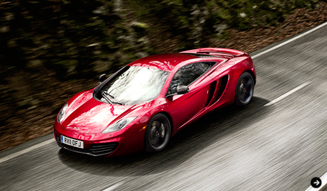
However, for McLaren, this car, which is essentially their first mass-produced vehicle, enters the heart of the supercar segment. By venturing into a territory crowded with rivals, they must have confidence in their ability to outperform them.
McLaren MP4-12C | McLaren MP4-12C
An Innovative Supercar with Hidden Ambitions (2)
Adopts a "Monocell" Composed of a Composite Structure of Dry Carbon and Extruded Aluminum
What is this confidence based on? The most significant consideration in the MP4-12C's development was likely mass reduction. The core structure that handles its 600ps of power is a "Monocell" made from a composite of dry carbon and extruded aluminum, weighing a mere 75kg. As cars like theLexus LFAandLamborghini Aventadorhave also employed similar structures, it's evident that this approach offers significant benefits for sports cars. Moreover, it's only natural that McLaren, the very company that introduced carbon fiber to F1, would adopt this construction. The MP4-12C's curb weight, according to the DIN standard (similar to Japanese specifications), is 1,434kg. This is nearly 10% lighter than its direct rivals.
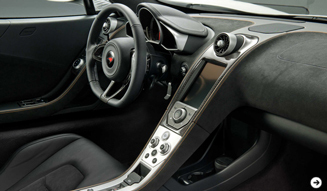
Furthermore, the MP4-12C meticulously addresses the crucial human-interface aspects: a compact body and excellent visibility. Its 1,908mm width is notably narrower than the standard for this class, achieved through design choices like a vertical center console. Once inside, the driver enjoys an unobstructed view to the rear-sides, unusual for a mid-engine car. Looking forward, the prominent fenders help the driver gauge the car's width and the position of the front wheels. There is no doubt that the clarity and volume of visual information are paramount for enjoyable sports driving. Knowing that this was not a mere coincidence but a design prerequisite—such as keeping the top of the front cowl as low as possible—underscores how seriously McLaren has considered the driving experience.
The In-House Developed 3.8-Liter Twin-Turbo Engine Delivers a Maximum Output of 600ps
Lightweight, compact, and easy to maneuver. The concept behind its design echoes that of the Honda NSX of yesteryear. Indeed, once seated in the cockpit, its familiarity is remarkably distinct within the supercar category, reminiscent of the NSX.
However, the MP4-12C is powered by an engine producing 600ps, a figure considered almost forbidden for a 2WD mid-engine car. Combined with its aforementioned weight, its acceleration is formidable, rivaling that of theFerrari 458 ItaliaandNissan GT-R, with a claimed top speed exceeding 330 km/h. The "12C" in the car's name itself signifies its equivalence to a 12-cylinder engine. McLaren claims that by achieving this with their in-house designed 3.8-liter V8 twin-turbo engine, which has a short front-to-back length, they have also realized an ideal package. The weight distribution, approximately 42:58, shows a slightly higher load on the rear wheels, which is common for modern mid-engine cars. Furthermore, the electronic body control devices are said to have been tuned through extensive testing under various conditions, from icy roads to circuit attacks, suggesting considerable attention has been paid to traction.
McLaren MP4-12C | McLaren MP4-12C
An Innovative Supercar with Hidden Ambitions (3)
Proportions Optimized for Aerodynamics
The stability at extremely high speeds is likely attributed to aerodynamics, an area where McLaren's expertise is deeply ingrained. The concept of effectively channeling air beneath the car to extract heat from the engine bay while generating significant downforce is now common in this class. The MP4-12C is no exception, with its airflow meticulously analyzed using F1-spec wind tunnel facilities. The smooth cutout at the center of the lower front bumper is designed to guide airflow underneath the car, with its shape optimized for this purpose.
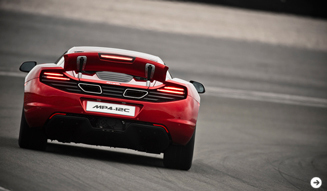
Additionally, theSLR McLaren, which was previously released through a joint venture with Mercedes-Benz, featured an air brake that deployed from the rear hood to create significant deceleration. This concept has been carried over to the MP4-12C.
Excellent Environmental Performance Relative to High Performance
Lightweight construction, an optimal package, and aerodynamics—While these are essential elements when discussing the MP4-12C, all geared towards high-speed performance, a notable byproduct is its superior environmental performance relative to its power. This is another key aspect.
With a stated CO2 emission of 279g/km, it's likely that its highway fuel economy in Japan will exceed 10 km/l. McLaren also frequently emphasizes its "ride comfort comparable to a mid-size sedan." While this remains to be confirmed through a test drive, it's unlikely that a car in this segment would disregard comfort.
If this claim holds true, combined with its size and excellent visibility, this car might become as practical for daily use as the Porsche 911.
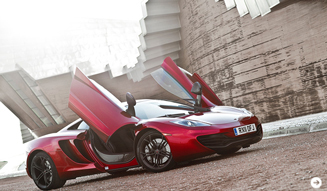
I first encountered a running prototype of the MP4-12C in Woking in the spring of 2010. Even with the production model now released, there are no visible changes. Considering the time elapsed, McLaren must have carefully brought this car to public roads after a thorough maturation period. Their envisioned story has just begun, but the white production model displayed at the Japanese launch exuded a rare purity, beyond mere splendor. It unexpectedly synchronizes with our perception of "perfection" associated with the McLaren name.
McLaren MP4-12C | McLaren MP4-12C
Body Dimensions | Length 4,509 x Width 1,908 x Height 1,199mm
Vehicle Weight | 1,434kg
Engine | 3.8-liter V8 Twin-Turbo
Maximum Output | 600ps (441kW) / 7,000rpm
Maximum Torque | 600Nm / 3,000-7,000rpm
Transmission | 7-speed Dual Clutch
Fuel Consumption | 11.7ℓ/100km
CO2 Emissions | 279g/km
Price | ¥27,900,000
McLaren Tokyo
Tel. 03-5411-1510
McLaren Osaka Hachiko Preparation Office
Tel. 06-6531-8886
E-mail | mclaren.osaka@hakko-group.co.jp
URL | http://www.mclaren-hakko.com