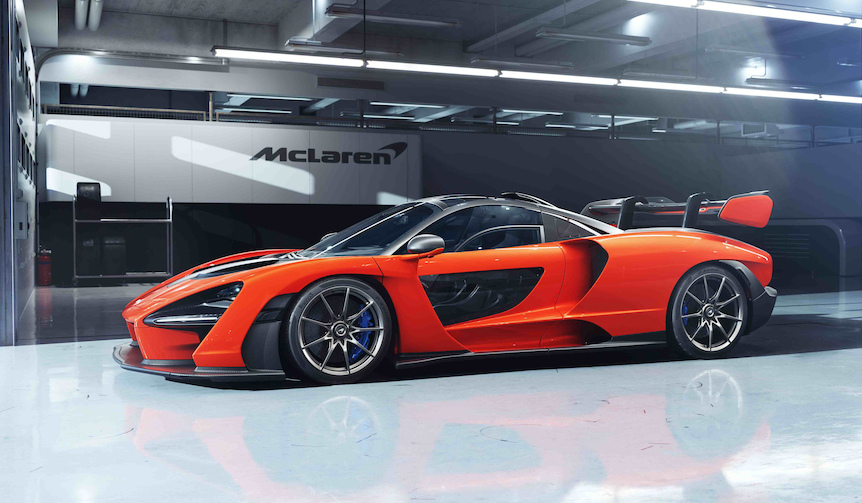
The Ultimate Road Car Bearing the "Senna" Name, the McLaren Senna, Debuts | McLaren
McLaren Senna
The Ultimate Road Car Bearing the "Senna" Name, the McLaren Senna
On December 10, McLaren Automotive unveiled the new circuit-focused hypercar "McLaren Senna," named after the late F1 driver Ayrton Senna.
Text by HARA Akira
The Reason for Bearing the Senna Name
"To push yourself to a level of no compromise. To give everything, absolutely everything." This new "McLaren Senna" embodies these words from the late Ayrton Senna, a three-time world champion who drove for McLaren F1. The development had a single objective: to create McLaren's ultimate circuit-spec model that can also be driven on public roads.
The McLaren Senna (hereafter referred to as Senna) belongs to McLaren's top-tier Ultimate Series and is the third new model following the first model, the "P1", and the next, the "P1 GTR". While the P1 was designed to be the ultimate driver's car for both public roads and circuits, the Senna, although legally road-legal, was conceived with circuit prowess as its primary goal, featuring functions that prioritize performance on the track.
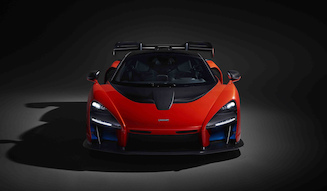
Therefore, there has been a deliberate departure from McLaren's trademark of creating supercars with diverse usability for daily life. The focus is on achieving the purest form of driver-car integration, delivering an intense circuit experience unattainable in other road cars.
"Our family is immensely proud that the new model in the Ultimate Series will bear the name 'McLaren Senna.' This is the first project that connects with Ayrton's racing spirit and achievements. The McLaren Senna is a tribute to my uncle," said Bruno Senna, Ayrton Senna's nephew, a racing driver, and McLaren Ambassador.
McLaren Senna
The Ultimate Road Car Bearing the "Senna" Name, the McLaren Senna (2)
Ultra-lightweight Aerodynamic Structure with Carbon Fiber Chassis and Body Panels
The Senna's core carbon fiber "Monocage III" chassis is an evolution of the basic structure of the "720S", forming the most rigid monocoque structure for a road car. Combined with all-carbon body panels, it achieves a weight of 1,198 kg, the lightest since the legendary McLaren F1.
The exterior is a pure expression of McLaren's "Form follows function" design philosophy, and it is truly striking. Its fierce, organic shape is a testament to balanced downforce and aerodynamics. The body adopts the teardrop shape, nature's most efficient form, with body parts appearing "clipped" onto the cabin to optimize aerodynamic performance.
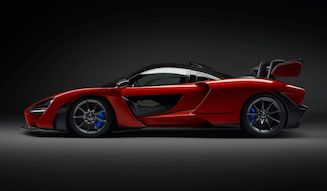
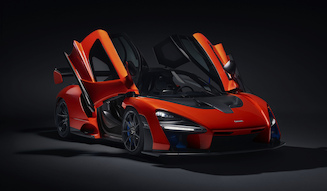
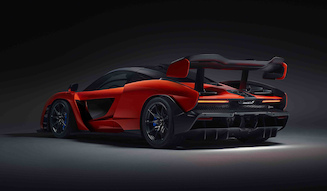
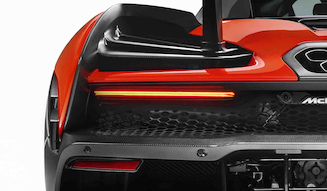
The front aero blades and splitter, along with the double diffuser and massive two-tier carbon fiber rear wing at the rear, represent the next generation of active aerodynamics. They constantly adjust to optimize downforce and aerodynamic control during braking, mid-corner throttle adjustments, and acceleration out of corners.
The slash-cut exhaust, crafted from Inconel superalloy and titanium, exits at the rear deck's trailing edge, with its angle designed to expel exhaust gases over the rear wing.
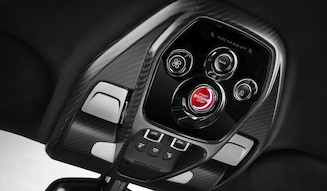
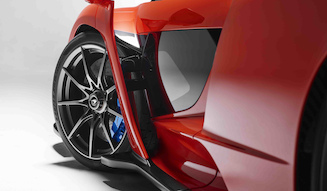
Inspired by the McLaren F1, the dihedral doors open upwards and forwards, incorporating a portion of the roof. Their wide aperture allows drivers to easily access the cockpit, even when wearing a helmet and racing suit. The doors feature two glass side windows, with the upper glass fixed and a smaller opening below. Optionally, the upper carbon sections of the doors and the lower side sections, effectively forming the roof, can also be specified with glass, enhancing the sense of connection with the external environment (the circuit).
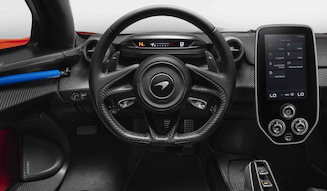
The cockpit is a minimalist, racing-inspired environment, heavily utilizing carbon fiber and stripped of all non-essentials to avoid clutter. The carbon fiber console above the driver houses the engine start button, release mechanism, and window switches. The three-spoke steering wheel is devoid of buttons and switches to ensure pure feedback, with essential information delivered via a high-resolution folding driver display and a vertical infotainment screen in the center console. The interior, designed with the removal of the passenger seat in mind, does not accommodate extra luggage, but the space behind the seats is sufficient for two helmets and racing suits.
McLaren Senna
The Ultimate Road Car Bearing the "Senna" Name, the McLaren Senna (3)
Powered by a 4.0-liter V8 Twin-Turbo Engine Producing 800ps and 800Nm
The Senna is exclusively powered by a mid-mounted 4.0-liter V8 twin-turbo engine with the code name M840TR; no hybrid systems are employed. It produces a maximum output of 800ps and peak torque of 800Nm, making it McLaren's most powerful internal combustion engine for a road car. The power-to-weight ratio is 668ps/ton. While these figures indicate the new model's high performance, data on acceleration and top speed have not yet been released.
Motorsport-derived dry-sump lubrication and a flat-plane crankshaft contribute to the powertrain's lightweight design. The combination of ultra-low inertia twin-scroll turbochargers and electronically controlled turbo wastegates achieves throttle response described as "light-speed fast."
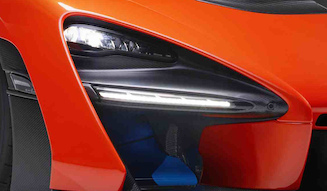
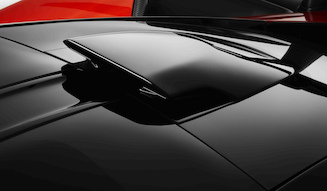
For the fortunate drivers who will experience the Senna, engineers have meticulously designed the entire engine, from intake to combustion and exhaust, to create a mechanical symphony. The high-frequency sounds produced by the air drawn through the roof-mounted "snorkel" intake, also featured in the F1 and P1, blend with the low-frequency sounds that resonate through the engine mounts into the cockpit and vibrate the carbon fiber Monocage III's double-wall rear structure. This creates an immersive experience, as if the V8 engine is positioned right beside the driver's seat.
The transmission is a dual-clutch 7-speed gearbox that achieves seamless shifting, driving the rear wheels. The carbon fiber paddle shifters for manual control are elongated to enhance the mechanical connection, whether wearing racing gloves or not.
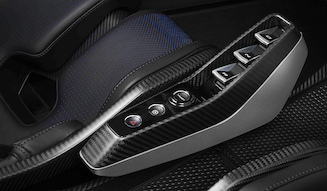
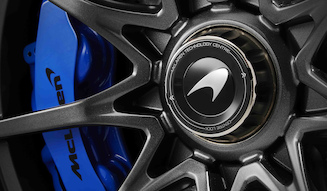
The engine and transmission characteristics can be adjusted through three modes—Comfort, Sport, and Track—selected via the Active Dynamics Panel on the center console.
The suspension utilizes a double-wishbone Race Active Chassis Control II (RCC II) system. This works in conjunction with the front and rear active aerodynamics and the Monocage III chassis to maximize driver connection at all speeds and conditions. This evolution includes an added "Race" mode, adjustable via a panel on the roof. The tires are bespoke Pirelli P ZERO Trofeo, developed in collaboration with technical partner Pirelli.
"The Senna delivers true performance that allows the driver to explore their capabilities to the limit. Its approachable nature and astonishing power-to-weight ratio enable full exploitation of its performance, while also providing an intense experience filled with the excitement and challenge that only the world's finest drivers can appreciate," says Andy Palmer, Director of Ultimate Series Vehicle Line.
The McLaren Senna, the third model launched under the McLaren Track22 business plan, will be hand-assembled at the McLaren Production Centre in Woking, Surrey, UK, starting in the third quarter of 2018. Production will be limited to 500 units. Priced from £675,000 (approximately ¥102.6 million), all vehicles have already been allocated to owners. The car will make its public debut at the 88th Geneva Motor Show in March next year.