Successor to the Veyron Boasts 1500 PS | Bugatti
Bugatti Chiron
Successor to the Veyron Boasts 1500 PS!
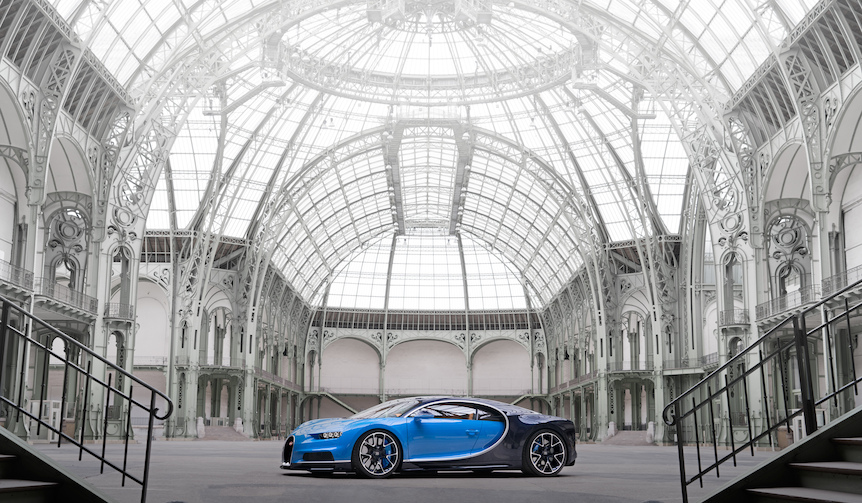
Bugatti unveiled the Chiron, the successor to the Veyron, at a Volkswagen Group event on the eve of the Geneva Motor Show, followed by its public debut at the show itself. The highly anticipated powertrain is a W16 quad-turbo engine producing a maximum output of 1,500 PS. It is the most powerful road car ever built, capable of 0-100 km/h in 2.5 seconds and a top speed of 420 km/h.
Text by SAKURAI Kenichi
Double the Price, Double the Production of the Veyron
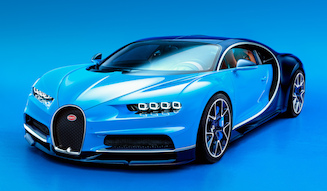
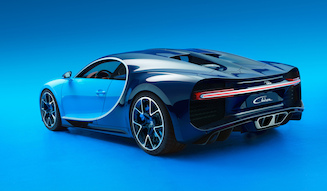
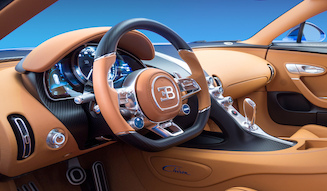
It is clear that the overall silhouette, as well as the motifs for the front grille, headlights, taillights, and interior, are rooted in the "Vision Gran Turismo Concept" shown at last year's Frankfurt Motor Show.
Of course, the visual cues also trace their lineage back to the previous model, the Veyron (though technically a different car). The "Vision Gran Turismo Concept" is a virtual machine that appeared in the PlayStation game "Gran Turismo 6." The vehicle unveiled was not merely a full-scale concept car based on it, but a preview for this "Chiron."
The name Chiron is derived from Louis Chiron, a racing driver who was active with Bugatti. Born in Monaco, Louis Chiron is recorded as having achieved a total of 10 Grand Prix victories with Bugatti's "Type 35" and "Type 51" between 1928 and 1933. Shortly after the launch of the new Bugatti, a car of the same name, the "EB18/3 Chiron" designed by Giugiaro, was announced, but there is no direct connection between the two vehicles.
Using the name of this legendary driver for the car's name was also done for the previous model, the Veyron. Incidentally, "Veyron" was named after Pierre Veyron, the driver who won the 24 Hours of Le Mans race in 1939. The Veyron, a high-performance machine with a top speed exceeding 400 km/h and a staggering 1,001 PS, rewrote numerous records before its approximately 10-year history came to a close with the final open-top model, the "Ettore Bugatti". A total of 450 units were produced, including both coupe and open-top versions.
The Chiron, which can be considered its second-generation model, is planned for a production run of 500 units. The price has been announced at 2.4 million euros (approximately 296 million yen), more than double the price of the Veyron.
The basic configuration remains the same as the Veyron: a quad-turbo 8-liter W16 engine and a carbon monocoque chassis, combined with an outer skin also made of carbon. However, the body (though the silhouette is similar) has been completely redesigned, and virtually nothing has been carried over from the previous Veyron.
The body dimensions are 4,544 mm in length, 2,038 mm in width, and 1,212 mm in height, with a wheelbase of 2,711 mm. This represents an increase in all sections compared to the Veyron's 4,462 mm length, 1,998 mm width, 1,204 mm height, and 2,710 mm wheelbase. The vehicle weight is 1,995 kg, an increase of 107 kg.
Bugatti Chiron
Successor to the Veyron Boasts 1500 PS! (2)
Speedometer Scales to 500 km/h
The traditional horseshoe-shaped front grille and the Bugatti emblem adorning it are design elements that immediately identify it as the successor to the Veyron. Combined with the distinctive four-LED headlights on each side, the large, oval side air intakes inspired by the doors of the Bugatti "Type 57," the rounded rear fenders also with roots in the Type 57, and the horizontal taillight design proposed in the Vision Gran Turismo Concept, it expresses a new generation. It forms an appearance that, like the Veyron, can only be called a Bugatti from any angle.
As mentioned, the engine is an 8-liter W16 unit with quad turbos. The exact displacement is 7,993 cc, the same as the Veyron. The only components carried over from the Veyron are this engine and the 7-speed DSG (dual-clutch) transmission, although significant improvements have been made for its installation in the Chiron. The turbochargers and intercoolers have been enlarged, and the carbon intake manifold and titanium exhaust system are also newly designed.
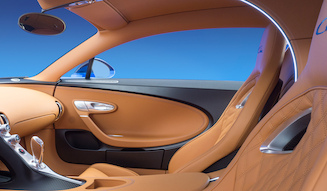
The maximum output is 1,500 PS at 6,750 rpm, a 500 PS increase over the Veyron's 1,001 PS at 6,000 rpm. Maximum torque is 1,600 Nm (163.2 kgm) at 2,000-6,000 rpm, also an improvement of 35.7 kgm over the Veyron's 127.5 kgm at 2,200-5,500 rpm. The power-to-weight ratio is an astonishing 1.33 kg/ps, with figures on the spec sheet that defy convention.
Speaking of unconventional figures, 0-100 km/h is achieved in 2.5 seconds, 0-200 km/h in 6.5 seconds, and 0-300 km/h in 13.6 seconds. The top speed is limited in two stages: 420 km/h in top speed mode and 380 km/h in handling mode. For comparison, the Veyron's 0-100 km/h was 2.5 seconds, 0-200 km/h was 7.3 seconds, and 0-300 km/h was 16.7 seconds, with a top speed of 407 km/h. This difference in figures represents 10 years of evolution. Of course, when making this comparison, the 107 kg increase in vehicle weight must be taken into account.
Bugatti Chiron
Successor to the Veyron Boasts 1500 PS! (3)
The World's Most Powerful Production Supercar
The newly designed chassis, which can be considered an evolution of the Veyron's, features double-wishbone suspension at both the front and rear. The drivetrain remains all-wheel drive. The suspension, designed to balance ride comfort and handling, is equipped with adaptive suspension that allows for arbitrary adjustment of ride height and damping speed, and a newly designed electric power steering system is also employed.
These systems are integrated with the 4WD system, allowing for five selectable modes: Lift, Auto, Autobahn, Handling, and Top Speed. The Lift mode raises the vehicle height to facilitate approach over bumps or on parking lot ramps. In Auto, Autobahn, and Handling modes, the top speed is limited to 380 km/h, while Top Speed mode unlocks the car's potential to 420 km/h, requiring the "Speed Key," similar to the Veyron.
The tires supporting the top speed of over 400 km/h are Michelin, as with the Veyron. The sizes are 285/30ZR20 for the front and 355/25ZR21 for the rear. The brakes consist of 420 mm carbon-ceramic discs at the front and 400 mm at the rear, paired with 8-piston front calipers and 6-piston rear calipers. This provides stopping performance from 100-0 km/h in 31.3 meters, 200-0 km/h in 125 meters, and 300-0 km/h in 275 meters.
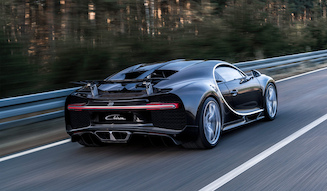
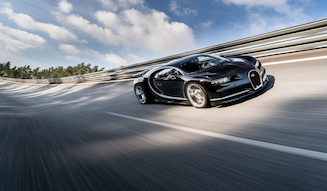
The standard Veyron model boasted a top speed of 407 km/h and evolved through the "Grand Sport" and "Super Sport" versions. While the Super Sport updated the maximum speed to a catalog figure of 415 km/h, it challenged for the Guinness World Record for the fastest production car, setting a record of 434.211 km/h.
While it may be a bit premature, it is likely that a high-performance version of the Chiron, surpassing its 420 km/h specification, will eventually be released. At that time, we cannot help but expect it to challenge for the top speed record once again and rewrite the record for the fastest production car with its own hands. After all, it is a well-known fact that Bugatti's catalog figures are not mere boasts, and that Bugatti is indeed the world's most powerful production supercar.

Bugatti Chiron
Body Size | Length 4,544 × Width 2,038 × Height 1,212 mm
Wheelbase | 2,711 mm
Weight | 1,995 kg
Engine | 7,993 cc W16 Quad-Turbo
Max Output | 1,103 kW (1,500 PS) / 6,700 rpm
Max Torque | 1,600 Nm / 2,000-6,000 rpm
Transmission | 7-speed Dual-Clutch (DSG)
Drivetrain | 4WD
Brakes Front | φ420mm Ventilated Disc
Brakes Rear | φ400mm Ventilated Disc
Suspension Front/Rear | Double Wishbone / Double Wishbone
Tires Front/Rear | 285/30R20 / 355/25R21
0-100 km/h Acceleration | Under 2.5 seconds
0-200 km/h Acceleration | Under 6.5 seconds
0-300 km/h Acceleration | Under 13.6 seconds
100-0 km/h Braking | 31.3 meters
200-0 km/h Braking | 125 meters
300-0 km/h Braking | 275 meters
Top Speed | 420 km/h (380 km/h outside Top Speed mode)
Price | 2.4 million Euros (approx. 296 million yen)