Maserati Festival 2012
Maserati
Maserati Festival 2012
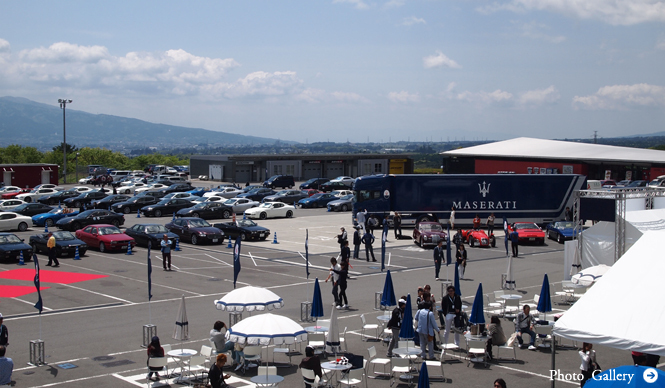
On May 13,MaseratiThe first-ever standalone owners' event, "Maserati Festival 2012," was held at Fuji Speedway.
Text & Photographs by SUZUKI Fumihiko (OPENERS)Official Photographs by MASERATI JAPAN
A Collaboration Watch with Bulgari Appears
On May 13, a swarm of Maseratis descended upon Fuji Speedway. This was for the "Maserati Festival 2012," the first standalone owners' event for the marque. We heard that 231 Maseratis and 400 fans gathered from all over Japan.
Maseratis, as far as the eye could see. The owners who created this rare spectacle were first greeted by an opening address from Fabrizio Cattori, President of Maserati Japan.
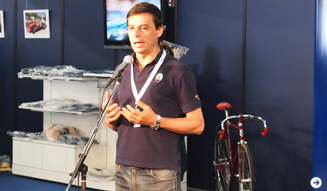
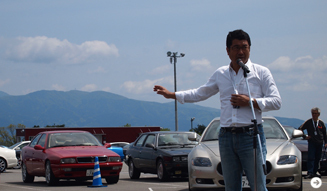
Fabrizio Cattori, President of Maserati Japan
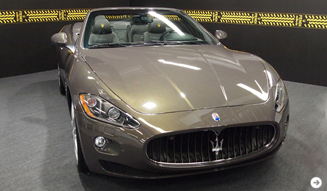
Maserati GranCabrio Fendi
Following this, two special products, a collaboration between an Italian luxury brand and Maserati, were unveiled.
One was the "Maserati GranCabrio Fendi" which we have previously featured on OPENERS. The other was the "Bulgari" Gerald Genta Octo Maserati Special Edition," a rare timepiece limited to just 200 units worldwide.
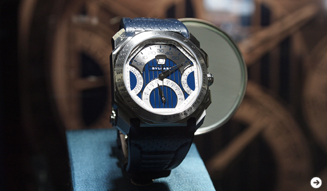
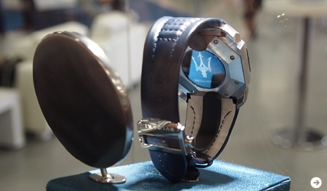
This "Bulgari Gerald Genta Octo Maserati Special Edition" is a special model based on Bulgari's chronograph, the "Bulgari Gerald Genta Octo Quadri-Retro," which features four retrograde hands. The dial evokes the front grille, the calfskin strap mimics the seats, and the brushed bezel is marked with a tachymeter scale. The blue see-through case back displays the Maserati emblem. It uses the automatic GG7800 caliber with a 38-hour power reserve and is priced at ¥3,276,000.chronographThis "Bulgari Gerald Genta Octo Maserati Special Edition" is a special model based on Bulgari's chronograph, the "Bulgari Gerald Genta Octo Quadri-Retro," which features four retrograde hands. The dial evokes the front grille, the calfskin strap mimics the seats, and the brushed bezel is marked with a tachymeter scale. The blue see-through case back displays the Maserati emblem. It uses the automatic GG7800 caliber with a 38-hour power reserve and is priced at ¥3,276,000.
Maserati
Maserati Festival 2012 (2)
Concours d'Elegance Grand Prix Awarded to "A6 GCS"
The afternoon began with the Concours d'Elegance awards ceremony. The cars were divided into three categories: Classico (from classicMaseratito Royale), Semi-Classico (Biturbo series, Quattroporte IV, Ghibli II, up to 3200GT), and Moderno (from V8 naturally aspirated models like the Coupé and Spyder to current models). From the 70 Maseratis displayed under the sun, three most elegant cars and one Grand Prix winner were selected by participants and special judges.
The three award-winning Maseratis were explained by Ken Okuyama, also known as Kiyoyuki Okuyama, who previously worked at Pininfarina and was the designer of the fifth-generation Maserati "Quattroporte" and alsoFerrarithe designer of the "Enzo." He participated in the concours as a judge.
The Moderno category winner was the "GranCabrio Sport." The "GranCabrio" is a model on which Okuyama partially worked on the design. While its coupé counterpart, the "Granturismo," has been on sale since 2007, Okuyama revealed that the basic design was nearly complete in 1998 but remained in limbo without a production decision. Later, the development of the Ferrari "California," a hard-top convertible, began based on the body of the Maserati "GranCabrio," preceding Maserati's own production.
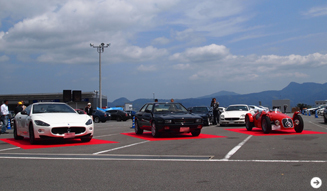
However, because the "California" used an aluminum body and chassis, it became a completely different car from the Maserati "GranCabrio," despite similar dimensions and layout. While the "California" adopted a hardtop, the "GranCabrio" opted for a soft top, emphasizing elegance and weight reduction. Okuyama described it as a beautiful car that embodies a mature image befitting Maserati, one he would genuinely want to own, and that despite the many difficulties in bringing it to production, it achieved its ideal form.
From the Semi-Classico category, the "Ghibli II" was selected. "Cars are getting larger these days, and there are rumors that Maserati is also feeling the need for a smaller segment, but looking at it again, I find the compactness of this "Ghibli II" very appealing," Okuyama began.
The designer of the "Ghibli II" is Marcello Gandini, whom Okuyama praises as a genius. Gandini, who served as chief designer at Bertone, is particularly known for wedge-shaped cars such asLamborghini's "Miura" and "Countach," the Lancia "Stratos," and the Ferrari "Dino 208/308 GT4."
"The "Ghibli II" was a car from a difficult era for Maserati, born under many challenging constraints, such as having to continue using the Biturbo doors. However, within those limitations, they created beautiful fenders and incorporated numerous clever details, like a small spoiler under the windshield to ensure clean airflow and prevent insects from sticking to it," he explained.
He noted that the award-winning cars were clearly cherished and well-maintained by their owners.
And from the Classico category, the "A6 GCS" was chosen, ultimately winning the overall Grand Prix.
"When I was designing the "Quattroporte," I looked at the "A6 GCS" and learned the masculine, muscular design language inherent to Maserati, from its grille to its overall stance. This is because the "A6 GCS" was the first model to express that language," Okuyama began, recalling his memories.
he began to share his memories.
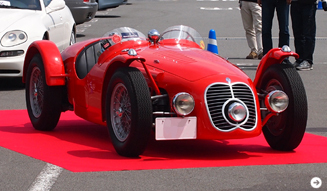
"The layout is that of a pure race car. However, to provide space for the driver, the engine and transmission are slightly offset to the right. All the components of a race car are fitted into a tight space, yet it's still road-legal," he continued, adding, "This 1947 car belongs to an era when the world was less complex, before the modern considerations of geometry, components, cost, and production efficiency. It's a car from a romantic era, and the winning example will likely receive awards worldwide."
Afterwards, owners enjoyed track driving in their own Maseratis. Following a demonstration run by Maserati's flagship GT car, the "MC12," the grand gathering of Maseratis at the foot of Mt. Fuji concluded with a parade lap led by the "A6 GCS," the Grand Prix winner of the concours.