McLaren Completes the Sports Series with the "540C" | McLaren
McLaren 540C Coupe
McLaren's 540C Completes the Sports Series
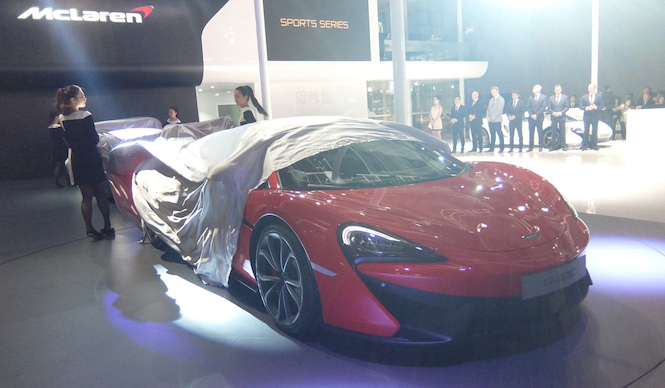
McLaren has unveiled its new model, the "540C," at the Shanghai Auto Show. Following hot on the heels of the "570S" announced earlier this month, what is the positioning of this new model? This report is by Tatsuya Otani, who witnessed the announcement firsthand.
Text & Photographs by OTANI Tatsuya
Rival: 911 GT3
At the New York Show, which opened on April 1st, the new model "570S" was announced, marking the start of the Sports Series, McLaren Automotive's third model range following the Ultimate Series "P1" and the Super Series "650S". On April 20th, during the press day of Auto Shanghai 2015, the second model in the Sports Series, the "540C" was unveiled.
The 570S is priced at ¥25.56 million and the 540C at ¥21.88 million. These prices are approximately ¥5-10 million lower than the current flagship model, the 650S, placing them in a similar price range to the Porsche "911 Turbo" or "Turbo S." However, Mark Vinnels, Executive Director of Product Development, stated, "The 911 Turbo is more of a luxury car than a sports car. Our rival is the 911, but specifically the "GT3" rather than the Turbo," explaining the positioning of the 570S and 540C.
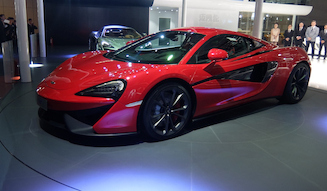
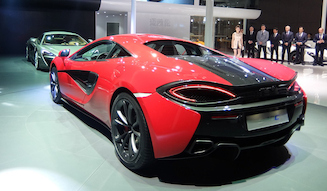
Incidentally, the 911 GT3 is priced at ¥19.12 million, slightly less than the two announced models. However, in typical McLaren fashion, the model name directly indicates the engine's maximum output. The McLaren is more powerful, and its weight of 1,313 kg is over 100 kg lighter than the GT3's 1,430 kg. Therefore, regardless of which is better, there's no doubt that a formidable rival has emerged for the 911 GT3 and 911 Turbo/Turbo S.
While the 570S and 540C (S for Sport, C for Club) share the same basic powertrain as the 650S, 30 percent of the parts in the V8 3.8-liter twin-turbo engine have been newly developed.
For example, the turbochargers have been downsized to match the lower maximum output compared to the 650S, and the exhaust manifold has been changed from the welded type used in the 650S to a cast one.
The gearbox is largely the same as the 650S, but McLaren's signature carbon monocoque has been reborn as the new-generation "MonoCell II." This aims to improve ingress and egress by making the sill sections lower and narrower, while maintaining the same monocoque rigidity through measures such as increasing the carbon panel thickness.
McLaren 540C Coupe
McLaren's 540C Completes the Sports Series (2)
The Sports Series Demands a Specific Driver
Another notable point is the adoption of a more conventional anti-roll bar, rather than the ProActive Chassis Control that characterized the 650S.
The ProActive Chassis Control is a system that connects the hydraulic circuits of the dampers on all four wheels to suppress body roll during cornering without compromising ride comfort. The reason for not adopting this in the Sports Series appears to be primarily cost. However, by carefully tuning the springs, dampers, and bushings, McLaren claims to have achieved its signature sporty handling while minimizing any degradation in ride comfort. Incidentally, the steering gear ratio seems to have been made quicker than the 650S to enable agile maneuverability.


Also noteworthy is the downsizing of the tires from the 650S's 235/35R19 front and 305/30R20 rear to 225/35R19 front and 285/35R20 rear. While this is partly to accommodate the reduced engine power, Vinnels also explained that the aim was "to make it easier to reach the limit."
He further commented, "While the 650S offers high performance that 99% of people can enjoy driving with confidence, the Sports Series assumes a more active driver involvement, so it might only suit 50% of people." This suggests that the Sports Series may be a supercar that appeals to a select group of drivers.
McLaren 540C Coupe
McLaren's 540C Completes the Sports Series (3)
Design Rooted in the P1, a Complete Vision
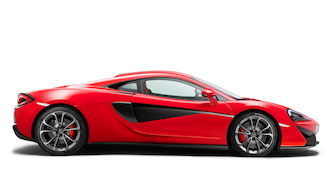
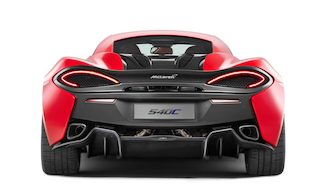
While the overall styling of the Sports Series is very similar to the 650S, closer inspection reveals sharper edges, giving an impression of a leaner, more tightly sculpted form. This design approach, which McLaren calls "shrink-wrapped," first appeared on the P1.
In fact, the "MP4/12C", which served as the base for the 650S, was largely completed before the current designers, such as Frank Stephenson and Rob Melville, joined McLaren, and the "shrink-wrapped" concept was not employed.
Although Stephenson and Melville made detailed modifications when it was reborn as the 650S, the basic design was inherited from the 12C, making it difficult to consider it entirely their own creation. In that sense, the Sports Series (and the P1) can be said to represent the design that Stephenson and Melville truly intended to realize.
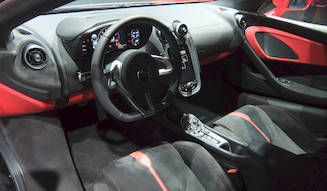
Inside, a full LCD display is used for the instrument panel, and the center console is split into upper and lower sections, creating a sense of lightness.
Even more significant are the improvements in ingress and egress due to the aforementioned sill modifications, and the expansion of cabin space.
Regarding the latter, the interior width has been increased by moving the A-pillars outward, and the interior length has been extended by 11 mm compared to the 650S. Mark Vinnels explains that the relocation of the A-pillars was made possible by aerodynamic improvements, which allowed the side windows to be moved further outward without significantly increasing the overall width.
McLaren 540C Coupe
McLaren's 540C Completes the Sports Series (4)
A Super Sports Car with Excellent Value for Money
Aerodynamics, another hallmark of McLaren alongside the carbon monocoque, are fixed rather than variable like the 650S. However, the introduction of new techniques has improved aerodynamic efficiency, ensuring the necessary downforce while minimizing any increase in drag.
One of these techniques is called "flying buttresses." This involves designing the C-pillars to float above the body, directing airflow along the side windows onto the engine cover. This increases downforce by enhancing the aerodynamic effect of the tail duck at the rear end and reduces drag by weakening the vortices generated behind the rear window.
In the 650S, the rear window sloped gently, allowing airflow along it to move smoothly towards the rear. However, the Sports Series has a nearly vertical rear window, which creates a low-pressure area behind it. Airflow from the surroundings forms strong vortices in this area, increasing drag. The flying buttresses cleverly mitigate this by directing fast airflow from the sides of the body behind the rear window, minimizing vortex formation – a remarkably ingenious solution.
Another feature is the "floating door shells," where parts of the door panels are also detached from the body. This channels fast airflow along the upper part of the body sides into the side air intakes, efficiently feeding cooling air to the radiators. This design allows for thinner doors and the aforementioned outward relocation of the side windows and A-pillars. Visually, this element also serves as an accent on the car's sides.
A significant difference from the 650S is that most of the body panels are made of aluminum (the 650S is mostly composite). While the use of aluminum is likely for cost reduction, the "Superforming" process, which molds heated aluminum using air pressure, has enabled the creation of deeply curved front and rear fenders from aluminum. These parts also boast a high surface precision, giving them a distinctly premium appearance.
Although the maximum engine output has been reduced and costs have been cut in the suspension and aerodynamics, the improved practicality and attractive design of the 570S and 540C make them excellent value-for-money super sports cars, perhaps even to the point of making one worry about the 650S's position.