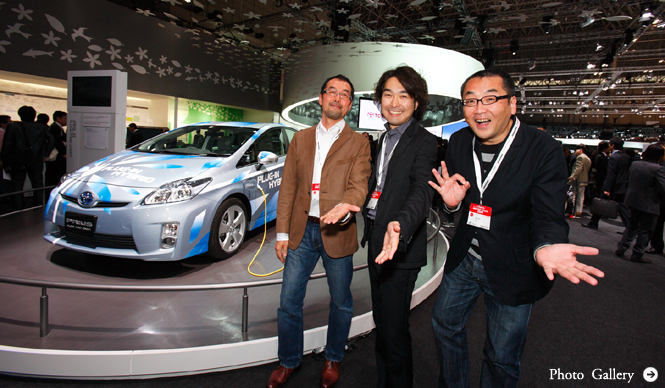
From the Tokyo Motor Show 2009: Will Electric Cars Change the Future?! (Part 2)
Three Sharp Automotive Journalists Hold an Emergency Meeting
From the Tokyo Motor Show 2009: Electric Cars Will Change the Future?! (Part 2)
The 41st Tokyo Motor Show 2009 was hit hard by the global recession, with only two foreign manufacturers exhibiting and total attendance dropping 43 percent from the previous show to 614,400 visitors. However, manufacturers were diligently showcasing next-generation vehicles and offering many proposals for the future. Where are cars headed in this turbulent era? Three sharp automotive journalists—Fumio Ogawa, Yasuhisa Shimashita, and Toshifumi Watanabe—cut through the present and future of the automotive world through the lens of the Tokyo Motor Show.
Text by OPENERSPhoto by MASAYUKI ARAKAWA
Even with Hybrids Dominating, We Must Look to the Future
OPENERSSpeaking of which, German manufacturers have also introduced hybrids. For example, Mercedes' S-Class Hybrid. What do you think of it?
WatanabeI think the hardware is well-executed. Perhaps it's suited for European driving conditions.
ShimashitaThe fundamental approach to how much the electric motor handles at high speeds and how much the engine handles is different from Toyota's hybrid system, isn't it? Mercedes' logic is that running the electric motor at high RPMs on the highway is wasteful, so they let the engine take over in that range.
WatanabeGerman manufacturers initially dismissed Toyota's Prius, the world's first hybrid released in 1997, as 'crazy,' yet now they are all releasing hybrid vehicles.
OgawaIt was said that the electric motor doesn't operate at high speeds, which actually worsens fuel economy. The actual usage environments in Germany and Japan are vastly different. In a country where people drive at 200 km/h, it's better to improve fuel economy through advancements in internal combustion engines and transmissions.
WatanabeAt this year's Frankfurt Motor Show, European manufacturers, albeit belatedly, were all present in the hybrid car arena. However, if Toyota and other Japanese automakers are satisfied with this, it's clear they will face repercussions later. They undoubtedly have a vision for what comes after hybrid cars.
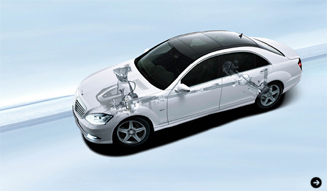
Mercedes-BenzS-Class Hybrid Long
OPENERSSo, we shouldn't be content with the current era of hybrid dominance.
WatanabeExactly. For instance, I think Toyota is overly reliant on hybrids. This is mentioned in various media, and I agree. Toyota argues that hybrids are the best current solution because they possess all the foundational technologies for next-generation vehicles like EVs and FCVs. However, if they neglect efforts to improve the efficiency of internal combustion engines, like Mazda and Daihatsu are doing, it could become a significant burden later.
OPENERSWith the advent of EVs and plug-in hybrids, there's a structural shift from current internal combustion engines to motors and batteries. This ultimately requires the development of charging infrastructure, doesn't it? Considering that, I believe only conventional hybrids will be practical for the next two to three years.
OgawaEVs are still limited by battery performance, making them suitable for urban use, while hybrids are for medium to long distances. But if you think about it, that leads to the conclusion that you need two cars (laughs).
ShimashitaYes, that's where the problem lies.
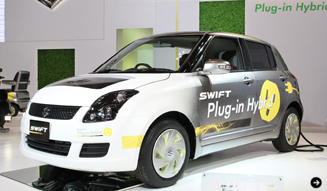
Suzuki Swift Plug-in Hybrid
WatanabeThe thinking in this area is becoming more mixed. Suzuki's Swift Hybrid is less of a plug-in hybrid and more of a range-extender concept; the engine acts as a generator. So, the distinction between EVs, hybrids, and plug-in hybrids is blurring. It's a given that to overcome the EV's limitation of short range, some form of power generation function will be necessary for the time being. The question is whether that will be used for driving as well, or if it will be further advanced to be used solely for power generation.
ShimashitaThat 1.4 percent figure we discussed earlier is precisely the point. For the time being, it will be about hybridization and plug-in technology. In other words, engines will definitely be necessary for several more decades.
OgawaThere were few FCV exhibits this time. FCVs require rare metals to generate electricity from the chemical reaction between hydrogen gas and air. However, considering the resource issues with precious metals, there's a theory that FCVs won't become the standard for next-generation cars. What do you think?
OPENERSEven lithium, used in batteries, is said to be in short supply.
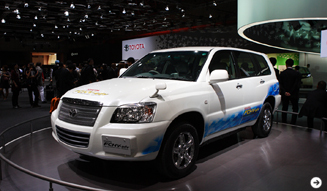
Toyota Fuel Cell Hybrid Vehicle "Toyota FCHV"
OgawaAlso, the shape of connectors, including power sources, is currently a patent battle. Since it's a new technology, it wouldn't be surprising if countries or companies emerge trying to gain hegemony over automobiles by securing numerous patents. Japan already failed with mobile phones. It's likely that automakers and Japanese government agencies are working hard through lobbying efforts with various governments regarding the establishment of next-generation technologies and de facto standards.
WatanabeJapan is undoubtedly leading in telematics technology. However, depending on the standards, what we've developed could be rejected. For example, if Toyota insists on its own de facto standard, I hope they consider avoiding a situation like early mobile phones, where overseas calls were impossible due to differing radio wave standards.
ShimashitaI'm sure each company is thinking about it, but there are too many uncertainties about the near future, so perhaps they're not saying much and are still exploring options.
Daihatsu Focuses on a Two-Cylinder Engine and Fuel Cells
OPENERSAt this point, I'd like to hear about the cars that left an impression on you at this year's Tokyo Motor Show.
WatanabeAs I mentioned earlier, Daihatsu's two-cylinder engine felt like it had finally arrived. Though not a car itself.
ShimashitaIt's a two-cylinder direct-injection turbo. Compared to a three-cylinder, it reduces parts, heat loss, and mechanical loss. Furthermore, they've increased EGR, or exhaust gas recirculation, by 50%. When exhaust gas is returned to the combustion chamber, the combustion temperature decreases, reducing NOx. If the vibration issue can be overcome, it's all positive.
OPENERSMazda was also pursuing the future of internal combustion engines in this regard.
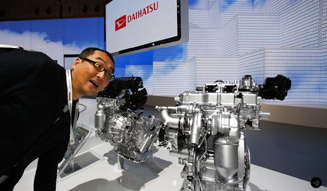
Daihatsu's next-generation eco-engine for mini vehicles and Mr. Watanabe
ShimashitaMazda exhibited a concept car called 'KAI.' Without using hybrid technology, they achieved a low fuel consumption of 32 km per liter through lightweighting, a high-efficiency engine, and idling stop. This is a realistic future that can be achieved without necessarily relying on hybrids or EVs.
WatanabeMazda seems to have made up its mind to reconsider the fundamental structure of internal combustion engines for next-generation technology. In terms of their approach to engines, they are a manufacturer to watch.
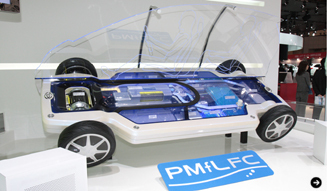
Daihatsu's Fuel Cell "PMfLFC"
ShimashitaI liked Daihatsu's fuel cell, the 'PMfLFC' (Precious Metal-free Liquid-feed Fuel Cell). It's precious metal-free and uses liquid fuel. Until now, fuel cells stored hydrogen in high-pressure tanks, which are expensive and bulky, making them impossible to fit in mini vehicles. In contrast, the 'PMfLFC' uses liquid fuel, similar to gasoline, making it easy to handle, and the fuel tank has a conventional shape.
OPENERSDoes this mean that liquid fuel has the potential to become the mainstream for fuel cells?
ShimashitaIt might. If it can be installed in small cars. Another key point is that the fuel cell electrodes and ion-exchange membrane are alkaline, not acidic like current fuel cells, so they don't corrode, eliminating the need for precious metals like platinum. This also significantly reduces costs. It might be usable in small, inexpensive cars. Incidentally, the miniature car in Daihatsu's booth was running using it.
OgawaUltimately, what will be the next generation of powertrains? That was the highlight of this show. I also asked engineers about it whenever I met them. Although there were many understated exhibits due to budget constraints, new initiatives like Daihatsu's fuel cell have significant appeal. Couldn't the show have focused more on that? Well, it's undeniably understated for the general public...
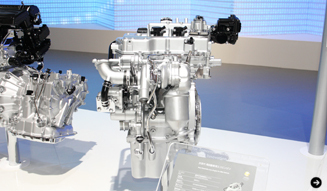
Daihatsu's next-generation eco-engine for mini vehicles
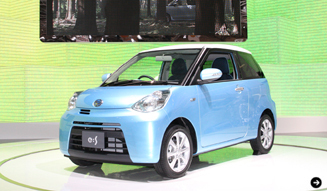
Daihatsu "e:S"
Toyota and Honda Propose a Blend of Eco-Friendliness and Driving Fun
ShimashitaFor cars, I was drawn to Toyota's 'FT-86 Concept.' Did you hear Akio Toyoda's presentation? He said, 'Toyota once had many sports cars, but they have disappeared. As someone who loves cars, I find this regrettable. They say young people are drifting away from cars, but perhaps it's we automakers who have drifted away.' I believe that was a very courageous statement from an automaker's top executive. The car itself is also generating considerable buzz, and I want to support it. The current discussion surrounding cars is very 'eco-first,' isn't it? But ultimately, that leads to the conclusion that it's best not to drive at all. The real point is that we want to make cars eco-friendly and keep them for a long time because they are fun and useful. I hope cars like the 'FT-86' can lead to a rediscovery of the joy of owning a car.
OPENERSIn that sense, Honda's 'CR-Z CONCEPT 2009' also proposed a balance of eco-friendliness and driving fun.
ShimashitaI think that's also wonderful. They announced they would offer a manual transmission, didn't they? A manual transmission shouldn't be about reaching high RPMs, but about bringing out the best performance. If you can achieve that with a manual, driving enjoyably and eco-consciously, then it's perfect.
WatanabeHonda's automotive division faced financial difficulties in the late 1970s and early 1980s, but the turning point for their revival was the first-generation 'CR-X.' It was originally introduced as a fuel-efficient commuter car.
ShimashitaThe Toyota 'FT-86 Concept' also emphasizes lightweighting. When a car is lighter, fun and eco-friendliness can be balanced through elemental and fundamental technologies. If that's their goal, I have high expectations.
WatanabeHowever, I think the 2-liter engine in the 'FT-86 Concept' is a bit much.
ShimashitaI agree that around 1.3 liters would be ideal. And the design could be simpler.
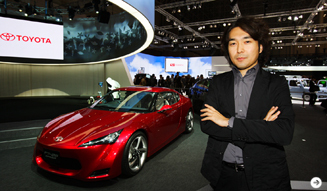
Toyota FT-86 Concept and Mr. Shimashita
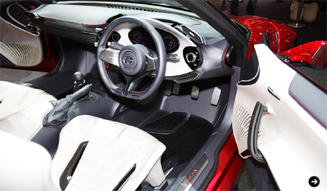
Toyota FT-86 Concept
The Production Model Lexus LFA Finally Appears
OPENERSFrom a design perspective, what did you think of the Lexus LFA? The concept car exhibited at the previous motor show and the current production model have slightly different impressions.
WatanabeIt felt like many requirements for production had been incorporated.
OgawaThe shape of the mirrors and the front end have also changed considerably.
OPENERSSpeaking of next-generation proposals, wouldn't an EV version of the LFA be great? For the survival of super sports cars.
ShimashitaI felt that way about Nissan. I wish Nissan would release an electric GT-R.
OPENERSNissan exhibited a hybrid sports car called the 'Essence' at this year's Geneva Motor Show.
ShimashitaAnd then there's Audi's EV 'R8'.AudiMercedes announced at the Frankfurt Motor Show that they would release an EV version based on the 'SLS AMG.' If Nissan were to release an EV version of the 'GT-R,' it would connect with the Leaf and establish consistency for the manufacturer. They should effectively leverage their image as 'EV Nissan.'
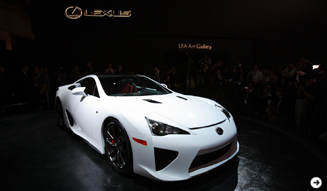
Lexus LFA
OGAWA Fumio
Freelance journalist. Formerly editor-in-chief of car magazines 'NAVI' and 'Motor Magazine.' Currently writes columns on automobiles for 'OPENERS,' 'GQ,' 'Nikkei Otona no OFF,' 'EDGE,' and others. Personally owns a Porsche 993 Carrera, but finds electric and hybrid cars interesting as automobiles. Hopes that the novelty of EVs and HVs will be recognized for their appeal as cars, not just for tax reasons. He contemplates these matters these days.
SHIMASHITA Yasuhisa
Motor journalist. Engages in writing that covers not only driving performance but also advanced environmental and safety technologies, brand theory, driving, and all other social phenomena surrounding automobiles. He also gives lectures and works as an instructor on eco & safety driving. A judge for the 2009-2010 Car of the Year Japan. His recent publications include 'Gokuraku Hybrid Car Driving Techniques' and 'Gokuraku Gasoline Diet' (both published by Nigen-sha). Blog: 'Blog Named Desire' http://minkara.carview.co.jp/userid/362328/blog/13360020/
WATANABE Toshifumi
After gaining experience in editing two- and four-wheel magazines at Kikaku Shitsu Neko (now Neko Publishing), he became an independent freelance writer. He excels at explaining the concepts, performance, and technical aspects of automobiles across various genres, and actively writes from a user's perspective to explore the ideal form of automobiles demanded by the times. In addition to automotive magazines, he also writes for numerous general interest magazines such as 'MEN'S EX' and 'UOMO,' gaining popularity.