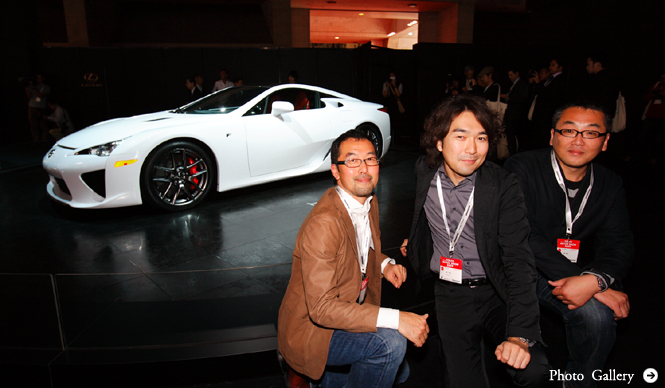
From the Tokyo Motor Show 2009: Will Electric Cars Change the Future?! (Part 1)
Three Rising Automotive Journalists Hold an Emergency Meeting
From the Tokyo Motor Show 2009: Will Electric Cars Change the Future? (Part 1)
The 41st Tokyo Motor Show 2009 was significantly impacted by the global recession, with only two foreign manufacturers exhibiting and total attendance dropping 43% from the previous year to 614,400. However, manufacturers were diligently showcasing next-generation vehicles and offering many proposals for the future. Where are cars headed in this era of upheaval? Three rising automotive journalists—Fumio Ogawa, Yasuhisa Shimashita, and Toshifumi Watanabe—discuss the present and future of the automotive world through the lens of the Tokyo Motor Show.
Text by OPENERSPhoto by MASAYUKI ARAKAWA
What's the Crucial Difference Between Tokyo and Frankfurt?
OPENERSThis was the first Tokyo Motor Show since the Lehman shock last year. What are your candid impressions?
WatanabeHonestly, it felt like a disaster. With fewer exhibitors, the venue felt so empty, you could have played a round of putt-putt. What concerned me most was the Japan Automobile Manufacturers Association (JAMA). It was evident six months in advance that foreign manufacturers would be absent, yet they had no contingency plan. While the economic situation made fewer exhibitors and importers understandable, there should have been more thought put into it.
ShimashitaEven the Frankfurt Motor Show in September saw a 30% drop in exhibitors, but it didn't feel as desolate as Tokyo. There was an effort to avoid a sense of anticlimax, both from the organizers and the manufacturers. In Japan, it didn't seem like JAMA or the remaining manufacturers felt the crisis and worked hard to generate excitement. What struck me more was Japan's inadequacy.
OgawaIn the late 1980s and mid-1990s, European cars were outsold by Japanese manufacturers. Despite talk of recession and declining sales, European makers didn't neglect R&D for next-generation vehicles, which later paid off, leading to the development of increasingly attractive models and market expansion. I wonder how much effort Japan is putting into similar endeavors now.
WatanabeIn terms of production volume, Toyota is likely the world's largest, but European manufacturers possess a strong conviction that they are the leaders in automobiles.
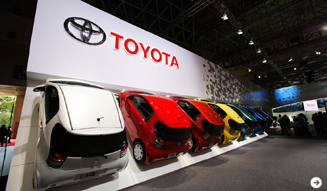
Toyota's Exhibition Space
ShimashitaThe proportion of the workforce involved in the automotive industry is also much higher in Europe than in Japan, so perhaps they have no choice. Furthermore, JAMA, as the organizer, should clarify what the Tokyo Motor Show is meant to be. Is it the place for Tokyo-specific design, or the hub for the latest technological information? If they don't clearly define the concept of the motor show, its very existence might become questionable.
OgawaExactly, the reason the motor show failed to attract visitors this time was a lack of concept. While it lacked concept before, it compensated with the allure of the cars. However, when some companies began to withdraw two years ago, and the term 'Japan Passing' (skipping Japan for China) emerged, they should have devised countermeasures. For instance, with the presidents of each company attending, it could have been interesting to have moderators for discussions. Isn't the motor show supposed to be a platform to appeal to the world, saying 'Please invest in Japan'? It was a missed opportunity.
WatanabeAt this rate, it's not impossible that there won't be a next one.
OgawaThis isn't just about a festive atmosphere. They need to feel a greater sense of urgency about Japan's declining position. Simply viewing it as a showroom relocated to Makuhari is insufficient. The domestic manufacturers clearly participated out of obligation.
Cutting-Edge Environmental Models Gather
OPENERSThere were various proposals from manufacturers, including electric vehicles, hybrids, plug-in hybrids, and fuel cell electric vehicles. What were your thoughts on this aspect?
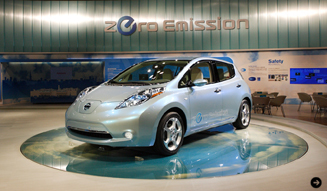
Nissan LEAF
ShimashitaThe media focused heavily on eco-cars, but I wonder how many truly new environmental proposals were actually presented. We hear a lot about the EV era, but regarding actual EVs, the Mitsubishi i-MiEV is already available. The vehicles displayed by Toyota and Honda were merely concept cars. The only new model introduced was the Nissan LEAF, wasn't it?
OgawaHowever, plug-in hybrids, which can be charged from an outlet, were being unveiled to the general public for the first time.
WatanabeIn situations like this, I felt Daihatsu and Mazda were grounded in reality. For example, Daihatsu exhibited a two-cylinder engine. If the direction is to make cars smaller, lighter, and cheaper, then sub-liter engines will become more prominent. While the current mainstream for kei cars is three-cylinder engines, a two-cylinder would reduce parts count, making it lighter and smaller. It would also reduce manufacturing costs. Furthermore, by modularizing these two-cylinder engines, they could be combined to create four-cylinder engines, covering vehicles up to the B and C segments with around 1.3-liter displacement.
ShimashitaMazda also emphasized vehicle weight reduction this time, didn't they? They declared a goal of reducing vehicle weight by 100 kg with their next-generation platform. I recently spoke with Dr. Wolfgang Steiger, head of powertrain external affairs at Volkswagen, and he mentioned that pure EVs would likely account for only about 1.4% even by 2020. While various plug-in hybrids will emerge, pure EVs are still a long way off. Ultimately, to increase range, you have to increase battery capacity, which isn't realistic considering the cost. The issue of battery disposal will also arise.
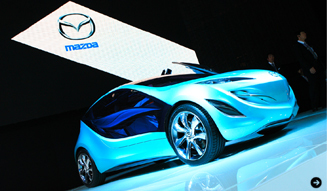
Mazda Kiyora
OPENERSSpeaking of which, I heard at the Denso booth about biofuels that don't use food crops like corn or sugarcane as raw materials.
OgawaThat's research into using microalgae as fuel. Apparently, there are about 300 venture companies in the US working on this. Japan and the UK are also actively involved. The advantages are that it's naturally derived, so no CO2 is emitted during production, and it has a high calorific value. Current research focuses on extracting oil from it to create biofuel, but even the dried form reportedly has a calorific value comparable to coal. It also avoids the environmental degradation associated with cultivating fields for ethanol production. Japanese microalgae are said to be found in hot springs.
ShimashitaIn that vein, in today's world, car information is readily available online. So, who would actually come to the venue? It must be people with a keen interest. While displaying general new models might be relevant for seeing the actual cars, there needs to be something uniquely profound exhibited at the show. For example, Honda stated, 'This time, we're broadening our scope rather than focusing on in-depth exhibits,' but I'd argue it's the opposite. For those who make the effort to come, you must present something they can only get by being here.
WatanabeI actually thought Honda's presentation was the most sensible. They truly created a show and clearly communicated their intentions in precise terms.
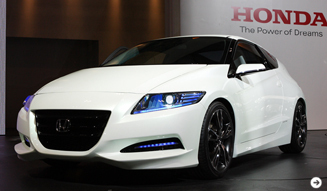
ShimashitaIf they broaden the scope, there should also be depth.
OgawaSuch as providing access to in-depth information. After all, even the developers of hybrid and plug-in hybrid cars admit that lithium-ion battery technology is still under development. What's the real status of the technology? What about the disposal and recycling of hybrid batteries? These are things that could be shared. Recycling, in particular, is linked to social infrastructure, and its impact extends beyond individual automobiles to our lives.
ShimashitaToyota is a pioneer in promoting hybrids globally, yet their exhibition didn't offer a deep understanding of hybrids. They should have explained more about why hybrids are so remarkable. If they had said, 'There are these challenges to overcome, but this is the future,' people would have understood.
OgawaWhile hybrids and EVs are emerging, some believe it will take another 20 years for them to mature. In parallel with the Tokyo Motor Show, Volkswagen held a workshop for journalists. A German engineer involved in researching future trends and reflecting them in automotive R&D stated, 'For now, we will do everything we can with gasoline cars. Rather than investing excessively in battery or infrastructure development, we will focus on reducing CO2 emissions.' The motor show venue could perhaps serve as a platform for such discussions. However, in that case, Tokyo would be better than Makuhari. It's already outdated to think of it as a place you 'make a special trip' to visit.
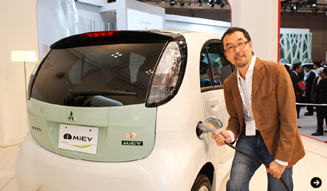
Mitsubishi i-MiEV and Mr. Ogawa
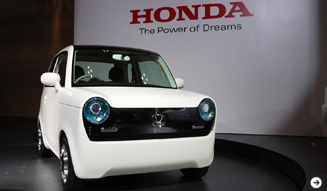
Honda Electric Vehicle 'EV-N'
Note 1: This refers to EU environmental regulations established due to the sharp increase in diesel vehicle share in new passenger car sales in Europe and the resulting severe air pollution. The 'Euro 5' emissions standard will apply to all new vehicles from 2011. Furthermore, 'Euro 6,' the next-generation standard, is scheduled to be applied in 2015.
FUMIO OGAWA
Freelance journalist. Previously served as editor-in-chief of automotive magazines 'NAVI' and 'Motor Magazine.' Currently holds automotive columns in 'OPENERS,' 'GQ,' 'Nikkei Ottona OFF,' and 'EDGE,' among others. Personally drives a Porsche 993 Carrera, but also finds electric and hybrid cars interesting from a vehicular perspective. Hopes that the novelty of EVs and HVs will be recognized for their automotive appeal, not just for tax benefits. These are his current thoughts.
YASUHISA SHIMASHITA
Motor journalist. His writing covers a wide range of automotive-related social issues, including driving performance, advanced environmental and safety technologies, brand theory, and driving itself. He also gives lectures and works as an instructor on eco-friendly and safe driving. He was a juror for the 2009-2010 Car of the Year Japan. His recent publications include 'Gokuraku Hybrid Car Driving Techniques' and 'Gokuraku Gasoline Diet' (both published by Nigen-sha). Blog: 'Blog Named Desire' http://minkara.carview.co.jp/userid/362328/blog/13360020/
TOSHIFUMI WATANABE
After gaining experience in editorial work for two- and four-wheel magazines at Kikaku Shitsu Neko (now Neko Publishing), he became an independent freelance writer. He excels at explaining automotive concepts, performance, and technical details across various genres, and actively writes from a user's perspective to explore the ideal form of automobiles for the times. In addition to automotive magazines, he also contributes to many general interest publications such as 'MEN'S EX' and 'UOMO,' where he has gained popularity.