December 5, 2014
On-site report from Geneva | McLaren
McLaren P1 | McLaren P1
McLaren P1 Finally Unveiled
As previouslyreported, McLaren's Supercar "P1"has finally2013 Geneva Motor Showwas unveiled. A report from Tatsuya Otani on-site has arrived!
Text by OTANI Tatsuya
Event Photographs by MOCHIZUKI Hirohiko
Supercar with 916 Horsepower
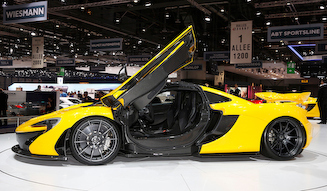
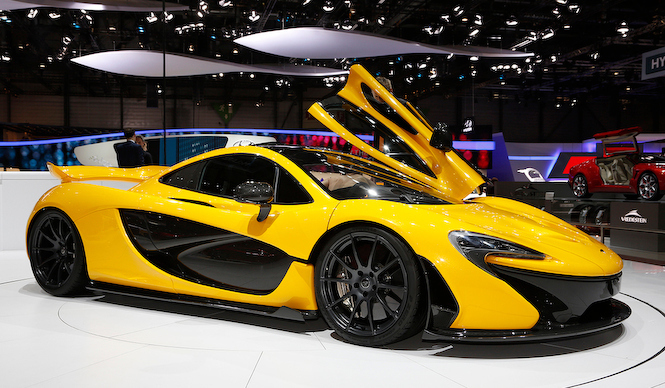
At last year'sParis Showconcept car was announcedThe production model of the McLaren "P1" wasGeneva Showunveiled. Currently, McLaren's road cars include the "MP4-12C" and "MP4-12C Spider". The P1 is the third model in this series.
The reason we consider the MP4-12C and P1 to be part of the same series is that they share many core components. However, as has already been introduced, the P1's performance far surpasses that of the MP4-12C.
For example, recentlythe 2013 modelreceived an update, the MP4-12C has a maximum output of 625ps, while the P1 has 916ps. The top speed is electronically limited to 350km/h, compared to the MP4-12C's 333km/h (!). Furthermore, acceleration from a standstill to 300km/h, which takes the MP4-12C 26.5 seconds, is achieved by the P1 in an astonishing 17 seconds.


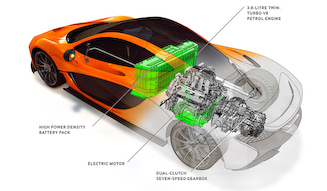
The reason for this difference in performance, despite both using a 3.8-liter V8 twin-turbo engine as the base, is that the P1 employs a hybrid system called IPAS, derived from F1's KERS.
Consequently, the 916ps power output cannot be sustained continuously. Nevertheless, it is still challenging for the rear two wheels alone to handle this immense power.
The Key is Downforce
Therefore, McLaren has made numerous innovations to make a 916ps rear-wheel-drive supercar a reality.
One of these is an exceptionally large amount of downforce for a road car. At 257km/h, a total of 600kg of downforce is generated, contributing to increased tire grip.
Normally, without downforce, the maximum lateral G-force during cornering can only reach about 1G. However, the P1 has succeeded in increasing this to 2G. The primary reason for this is undoubtedly the immense downforce.

Furthermore, the P1 adopts a new system called Race Active Chassis Control (RCC). This system uses hydraulics to alter the vehicle height and suspension spring rate. In race mode, the spring rate increases by 300 percent, and the vehicle height is lowered by 50mm. This allows for racing-car-like performance on the circuit without compromising everyday usability and comfort.
More Luxurious Carbon Monocoque than MP4-12C
The P1's monocoque is fundamentally made of carbon fiber composite using the same mold as the MP4-12C. However, in the P1, a roll cage section made using the pre-preg autoclave method, which is far more labor-intensive than the molding process, is combined with this monocoque, providing enhanced cockpit protection.
The drivetrain is largely based on the MP4-12C's. The brakes are carbon-ceramic units developed by Akebono Brake, McLaren F1 team's technical partner. These are not only powerful but also aesthetically refined with a mirror-polished disc surface.

Emotional Design Foreshadowing McLaren's Future
In contrast to the MP4-12C, whose exterior, designed by Paul Stephenson's McLaren design team, was often described as beautiful and well-proportioned but "somewhat dull," the P1's design is devoid of excess while exuding emotion.
Stephenson himself seems to favor the P1 over the MP4-12C, so it would not be surprising if future McLaren Automotive models adopt a more emotional design similar to the P1.
The McLaren P1 will be produced in a limited run of 375 units worldwide, with a price tag of £866,000 (approximately 120 million yen). Considering it offers technology directly from F1, this price is by no means excessive.