Ford Focus Sport Long-Term Report Part 4 | Ford
Ford Focus Sport Long-Term Report | Ford Focus Sport
Part 4: Embarking on a Long Drive in the Focus
Day trips around the Tokyo metropolitan area are a breeze, but the longest I'd driven previously was around 300km round trip. For the fifth long-term test car for OPENERS, the European-born Ford Focus, a distance of about 400km one-way should be as easy as an intercontinental flight... or so it should be. Can a comfortable long drive be achieved even in a compact car? We pointed the Focus's steering wheel towards a wintery Kanazawa.
Text by SAKURAI KenichiPhotographs by MOCHIZUKI Hirohiko
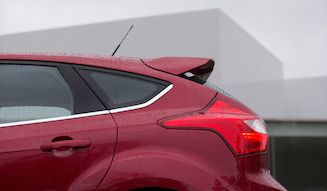
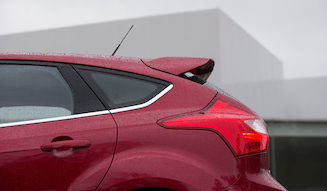
Car No. 5
Ford Focus Sport
Ford Focus Sport
Introduction Date: August 2013
Purchase Price: ¥2.93 million
Total Mileage: 13,155 km
Fuel Economy This Time: 12.8 km/ℓ
Average Fuel Economy: 12.3 km/ℓ
The Ancient Capital and the Focus
Editor A suddenly asked me, "Huh? Have you ever been to Kanazawa?" His questions always come out of the blue, starting with that distinctive "Huh?"
There was no preamble about the Sea of Japan in winter, or how the Focus would look in the historic streets of the ancient capital. And while his peculiar habit of starting sentences with "Huh?" is irrelevant to the main topic, to summarize, he was essentially asking, "Wouldn't a winter trip to Kanazawa be charming? I've always wanted to take the Focus on a proper long drive, so why don't we go to the ancient capital?"
Of course, there was no reason to refuse. In fact, the idea of driving a modernly designed Focus in an ancient city like Kanazawa seemed intriguingly mismatched, and I was quite drawn to the potential visual appeal. The ancient capital and the Focus. Surely, a fascinating chemical reaction would occur. Not Kyoto, but Kanazawa. Editor A certainly has good taste.
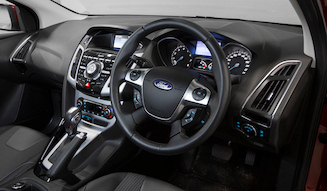
Thus, the plan came together smoothly, and along with photographer Mochizuki, who has extensive experience shooting in Kanazawa, we set off for the city in the Focus. Unfortunately, there was no elegant Japanese lady companion to match the scenery and the Focus, but the interior, more spacious than its compact size might suggest, made for a comfortable highway drive. Road noise and wind noise were impressively suppressed, and conversation flowed easily inside the Focus, led by Editor A.
We exited the Tokyo metropolitan area via the Shuto Expressway, bypassed the morning rush hour, and entered the Tokyo Gaikan Expressway. From Oizumi, we smoothly merged onto the Kan-Etsu Expressway. Continuing north, we approached the Joshin-etsu Expressway via the Fujioka Junction. The Focus powered its way up the inclines on the mountainous section that bypasses Mt. Myogi. The 2-liter naturally aspirated engine, revving slightly higher than during cruising, delivered ample acceleration. As expected from an engine producing 170ps in a compact body, it felt effortless.
In sections with these ascending高速 corners, the handling, which precisely traced the road surface, instilled a sense of security in the driver. The faithful response to the accelerator and the rhythmic steering work gave a feeling of being completely in control. Adding to this was the smooth ride, which, unlike boring stretches of straight road, enhanced the sense of unity with the driver.
The Focus comes standard with Torque Vectoring Control, which applies subtle braking to the inner front wheel when understeer begins, preventing wheelspin and improving grip. However, even without needing to engage this system at high speeds, the car maintained stable, grippy cornering that felt glued to the road.
Ford Focus Sport Long-Term Report | Ford Focus Sport
Part 4: Embarking on a Long Drive in the Focus (2)
Providing Sufficient Torque for Practical Use
Editor A, who has recently gained confidence driving on snowy roads, continued to grip the steering wheel after leaving the Tokyo area. The slight undulations of the road and the moderate G-force were pleasant, and I found myself leaning back in the comfortable seat, almost dozing off. I don't mean to make excuses, but this was a journey of about 500km one way. A 6 AM meeting and departure was a bit tough on a sleep-deprived body.
Traffic was light, and up to this point, we had been driving smoothly with the flow. On uphill stretches with passing lanes, we had several opportunities to overtake large trucks ahead. Editor A executed the entire maneuver—changing lanes to the right, passing the vehicle with ease, and returning to the driving lane—very smoothly.
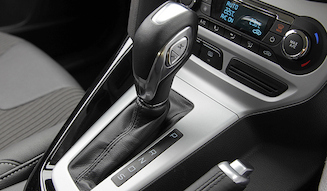
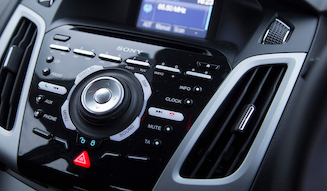
Unlike cars that only appear powerful, the Focus rarely exhibits excessive downshifting that fills the cabin with unnecessary engine noise. When the accelerator is controlled skillfully, the impressive DCT simply shifts down one gear, providing ample torque for practical use.
If the incline is steeper than expected and more power is needed, you can select S mode beforehand and choose the desired gear using the select switch next to the shift knob. The gear changes, with almost no shift shock, are executed without delay, allowing for immediate acceleration.
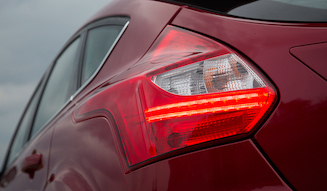
Although you need to shift back to D range to return to automatic mode, if you're on a winding section, it's also fun to stay in S mode and shift manually while climbing.
Passing through Komoro, Nagano, and Shinano-machi, the Focus finally entered the Hokuriku Expressway via the Joetsu Junction. After a break, we had been on the road for about three hours. It was incredibly smooth. Shortly after entering the Joshin-etsu Expressway, the sea came into view on our right. The Sea of Japan in winter.
"Huh? I've never seen the Sea of Japan in winter before. The waves are amazing. It's like an enka song, a man's sea!" Editor A exclaimed excitedly. Indeed, the sea was powerfully rough. A bad premonition struck me, but I decided to let the excitable Editor A deal with it when we arrived, leaving him to his excitement for the moment.
Ford Focus Sport Long-Term Report | Ford Focus Sport
Part 4: Embarking on a Long Drive in the Focus (3)
The Focus's True Capabilities, Beyond the Specs
After passing Niigata and entering Toyama, the Hokuriku Expressway continued along the coast, with the Sea of Japan on our right. While trucks and minivans struggled to maintain a straight line against the strong crosswinds, the Focus steadily covered the miles towards Kanazawa. Occasionally, the strong gusts from the sea threatened to pull the steering wheel, but otherwise, the car was not significantly affected by the wind.
"Huh? It's quite windy, but surprisingly easy to drive at high speeds, isn't it?" remarked Editor A. Thanks to its aerodynamic design, which minimizes the impact of crosswinds, and its high-grip suspension, the Focus exhibits excellent straight-line stability.
The steering feel not becoming excessively nervous is a crucial factor in reducing fatigue on long drives. This is another merit of the Focus. It's an example of the Focus's true capabilities, which can only be appreciated through actual driving, going beyond mere specifications.
We exited the Hokuriku Expressway at the Kanazawa-Morimoto IC and turned our nose towards the Noto Peninsula. Our destination was the Chirihama Nagisa Driveway in Hakui City, Ishikawa Prefecture. This is famously the only place in Japan where you can drive on a sandy beach. It stretches for about 8km, and driving while watching the sunset over the Sea of Japan would be spectacular.
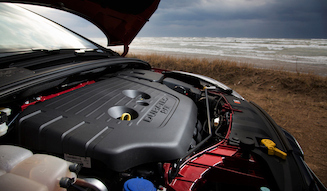
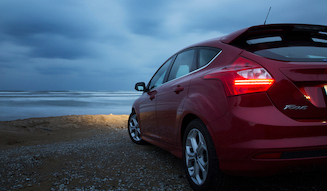
"I've always wanted to drive on a beach with the sea breeze," said Editor A, full of excitement, but my bad premonition proved correct. Due to strong winds, the waves were high, and a sign indicated "Closed Today." After driving for over four hours from Tokyo, the result was "Closed." Editor A truly has a knack for this.
"Huh? What? Seriously? Why?" Well, it's obviously because of the strong winds. However, the way he used "Huh?" this time was appropriate. But even as we were buffeted by strong winds on the Hokuriku Expressway, we had noticed... Putting aside the question of whether he had anticipated this at all, we took this photo as a small consolation.
To prevent more unfortunate tourists like Editor A, we recommend checking the "Ishikawa Road Information Network" and the "Chirihama Live Camera" for updates on the Chirihama Nagisa Driveway's status.
The "Chirihama Live Camera" footage, in particular, provides real-time information about the conditions at Chirihama, so we highly recommend checking it before your arrival. Despite this somewhat disappointing turn of events, we enjoyed the local seafood of the Sea of Japan that day and, tired from the long journey, retired early.
Ford Focus Sport Long-Term Report | Ford Focus Sport
Part 4: Embarking on a Long Drive in the Focus (4)
Candy Red Body Repels Water Droplets
The next day, we intended to continue our drive with renewed spirits, but unfortunately, Kanazawa was experiencing rain from the early morning. Nevertheless, we decided to make the most of it and visited the Higashi Chaya District early in the morning to explore Kanazawa's traditional streets.
Along the banks of the Asano River, at the foot of Mt. Udar, lies a beautiful old townscape characterized by its distinctive 'kimusuko' (latticed windows), preserving the atmosphere of Kanazawa's castle town during the Kaga domain. This area alone allows you to feel as if you've stepped back in time to the Meiji era.
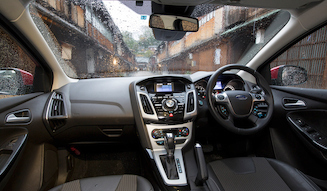
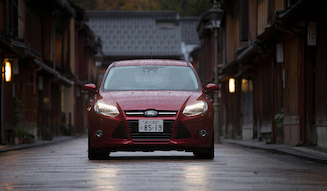
It is also known as the setting for Hiroyuki Itsuki's novel, "Toki no Haka"—a fact I learned from local tourist information. The area is being preserved as "Cultural Assets of Townscape" and was designated a National Important Preservation District for Groups of Traditional Buildings in 2001.
The collaboration between this historic, rain-soaked ancient city and the modern Focus was breathtakingly harmonious. I had assumed its kinetic design and emotional form were best suited for urban environments, but it also stood out beautifully amidst the subdued elegance.
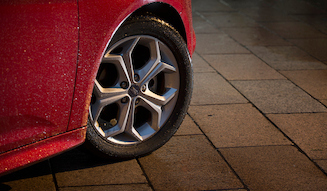
Editor A, perhaps moved by the scenery, was diligently capturing the townscape with his camera, which he proudly claims is favored by professionals. However, I could understand his sentiment; the Focus truly enhanced the picturesque setting of the Higashi Chaya District.
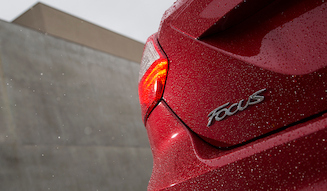
The rain-dampened atmosphere of the ancient city and the Candy Red body, repelling water droplets, created an undeniably alluring and beautiful scene. Just seeing this landscape and the Focus made the trip to Kanazawa worthwhile.
Ford Focus Sport Long-Term Report | Ford Focus Sport
Part 4: Embarking on a Long Drive in the Focus (5)
The Focus Also Complements Modern Architecture
Leaving the Higashi Chaya District in the early morning, our next destination was the 21st Century Museum of Contemporary Art, Kanazawa, famous for its modern architecture, a stark contrast to the former. This museum, with its circular building surrounded by roads on three sides, is located near the renowned Kenrokuen Garden. It has two floors above ground and two below, is constructed of concrete, and opened in 2004.
It received the Good Design Award in 2005 and the Architectural Institute of Japan Prize in 2006. Furthermore, the architectural unit SANAA, comprising Kazuyo Sejima and Ryue Nishizawa, won the Golden Lion, the highest honor at the Venice Biennale International Architecture Exhibition, for this building.
Needless to say, the Focus harmonizes well with such modern architecture. Its design rivals that of this museum, which represents Japan and conveys the present to the world, shaping future history. There was no reason to refuse Editor A's suggestion, "Since we're here, let's take a look inside."
At the time of our visit,Koji Kakinuma's Calligraphy Journey "Paa!"and exhibitions like "Borderline Collection II" were being held. However, Editor A seemed to manage only a "There's a lot to see, it's fun." Perhaps he should read "Tomehane! Suzuri High School Calligraphy Club" to brush up on his calligraphy knowledge, Editor A.
As we were leaving Kanazawa, having visited Kanazawa Castle Park and Kenrokuen Garden, we happened to witness the test run of the Hokuriku Shinkansen. Editor A, who also likes trains, became visibly excited, exclaiming repeatedly, "Wow, wow! I've never seen it before!" "Man, this is amazing, Kanazawa is amazing," he rejoiced. We decided to accept his enthusiasm as a unique encounter of a long drive, swallowing the urge to say, "I wish you'd been that impressed at the museum earlier."
Ford Focus Sport Long-Term Report | Ford Focus Sport
Part 4: Embarking on a Long Drive in the Focus (6)
The Quiet Cabin of the Focus
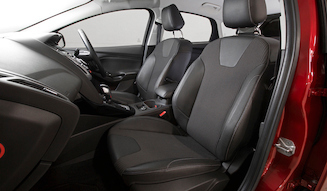
After a late lunch, we headed back to Tokyo on the Hokuriku Expressway. Editor A had been driving for most of the journey, but he rarely complained of fatigue until we returned to the metropolitan area. The seats, a combination of leather and fabric, offered excellent hold and prevented sliding. The well-designed seats, which firmly supported his lower back and spine, likely contributed to his minimal fatigue, making long distances comfortable.
Furthermore, the cabin's quietness in the Focus is exceptionally high for its class, meaning these factors significantly reduce fatigue on long drives. It's well-known that one reason for fatigue during air travel is the constant, irritating noise, but it's less known that this noise also contributes to the perception of airplane food tasting bland.
Research suggests that human taste perception becomes significantly dulled in noisy environments. This demonstrates how much stress noise can cause. The reason we felt physically less tired, whether in the passenger seat or the rear, was precisely due to this quietness.
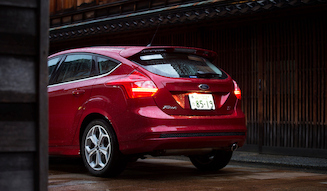
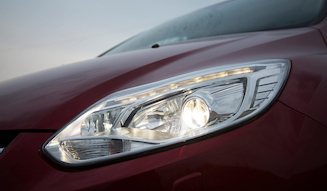
We saw the Focus's design against the backdrop of traditional old Japanese townscapes and new, forward-looking Japanese architecture. The dynamic form of the Focus, standing elegantly amidst the serene, static beauty of the ancient city of Kanazawa, was superb. It wasn't just modern buildings; the Focus blended seamlessly with Japan's historic landscapes. This was a discovery beyond our expectations.
On the drive back, Editor A, without any preamble, said, "Huh? Now that we've learned the Focus suits both old Japan (Higashi Chaya District) and new Japan (21st Century Museum of Contemporary Art, Kanazawa) on this trip, let's go take some photos of it with the E7 Series (Hokuriku Shinkansen). Wasn't the E7 Series super cool?"
"Huh? Should we go back to see the E7 Series again? I'm not tired at all," said Editor A, his excitement undiminished even in the car on the way home. That's a total of about 800km round trip. Honestly, Editor A, could you please get a little tired?

Ford Focus Sport | Ford Focus Sport
Body Dimensions | Length 4,370 x Width 1,810 x Height 1,480 mm
Wheelbase | 2,650 mm
Tread Front/Rear | 1,555 / 1,545 mm
Minimum Ground Clearance | 130 mm
Weight | 1,380 kg
Engine | 1,998cc Inline 4-Cylinder Direct Injection DOHC
Bore x Stroke | 87.5 x 83.1 mm
Max. Output | 125kW (170ps) / 6,600 rpm
Max. Torque | 202Nm (20.6kgm) / 4,450 rpm
Transmission | 6-Speed Automatic (Dual Clutch)
Gear Ratio | 1st: 3.917
2nd: 2.429
3rd: 1.436
4th: 1.021
5th: 0.867
6th: 0.702
Reduction Gear Ratio | 3.850 (1st, 2nd, 5th, 6th gears) / 4.278 (3rd, 4th gears, Reverse)
Drivetrain | FF
Suspension Front | MacPherson Strut
Suspension Rear | Multi-Link
Tires | 215/50R17
Brakes Front/Rear | Ventilated Disc / Disc
Fuel Tank Capacity | 55 ℓ
Minimum Turning Radius | 6 m
Price | ¥2.93 million
Ford Customer Service
 0120-125-175
http://www.ford.co.jp