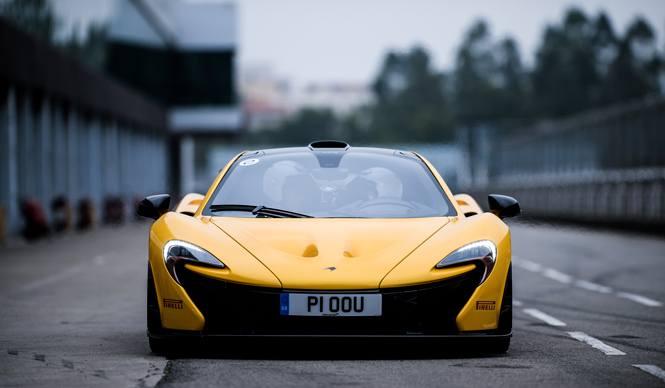
Test Drive: McLaren P1 at Zhuhai International Circuit | McLaren
McLaren P1 | McLaren P1
Test Drive of the McLaren P1 at Zhuhai International Circuit
The McLaren "P1," equipped with a hybrid system inherited from F1, boasts astonishing performance, with a top speed of 350 km/h and a 0-100 km/h acceleration time of under 3 seconds. We have previously reported on this super sports car, limited to just 375 units worldwide, from its announcement to rides with test drivers. Now, the time has finally come to get behind the wheel of the P1 ourselves. Tatsuya Otani reports from the Zhuhai International Circuit in China.
Text by OTANI Tatsuya
Finally, Behind the Wheel
Zhuhai, not far from Macau. Approximately 20 years have passed since the Zhuhai International Circuit was built in the suburbs of this city, with the claim that it could host Formula 1 Grand Prix races.
I happened to be in this very place to cover its inaugural event, and I thought I would never visit this circuit again, especially after the Chinese Grand Prix was decided to be held in Shanghai. Yet, by some twist of fate, I find myself here again at the Zhuhai International Circuit. The reason is singular: to test drive the McLaren P1.
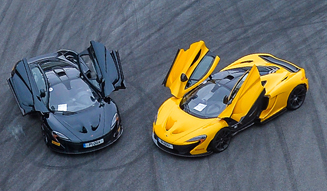
There is likely no need to reintroduce the P1 in detail to OPENERS readers. The P1 is the flagship model of McLaren Automotive, which resumed its independent path in 2010 after ending its 11-year partnership with Mercedes.
While it shares the 3.8-liter V8 twin-turbo engine and carbon monocoque with the MP4/12C, the debut model of the reborn McLaren, the engine has been boosted to 737ps. The monocoque is reinforced with stronger dry carbon, and the suspension and aerodynamics have been enhanced with variable control systems that deliver entirely different performance for public roads and circuits.
Furthermore, it is equipped with a hybrid system centered around an electric motor producing 179ps, resulting in a monster with a system maximum output of 916ps and a system maximum torque of 900Nm – this is the P1.
McLaren states that the P1 was developed with the goal of "creating the ultimate driver's car for both public roads and circuits," and there is no doubt that this statement is true.
McLaren P1 | McLaren P1
Test Drive of the McLaren P1 at Zhuhai International Circuit (2)
Common Points of the New Generation McLarens
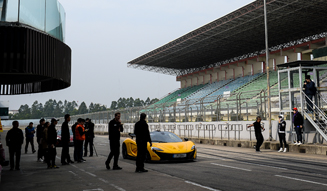
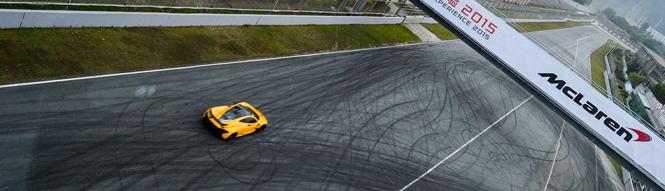
The Zhuhai International Circuit, visited for the first time in about 20 years, has a layout that can be described as a stop-and-go circuit with a succession of straights and tight corners. There are virtually no large, sweeping high-speed corners like the 100R at Fuji Speedway. Conversely, this means it is a safer circuit with less risk.
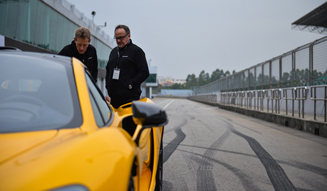
The test drive format involves a McLaren instructor accompanying the driver and offering driving advice. During this, we would sequentially test each of the modes – E mode, Normal, Sport, and Track – which are key features of the P1. However, we would only have about two laps to experience each mode.
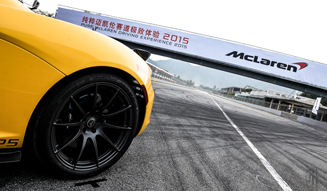
Even though this is my second visit to the Zhuhai International Circuit, it is my first time driving here, so it would be difficult for someone with my driving skills to push the car to its cornering limits. With that in mind, I hope you will read the following impressions.
After the instructor's demonstration run, I got into the P1's cockpit. While there are differences in the details, the overall impression is very similar to the12Cand650S. Firstly, the visibility is excellent, allowing easy sight of the road directly ahead of the car. The rearward visibility, often difficult to achieve in mid-engined cars, is adequate, though not perfect.
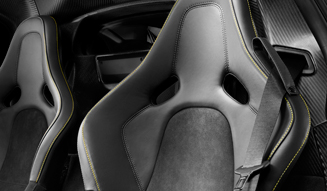
Furthermore, the steering wheel, pedals, and various switches and levers are all laid out in places that feel perfectly suited for use. The deeply sculpted bucket seats provide excellent support without forcing an uncomfortable posture. This allows the driver to remain in a natural position at all times.
This sense of security is a common point across all "new generation McLarens," including the MP4/12C.
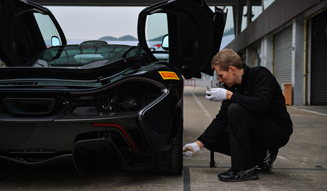
The car never intimidates the driver by saying, "You are driving an incredibly high-performance machine right now." Instead, it envelops you in a profound sense of security, as if encouraging you: "Don't worry, you can surely enjoy driving. Go ahead and drive with confidence."
Thanks to this, I felt no fear even when a light rain began to fall just before the drive.
If you get into a dangerous situation, the car will alert you immediately—. Protected by such absolute confidence, I began driving the P1 around Zhuhai.
McLaren P1 | McLaren P1
Test Drive of the McLaren P1 at Zhuhai International Circuit (3)
Experiencing the Differences Between Modes
First, I tried "Normal Mode." Despite being a monster with over 900ps, its ease of handling is identical to the 12C or 650S. The ride quality doesn't feel harsh either. Even when switching to Sport Mode and then to Track Mode, I didn't feel a significant difference in ride comfort or handling. Or rather, to be honest, I was so focused on learning the Zhuhai circuit layout, which I was driving for the first time, that I didn't have the余裕 to closely observe the changes associated with mode switching.
When I selected "E Mode," which allows for pure electric driving, the engine noise that had been audible suddenly stopped, and the P1 continued its journey in silence. Apparently, E Mode allows for over 10 km of driving. While the range is shorter compared to typical plug-in hybrids, this difference should be seen as a reflection of the differing philosophies: whether to use the hybrid system to reduce CO2 emissions or to enhance performance.
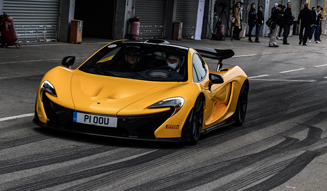
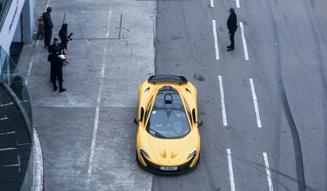
As I completed lap after lap, three, then four, the circuit layout gradually became familiar, and I was able to gradually increase my pace. Even so, I couldn't reach the cornering limits, but I could brake with confidence into the ABS activation zone.
Still, it's rare for a road car to offer such solid brake pedal feel and allow you to sense the contact between the tires and the road through the pedal. With this, it seems possible to control braking right up to the point of lock-up, even without ABS.
This is likely one of the points that McLaren's engineers aimed for.
In fact, the P1 is not equipped with a regenerative braking system. This is because installing regenerative braking inherently degrades the brake pedal feel. So, how does the P1 charge its battery? It generates electricity by running a generator during times when the engine has surplus capacity.
"To provide the driver with the best feedback and allow them to confidently push the car's limits." This McLaren philosophy is evident everywhere in the P1. The relationship between the tires and the road is constantly transmitted through all senses, not only from the steering but also from the incredibly rigid body.
This is why the driver can feel at ease at all times. If only I could learn the track better, I could push harder—.
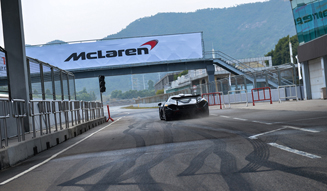
Meanwhile, the test drive entered its final stage, "Race Mode."
McLaren P1 | McLaren P1
Test Drive of the McLaren P1 at Zhuhai International Circuit (4)
A Strong Sense of Unity, Like a Formula Car
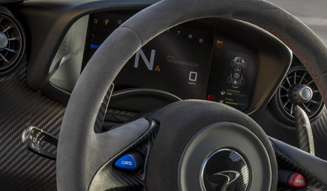
Switching to "Race Mode" lowers the vehicle height by 50mm and increases the spring rate by 300%, requiring the vehicle to stop temporarily. During this time, graphical displays of the height change are shown on the instrument panel, with even the waiting time designed to be part of the entertainment.
After about 30 seconds for the "transformation" to Race Mode to complete, the instructor prompted me to re-enter the track.
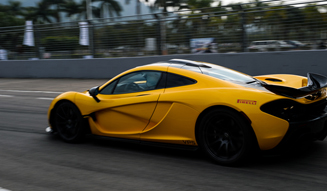
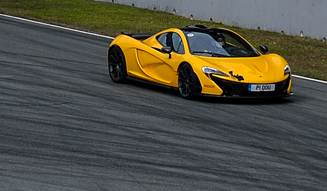
Indeed, the difference in spring rate – a 300% increase – is immense, and the fine undulations of the road surface are clearly transmitted to the cockpit. However, thanks to the astonishingly rigid monocoque and the precisely engineered suspension, there is absolutely no discomfort.
On the other hand, the car's response to driver inputs becomes incredibly sharp, providing a sense of unity comparable to a real Formula car. This makes it understandable why McLaren's Chris Goodwin was able to control the P1 while freely sliding all four wheels on the 100R at Fuji Speedway.controlling the P1 while freely sliding all four wheelsI thought, "Ah, I wish I could drive like that," but with only two laps, I was nowhere near achieving that. I have never regretted my lack of driving skill so much.—Nevertheless, during these two laps, I caught a glimpse of the P1's formidable capabilities.
For example, the effect of IPAS (Instant Power Assist System), which can be activated to full power by simply pressing a switch on the steering wheel.
The first time I was allowed to use this was on the exit of the final corner. I pressed the switch while still at a relatively low speed, and the resulting acceleration G-force was so immense and unexpected that I almost took my finger off the switch out of sheer terror.
McLaren P1 | McLaren P1
McLaren P1 | McLaren P1
Test Drive of the McLaren P1 at Zhuhai International Circuit (5)
Acceleration Sensations with Multiple Nuances
Strangely, the second time I tried it, I didn't feel the same intensity. When I asked the accompanying instructor why, he explained, "The first time, you pressed IPAS at a very low speed, so you clearly felt its effect. However, the second time you pressed it, the speed was higher, and the engine power was already significant. Therefore, the power added by the electric motor was relatively less, and you didn't feel as strong an acceleration. That's likely why." Indeed, a very logical explanation.
Another interesting feature was the DRS (Drag Reduction System). While the F1 uses a system with the same name, the principle is identical for both the P1 and F1: pressing a switch changes the angle of the rear wing, reducing drag and increasing straight-line speed.
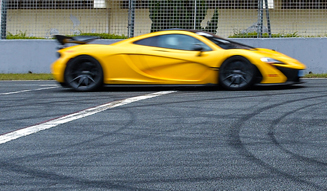
I also tried this on the exit of the final corner. In contrast to IPAS, the higher the speed, the more clearly I could feel its effect. Unlike IPAS, which provides a strong push from behind, with DRS, the car felt as if it became lighter.
This is understandable, as air resistance is proportional to the square of the vehicle speed, meaning the benefit gained from DRS increases with higher speeds. However, whether the impressions of "being pushed from behind" or "feeling lighter" are my own subjective perceptions or actual physical differences is unclear. Nevertheless, the P1 is the first car I've encountered that offers multiple nuances even in its acceleration. In that sense, it was a truly fascinating experience.
McLaren Automotive, which released the P1, has since announced a series of new models, including the 650S,675LT, and570S, but no model has yet matched the P1 (and its derivative, the P1 GTR). In other words, the P1 remains an unparalleled existence for McLaren today. Therefore, it would be entirely unsurprising if, in 10 or 20 years, this P1 were to become a legendary super sports car, much like the McLaren F1 road car of the past.

McLaren P1 | McLaren P1
Body Dimensions | Length 4,588 x Width 1,946 x Height 1,188 (1,138 in Race Mode) mm
Wheelbase | 2,670 mm
Tread Front/Rear | 1,658 / 1,604 mm
Weight | 1,395 kg
Engine | 3,799 cc V8 Twin-Turbo
Maximum Output | 737 ps / 7,500 rpm
Maximum Torque | 720 Nm / 4,000 rpm
Motor Output | 179 ps
Motor Torque | 260 Nm
System Maximum Output | 916 ps
System Maximum Torque | 900 Nm
Transmission | 7-speed Automatic (SSG)
Drivetrain | MR
Tires Front/Rear | 245/35ZR19 / 315/30ZR20
Brakes | Carbon Ceramic Discs
Top Speed | 350 km/h (electronically limited)
0-100 km/h Acceleration | 2.8 seconds
0-200 km/h Acceleration | 6.8 seconds
0-300 km/h Acceleration | 16.5 seconds
CO2 Emissions | 194 g/km