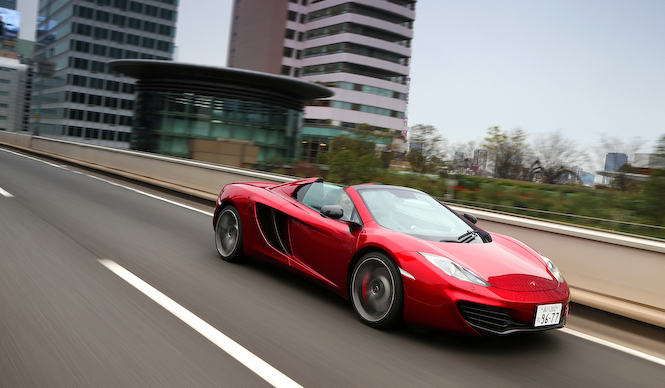
McLaren MP4-12C Spider Domestic Test Drive | McLaren
McLaren MP4-12C Spider
A Supercar That Offers Open-Air Thrills
Test Drive: McLaren MP4-12C Spider
McLaren, renowned for its F1 team, created a supercar for the road called the MP4-12CMP4-12C. In August 2012, its open-top variant, the MP4-12C Spiderwas announced, and in October of the same year, it waslaunched in Japan.Overseas circuit test drive report by Mr. YamazakiFollowing the report, Tatsuya Otani tests this open-top sports car, which has finally begun its introduction in Japan.
Text by OTANI Tatsuya
Photographs by NAITO Takahito
A Nonsensical Argument
The talk that the body rigidity of the McLaren MP4-12C Spider is exactly the same as the coupe version is currently buzzing, but I think it's a truly nonsensical argument.
This is because the main structural component of the MP4-12C is a carbon composite monocoque called a "monocell" weighing 75kg, which consists of the cabin floor and a wall about 20-30cm high surrounding it. It originally has no roof. Therefore, it's natural that opening it has almost no impact on body rigidity.
On the other hand, the monocoque structure used in many mass-produced cars is shaped to surround the entire body like an eggshell. Therefore, if you remove a part of it to make it open, the body rigidity will naturally decrease.
An egg is surprisingly strong if its shell is intact, but it becomes brittle as soon as part of it is damaged. Similarly, if you want to maintain body rigidity when opening it, you must reinforce other parts very carefully.
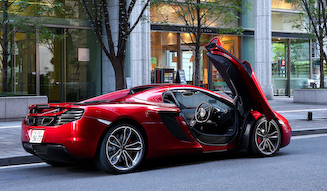
In other words, if you convert a sedan or coupe into an open-top, you absolutely cannot avoid either a decrease in rigidity or an increase in weight.
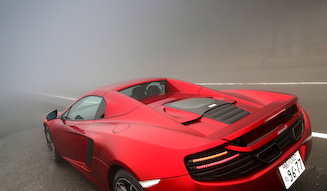
However, with the MP4-12C, which uses a roofless monocoque from the start, rigidity does not decrease when opened, and no body reinforcement is necessary, so the increase in vehicle weight is only a slight 40kg. In other words, it doesn't even weigh as much as one adult. This is likely due to the weight increase associated with adding the necessary mechanisms for an open-top.
McLaren MP4-12C Spider
A Supercar That Offers Open-Air Thrills
Test Drive: McLaren MP4-12C Spider (2)
It's Still the Same
That's not the only amazing thing about the MP4-12C Spider. Its center of gravity height is the same as the coupe's. However, this is something I heard in a casual conversation with a McLaren engineer, and I didn't confirm the exact millimeter difference. So, perhaps it differs by 1 or 2 millimeters, but the engineer likely meant that it's practically zero.
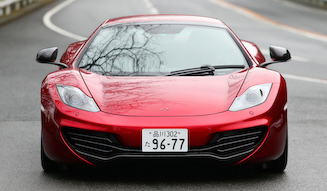
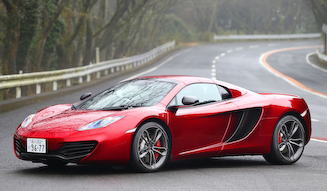
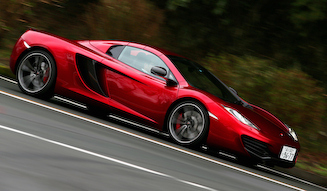
You'll notice this as soon as you drive it. The impression is completely unchanged from the coupe in every aspect. The ride comfort, which is unusually comfortable for a supercar, the precise and deeply capable handling that is not just sensitive, and the astonishing rigidity emanating from the entire body are all exactly the same as the coupe. It is undeniably an MP4-12C.
What the Spider Gained
On the other hand, there are several things the Spider has gained. The most significant is the sense of openness when the roof is down. For a serious supercar like the MP4-12C, one would naturally want to concentrate intensely on driving, but another characteristic of the MP4-12C is its comfort, making it suitable for long touring.
Therefore, when you open the roof while facing a vast ocean or when you take a moment to relax after a spirited drive on a winding road, even though the opening is not very large due to its nature as a supercar, cool air flows into the cabin, providing a perfect change of pace. It's a moment when you think, "Ah, I'm glad I chose the Spider."
McLaren MP4-12C Spider
A Supercar That Offers Open-Air Thrills
Test Drive: McLaren MP4-12C Spider (3)
A Small Feature Unique to the Spider
There's one more thing the Spider can do that the coupe cannot.
It's the ability to open and close the rear window. This rear window, which also serves as an air deflector when the top is down, can be opened and closed independently of the roof. In other words, you can open the rear window even with the roof closed. Doing so allows the engine sound resonating from the rear of the cabin to directly enter, further exciting the driver.
However, as I've always felt the MP4-12C's exhaust sound is too loud, I personally wouldn't open the rear window when the roof is closed. In fact, I wish there was a feature to significantly quiet the exhaust sound at the press of a button.
Other than that, the only differences from the coupe version I tested previously are a 25ps increase in maximum engine output, bringing it to 625ps, and a change in how the doors open and close.
Unfortunately, the 25ps power increase is barely perceptible, but it can be retrofitted to the 2012 models, so current owners should consult their dealers.
Meanwhile, the early MP4-12C doors had a unique opening mechanism: you'd slide your hand into the recessed part of the door's center and slide it forward or backward to release the lock. This required a bit of a knack, but mastering it also contributed to the owner's pride, so I personally even preferred it.
However, it had the drawback of becoming difficult to operate when dirty, so it was changed to the more common push-button type. While it's a somewhat regrettable change, this new method is undoubtedly more reliable for opening and closing.
McLaren MP4-12C Spider
A Supercar That Offers Open-Air Thrills
Test Drive: McLaren MP4-12C Spider (4)
McLaren's Approach to Sports Car Design
Finally, I want to reiterate something about the connection between the MP4-12C and racing cars. I touched upon this when I reported on the coupe version, but despite the lack of obvious visual similarities between the racing car, the F1 machine, and the MP4-12C, there is a deep connection in their design philosophy. The most prominent aspect of this is the creation of an environment that allows the driver to make calm and composed judgments without unnecessary stimulation during spirited driving.
The same can be said for the cockpit. Frankly, the controls and displays of the MP4-12C bear no resemblance to the latest F1 cars. However, its highly original layout is designed with ergonomics in mind; the displays are compact yet remarkably easy to read, and the controls are designed for easy and secure operation.
Particularly noteworthy are the vertical placement of the center console display instead of the usual horizontal orientation, and the separation of the air conditioning display and controls to the sides, placed above the door handles. These are excellent ideas for effectively utilizing the limited cabin space of a supercar. It's truly creative and flexible thinking.
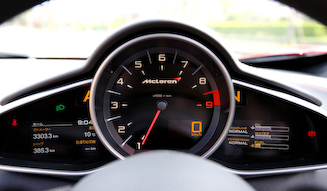
On the other hand, the MP4-12C's steering wheel has no buttons at all. This is a significant difference not only from F1 machines, which have buttons and dials densely packed on their steering wheels, but also from recent luxury cars.
When I asked Design Director Frank Stephenson about this, I received the following response:
"Some supercars adopt interior designs influenced by F1. While that in itself is interesting, one must realize that F1 is F1. The reason F1 cars have buttons lined up on the steering wheel is simply because the cockpit is extremely narrow. Moreover, for F1 drivers, the steering wheel is like their office, so they can operate them freely. However, ordinary drivers absolutely cannot replicate this. Therefore, I decided not to place buttons on the steering wheel."
While the designs of F1 and the MP4-12C differ greatly, the pursuit of truly excellent space efficiency and operability is perfectly maintained in both. This is precisely what should be most proud of as a road car created by an F1 team like McLaren.

McLaren MP4-12C Spider
Body Size | Length 4,509 x Width 1,910 x Height 1,203 mm
Wheelbase | 2,670 mm
Tread Front / Rear | 1,656 / 1,583 mm
Vehicle Weight | 1,376 kg
Engine | 3,799 cc V8 Twin-Turbo
Maximum Output | 625 ps (approx. 460 kW) / 7,500 rpm
Maximum Torque | 600 Nm (approx. 61.2 kgm) / 3,000-7,000 rpm
0-100 km/h Acceleration | 3.3 seconds (3.1 seconds with Corsa tires)
Top Speed | 329 km/h
Transmission | 7-speed Dual Clutch
Tires Front/Rear | Pirelli P Zero 235/35 R19 / Pirelli P Zero 305/30 R20
Fuel Consumption (EU Combined Cycle) | 11.7 ℓ / 100 km
CO2 Emissions | 279 g/km
Price | 30,000,000 yen