Testing the Two-Wheel-Drive Huracán LP580-2 at Suzuka Circuit | Lamborghini
Lamborghini Huracán LP580-2 | The Lamborghini Huracán LP580-2
A supercar with irreplaceable value
Testing the Two-Wheel-Drive Huracán LP580-2 at Suzuka Circuit
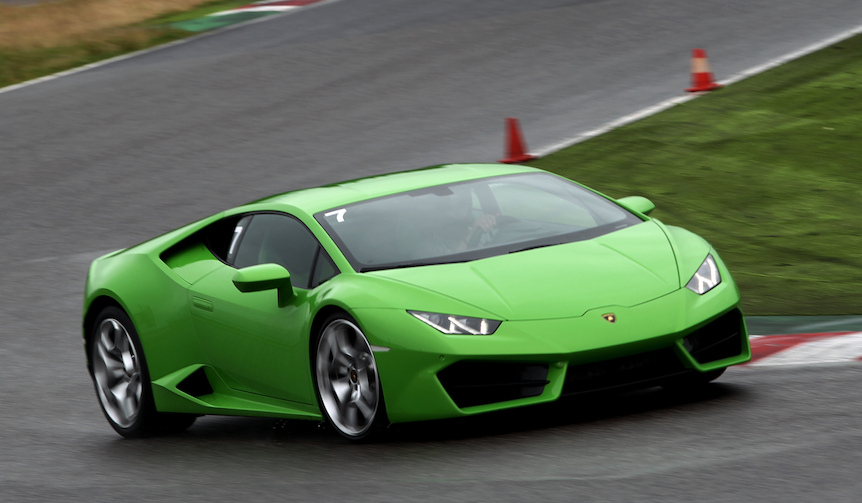
Tatsuya Otani test-drives the rear-wheel-drive LP580-2 model of the Lamborghini Huracán. While the Huracán's main model, the "610-4," is all-wheel-drive, this car is intentionally rear-wheel-drive. What kind of character will it reveal on a wet Suzuka Circuit?
Text by OTANI Tatsuya
RWD is not a cheaper version of 4WD
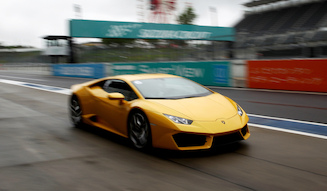
Today, a test drive event for Lamborghini's latest model, the LamborghiniHuracán LP580-2Huracán LP580-2, is being held at Suzuka Circuit. However, it has been raining since last night, and the track is still soaking wet. Even during the first run, which has already concluded, as soon as the rear started to slip on the wet surface, the stability control immediately intervened, meaning the car could only maintain a tail-out attitude for a fleeting moment.
I couldn't enjoy the driving experience of freely controlling the tail-out attitude using the high controllability of rear-wheel drive, which I experienced at the Phillip Island Circuit in Australia. I resentfully gazed at the Suzuka track, which refused to dry.
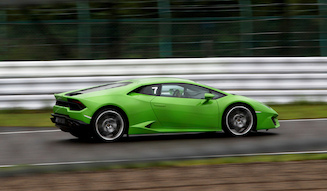
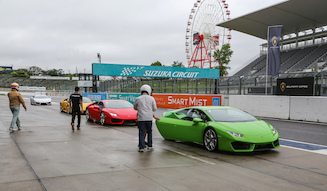
The Huracán LP580-2 is a model derived from the earlier debuted 4WD "Huracán LP610-4" by removing its front-wheel-drive mechanism and reducing the engine power by 30 hp, from 610 hp to 580 hp.Huracán LP610-4
However, the differences between the two are not limited to that. If one were to simply convert the 4WD to rear-wheel drive, the frustration of not being able to effectively transmit nearly 600 hp to the road would only mount, making it impossible to enjoy driving. In other words, without some new innovation to compensate for the 4WD's superior traction performance, the LP580-2 would be nothing more than a cheaper version of the LP610-4.
Lamborghini itself seemed fully aware of this risk. Therefore, they aimed to create an RWD Huracán with appeal equal to, if not greater than, the 4WD version, by creating new driving enjoyment and minimizing the performance decrease associated with the RWD conversion.
So, what specific methods did they employ?
Lamborghini Huracán LP580-2 | The Lamborghini Huracán LP580-2
A supercar with irreplaceable value
Testing the Two-Wheel-Drive Huracán LP580-2 at Suzuka Circuit (2)
The car signals its limits early
First, by softening the suspension springs, they improved the basic road holding and made the car's behavior changes more pronounced and distinct. Furthermore, by softening the rear stabilizer (anti-roll bar), they improved rear-wheel traction, minimizing the disadvantages of the RWD conversion. On the other hand, the concern about reduced spring response due to softer springs was addressed by stiffening the front stabilizer.
As a result, the Huracán LP580-2 has become a supercar where the increased body roll during cornering allows the driver to intuitively understand the current cornering speed. This enables the driver to sense the car approaching its limits well before the tires begin to lose grip.
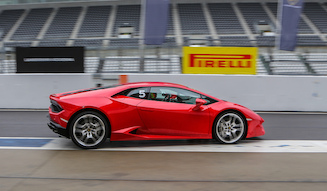
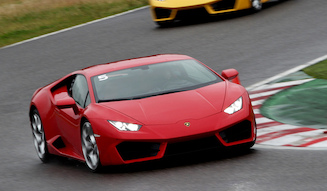
For drivers like myself, whose skills are not exactly top-tier, the most frightening thing is for the car to suddenly exceed its limits and start sliding during a corner. Conversely, if you know in advance that the limit is approaching, you can slow down or prepare to apply counter-steer.
In other words, if the car signals its limits early, even drivers without racing-level skills can drive a supercar like the Huracán at considerable speed.
Furthermore, the Huracán LP580-2 is also appealing to drivers who can freely control drifts. After all, the LP610-4, being all-wheel-drive, cannot easily enter a tail-out attitude, and even if it could, maintaining a large drift angle is difficult. With the rear-wheel-drive LP580-2, thanks to the specially tuned stability control, it's possible to enjoy quite large angles of oversteer.
Lamborghini Huracán LP580-2 | The Lamborghini Huracán LP580-2
A supercar with irreplaceable value
Testing the Two-Wheel-Drive Huracán LP580-2 at Suzuka Circuit (3)
Taming the "Raging Bull"
As the final session arrived, the track finally began to dry. I had also thoroughly learned Suzuka's unique racing lines during the previous runs. My heart pounded with a mixture of excitement and anticipation as I pulled my full-face helmet down deep.
As expected, with the track drying, the cornering speeds increased, and the body roll became deeper than before. Light squealing sounds could be heard in some corners. It seemed that the ultra-wide Pirelli P Zeros were not far from starting to slide.
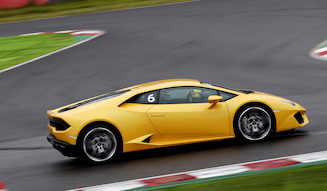
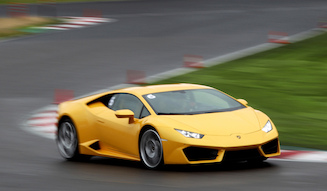
I closed the gap to the instructor in front and then applied more throttle on the exit of a tight corner. The rear tires, which had been holding on by a thread, finally gave way and began to slide outwards. However, this was all within expectations. I used a slight counter-steer to prolong the oversteer attitude, then smoothly regained rear grip and reapplied throttle towards the corner exit.
Indeed, I was thrilled, just as I had been at Phillip Island. Moreover, this time, I was able to tame the "raging bull" at Suzuka Circuit, the stage for the F1 Japanese Grand Prix, a circuit that top drivers from around the world praise as "the world's finest circuit" alongside Spa-Francorchamps. The satisfaction was immeasurably greater.
Lamborghini Huracán LP580-2 | The Lamborghini Huracán LP580-2
A supercar with irreplaceable value
Testing the Two-Wheel-Drive Huracán LP580-2 at Suzuka Circuit (4)
Not a choice for everyone, but—
Although I've written a lot with an air of authority, the stability control was likely still subtly engaged even during the oversteer, so it could be argued that I was merely playing in the Huracán's hands, including the counter-steering. However, the driver certainly didn't feel that way at all.
The driver is always the protagonist. And the deep joy of having controlled the Huracán with one's own hands remains within the heart.
Finally, I should add that when skilled drivers take it to the circuit, the Huracán LP610-4 will undoubtedly achieve faster lap times than the LP580-2. That's how significant the traction performance provided by 4WD is. And the 4WD version, the LP610-4, is also safer on slippery surfaces with higher stability in critical situations.
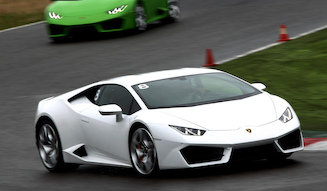
As someone who personally prefers 4WD, I have never had any complaints about the LP610-4. And even after experiencing the LP580-2, my evaluation of the LP610-4 has not diminished at all. However, the exhilarating handling of the LP580-2 left a deep impression on me. So, if I had to choose one now, I would probably opt for the LP580-2.
However, this is not a choice that can be recommended to everyone. Only those who have a strong desire to improve their driving skills and have already gained some experience can truly bring out the full potential of the LP580-2. And for such drivers, the LP580-2 will be a supercar with irreplaceable value.

Lamborghini Huracán LP 580-2 | The Lamborghini Huracán LP 580-2
Body | Length 4,459 × Width 1,924 × Height 1,165 mm
Wheelbase | 2,620 mm
Tread Front/Rear | 1,668 / 1,620 mm
Vehicle Weight | 1,389 kg
Engine | 5,204cc V10
Bore x Stroke | 84.5 × 92.8 mm
Max Output | 427 kW (580 ps) / 8,000 rpm
Max Torque | 540 Nm / 6,500 rpm
Transmission | 7-speed LDF (Lamborghini Doppia Frizione)
Drivetrain | FR
Suspension Front/Rear | Double Wishbone
Tires Front | 245/35R19
Tires Rear | 305/35R19
Brakes Front | Ventilated φ365 × 34 mm
Brakes Rear | Ventilated φ356 × 32 mm
Max Speed | 320 km/h
0-100km/h Acceleration | 3.4 seconds
0-200km/h Acceleration | 10.1 seconds
Fuel Consumption (EC) | 11.9 ℓ/100 km (approx. 8.4 km/ℓ)
CO2 Emissions | 278 g/km
Price (incl. tax) | ¥25,350,840