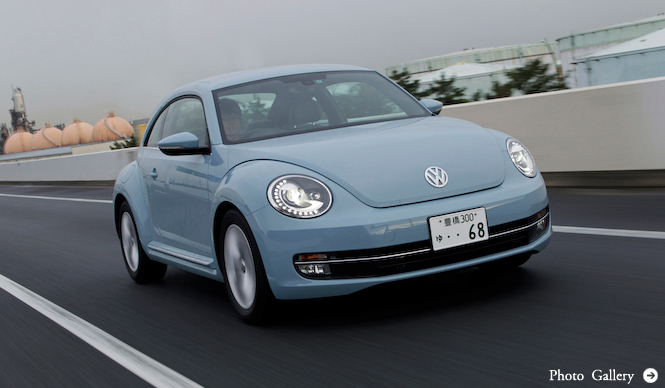
Test Drive the Beetle! | Volkswagen
Volkswagen The Beetle | Volkswagen The Beetle
The Third Generation
Test Drive: Volkswagen The Beetle
The third-generation Beetle, "The Beetle," has finally debuted in Japan, transforming from the New Beetle into a silhouette closer to the original "Type 1." Designer Resmann visited Japan, and from a large-scale test drive event attended by owners of both the original Beetle and the New Beetle, here is Yoshiyuki Aoki's impression of "The Beetle"!
Text by AOKI Yoshiyuki
photographs by MOCHIZUKI Hirohiko
Not a "Fun Car"
The new Volkswagen Beetle, dubbed "The Beetle," is, in essence, a Beetle optimized for a front-wheel-drive platform. The New Beetle—no, the new Beetle, "The Beetle"—was developed to directly address practicality, becoming one of Volkswagen's core models (though not quite reaching the level of the Yokozuna Golf) after evolving from a mere Golf IV-based facade (excuse the rudeness!). Volkswagen, as a Wolfsburg-based automaker, is serious this time, and likely gave the new model the name "The Beetle" to distinguish it from the previous "fun car"-like New Beetle (how confusing!). The "The" signifies its grand entrance.
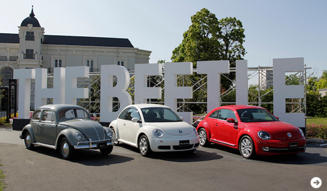
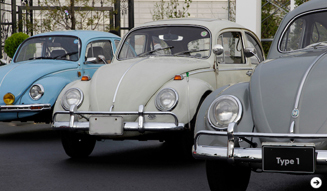
For clarification, the New Beetle, which went on sale in 1998, was the "kabutomushi" (rhinoceros beetle). The following year, Aiko released a song with the same title, but that's unrelated. Tracing the origins of the New Beetle, we arrive at the "people's car" conceived by Adolf Hitler and his favorite engineer,Dr. Ferdinand Porschebut its direct origin is the concept model "Concept 1" unveiled at the 1994 North American International Auto Show.
This creation emerged from a project to revitalize the North American market, a notoriously challenging one for Volkswagen. It was a concept car meticulously crafted by J. Mays, who later rose to Vice President at Ford, and Freeman Thomas, who gained recognition for theAudi TTIt's imagined that this was conceived because the Golf (Rabbit in North America), which enjoyed solid sales globally and was the benchmark for practical cars, was "not quite hitting it off in America," leading to the idea, "We need the dreamlike California Beetle, don't we?" Some might have thought, "I prefer 'Hotel California,'" but that would lead us to Mercedes-Benz's concept models.
Volkswagen The Beetle | Volkswagen The Beetle
The Third Generation
Test Drive: Volkswagen The Beetle (2)
A More Sophisticated Look
The body dimensions of "The Beetle" are 4,270mm (length) x 1,815mm (width) x 1,495mm (height). The 2,353mm wheelbase is 40mm shorter than the Golf VI it's based on, but the vehicle dimensions are slightly larger. At 1,280kg, its catalog weight is only 10kg heavier than the "Golf TSI Trendline Premium Edition" with the same powertrain: a 1.2-liter inline-4 turbo and a 7-speed DSG automatic transmission.
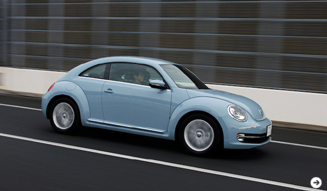
While both the length and width exceed those of the previous New Beetle, the height is slightly lower. Consequently, with the extended front and rear, the overall impression is significantly more streamlined. Cars that gained popularity for being "funny," "cute," or "odd" often transition to a more sophisticated image with a model change, and the Beetle is no exception.
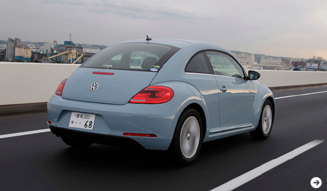
The base of the A-pillar, where the windshield begins, is set further back than before, while the rear hatch bulges backward. The expansive dashboard space, which felt peculiar every time I sat in the New Beetle's driver's seat, has been resolved, with the area in "The Beetle" now occupying a conventional size. Furthermore, the New Beetle's rear cargo space was unreasonably small because its body was mounted on a front-wheel-drive chassis, mimicking a rear-engine, rear-drive car. However, with this model change, the cargo capacity has increased by a remarkable 45 percent, from 214 liters to 310 liters.
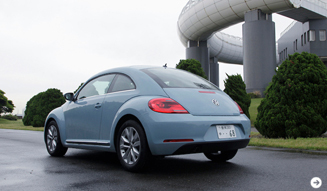
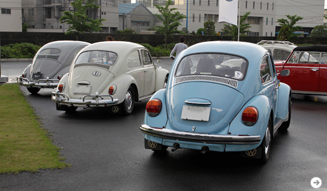
In "The Beetle," the visual center of gravity for the entire car has shifted backward. Viewed from the rear three-quarter angle, it appears slightly hunched, a result of fitting the "Beetle" form onto a typical front-wheel-drive hatchback platform. It might be an ironic design outcome that the roofline of this new model, incorporating the practicality of a front-wheel-drive car, has become closer to the Type 1, the original Beetle, rather than the previous New Beetle. However, because the fundamental design structure is different, while the Type 1's rear could accommodate a Porsche 911, you won't see a 911 in the rear view of "The Beetle."
Volkswagen The Beetle | Volkswagen The Beetle
The Third Generation
Test Drive: Volkswagen The Beetle (3)
Getting into the Leather Package
The Beetle began accepting orders in Japan on April 20, 2012. The grades are "Design" and "Design Leather Package." The former is priced at 2.5 million yen, and the latter, with leather seats, is 3.03 million yen.
Both models are equipped with a 1.2-liter turbo engine (77kW (105ps), 175Nm) paired with a 7-speed DSG. However, the luxurious Leather Package features bi-xenon headlights, paddle shifters, and 17-inch wheels (215 width, same as standard) that are one inch larger. The option to select a sliding sunroof is also a privilege exclusive to the Leather Package.
The car assigned for the press test drive was a Leather Package model, for which orders had already begun ahead of the base grade. It was painted in "Denim Blue," a color that might remind older Beetle enthusiasts of the word "Sax," and upon opening the door, the same color was repeated on the interior panels.
This design treatment has become a staple since the early 1990s, when Chris Bangle, a designer at Centro Stile, experimented with it on the "Coupé Fiat," riding the wave of popularity for retrospective cars.
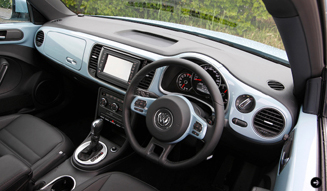
The sport-type leather seats, with their noticeable side bolsters, offer a firm ride characteristic of Volkswagen. They feature adjustable lumbar support and seat heaters. When I started the engine and prepared to drive, extending my right foot, I noticed something surprising! The throttle pedal was the floor-hinged type! I never expected to see a trace of the Porsche 911 in such a detail...
Volkswagen The Beetle | Volkswagen The Beetle
The Third Generation
Test Drive: Volkswagen The Beetle (4)
A Surprisingly Nimble and Powerful Swimmer
The engine in "The Beetle" is Volkswagen's pride and joy, the TSI unit. This power plant features a small-displacement 4-cylinder engine with direct injection, maximizing the efficiency of the turbocharger through precise fuel injection. Paired with the low-loss twin-clutch gearbox "DSG," it boasts a catalog fuel economy of 17.6 km/L (JC08 mode). In Japan, it qualifies for eco-car subsidies (100,000 yen) and tax reductions (50%).
Considering the car's size, the 1.2-liter displacement might seem modest, but as soon as you press the organ-type throttle pedal and start moving, you feel no dissatisfaction from the very first rotation of the tires. In fact, it feels powerful. The Beetle's 4-cylinder engine, leveraging its turbocharged characteristics, produces its maximum torque of 175Nm from just 1,500rpm. It's essentially like a low-revving 1.8-liter engine, so it's natural that there's no lack of responsiveness. However, even with the throttle pedal fully depressed, the initial acceleration isn't as robust as one might expect. While it accelerates briskly up to 60 km/h, it struggles to gain further speed, likely due to the limitations of its modest displacement.
The ride quality is somewhat firm. On rough city streets, the suspension with 17-inch wheels can feel a bit bouncy, but once on well-paved highways, its German stability shines through. The turbo engine's strong torque delivery even at half throttle means this streamlined Beetle can, if you push it, move like a water strider. Personally, I found the brake feel to be a bit lacking in initial bite; naturally, it stops effectively when you press the pedal. However, the braking force increases in a non-linear fashion, so immediately after pressing the pedal, there's a brief moment of feeling like it's coasting, which is startling! ...It's unnerving.
Improved Practicality
As a front-wheel-drive car based on the Golf, the new Beetle has a more logical structure. While the legroom in the rear seats isn't impressively spacious, offering only about 6cm more than before, and the headroom isn't remarkable, it's still an improvement. Compared to the old New Beetle, where the rear passengers' heads were close to the rear glass, on a hot summer day, one might appreciate the extended roofline behind their head.
Compared to the previous New Beetle, which featured three semicircles as a design motif, the new "The Beetle" may have lost some of its design purity. Conversely, this means that even for a retro model where appearance is paramount, the time for using design as an excuse has passed. In terms of practicality, this 21st-century beetle has come a little closer to the great original Beetle. To those who have become owners, or those who will soon become owners, I urge you to open the rear hatch of your car and exclaim, "My engine has been stolen!"

Volkswagen the beetle design leather package |
Volkswagen The Beetle Design Leather Package
Engine | 1.2-liter inline 4-cylinder SOHC intercooled turbo
Maximum Output | 77kW (105ps) / 5,000rpm
Maximum Torque | 175Nm (17.8kgm) / 1,500-4,100rpm
Transmission | 7-speed DSG
Vehicle Dimensions | Length 4,270 x Width 1,815 x Height 1,495 mm
Wheelbase | 2,535mm
Tread | 1,580mm (Front) / 1,545mm (Rear)
Minimum Ground Clearance | 130mm
Vehicle Weight | 1,280kg
Fuel Economy | 17.6km/ℓ (JC08 mode)
CO2 Emissions | 132g/km (JC08 mode fuel economy equivalent)
Base Price | 3.03 million yen
Click here for Fumio Ogawa's overseas test drive review of the "The Beetle 2.0 TSI"