December 16, 2014
Test drive the Chevrolet Bolt in Detroit
Chevrolet VOLT | Chevrolet Bolt
A Formidable Rival to the Prius & Leaf
Test Drive: Chevrolet Bolt in Detroit
The Chevrolet Bolt is an EV that also features a 1.4-liter engine for power generation. Classified by GM as an E-REV (Extended-Range Electric Vehicle), automotive journalist Yasuhisa Shimashita takes it for a spin, examining its advantages and disadvantages against rivals like the Toyota Prius and Nissan Leaf.
Text by YASUHISA SHIMASHITA
Is it Truly an EV, or a Hybrid?
Launched at the end of 2010 in select regions like California, the Bolt has expanded its sales area over the past year. Deliveries have finally begun in China this year, but Japan's introduction, initially announced for sometime after 2012, remains unconfirmed.
Since its debut, a debate has raged over whether the Bolt is an EV or a hybrid. However, for users, the crucial questions are likely: How does it compare to the Toyota Prius or Prius PHV, and the Nissan Leaf? Is it fuel-efficient? Does it drive well?
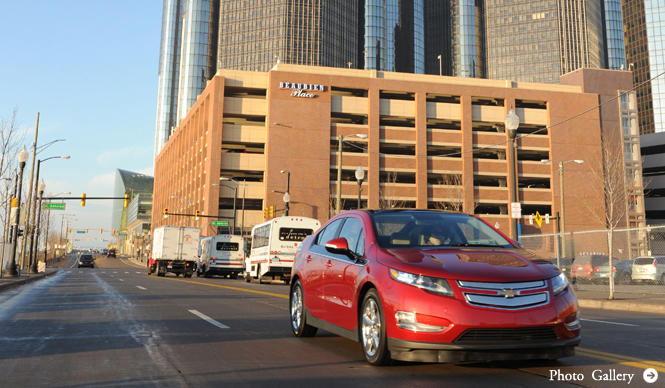
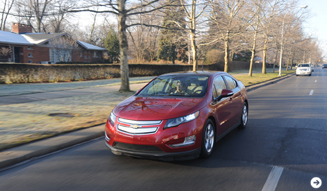
As the Bolt has already garnered significant media attention, its appearance needs little introduction. Its dimensions of 4,404mm (L) x 1,798mm (W) x 1,430mm (H) and its 5-door hatchback configuration bear some resemblance to the Prius. However, its assertive front fascia and sharply cut-off rear end give it a more robust and edgy styling, with details that lend it a somewhat futuristic and appealing aura.
Superior Quality in Appearance and Feel to the Prius
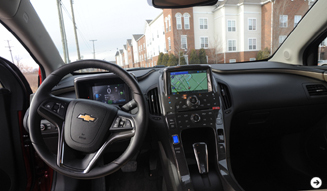
The interior design is also elaborate, but the controls, including the interestingly shaped shift lever, are surprisingly conventional and easy to operate. The quality of its appearance and tactile feel surpasses that of the Prius. Large displays within the instrument cluster and on the center console show various information such as driving range, battery level, and current driving mode. While stylish, they are somewhat cluttered and can be difficult to read at a glance.
Interior space is about as expected. With a height of 1,430mm, lower than the Prius, rear-seat headroom could be a bit more generous. However, including the luggage space, it's adequate for its size. The most challenging aspect of EV interior design is battery placement, but the Bolt's 16kWh high-capacity battery, utilizing LG Chem cells in a unique T-shaped casing, is compactly integrated entirely within the floor tunnel and beneath the rear seats. Consequently, it doesn't encroach on interior space at all.
A 16kWh battery capacity is comparable to that of the Mitsubishi i-MiEV. However, given the Bolt's larger size, its pure EV driving range is limited to 64km. Beyond that, specifically when the charge drops below 30 percent, a 1.4-liter engine starts up to generate electricity while driving. This is why GM calls the Bolt an E-REV (Extended-Range Electric Vehicle).
Chevrolet VOLT | Chevrolet Bolt
A Formidable Rival to the Prius & Leaf
Test Drive: Chevrolet Bolt in Detroit (2)
Quiet and Powerful EV Mode
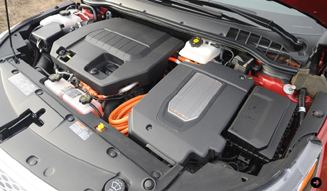
The "VOLTEC" powertrain connects two motors and the engine via a planetary gear system, switching between their operating modes as needed. When the battery has sufficient charge, a single drive motor powers the vehicle at low speeds. At higher speeds, a second motor, used for power generation and auxiliary drive, acts as a booster, with both motors propelling the car.
The driving feel in this mode is purely electric: quiet and very powerful. However, the initial acceleration isn't as sharp as in the Nissan Leaf. While you can switch between Normal, Sport, and Mountain modes with a switch, even Sport mode doesn't quite pin you to the seat. Nevertheless, its 0-400m acceleration is claimed to be under 17 seconds, likely due to its flatter power delivery.
After driving up to 64km on a full charge, the generator engine starts when the battery level decreases, supplying electricity to the drive motor and battery. For comparison, the Prius PHV has a smaller 5.2kWh battery, offering a maximum EV range of only 23.4km. Furthermore, while the Bolt can achieve its top speed of 160km/h in EV mode, the Prius's engine activates regardless of battery level once speeds exceed 100km/h.

A Highly Refined Powertrain
Regardless, the concern in this mode is how much of the EV mode's power is maintained. The main motor outputs 111kW, while the 1.4-liter generator engine and auxiliary drive motor together produce less than half that, at 50kW. However, at least in city driving, situations requiring more than 50kW rarely arise, and the acceleration felt no different from EV mode.
Interestingly, even when the displayed EV range is 0km, the remaining battery power is still utilized to supplement the output at startup, ensuring the initial acceleration feels the same as in EV mode. This is a design choice to maintain a consistent driving feel across modes. As speed increases, the engine directly assists via the auxiliary drive motor.
Another notable point is the near absence of the typical whirring electric noise heard in vehicles like the Prius. While the engine sound is present when it starts, and not particularly luxurious, the vibrations during startup and shutdown are well-suppressed, making it unobtrusive. Overall, the powertrain is remarkably refined.
Chevrolet VOLT | Chevrolet Bolt
A Formidable Rival to the Prius & Leaf
Test Drive: Chevrolet Bolt in Detroit (3)
An Exceptionally Well-Rounded Automobile
The ride quality is also commendable. Unlike the Prius, which can feel somewhat cheaply built, the Bolt's chassis exhibits solid rigidity, and the steering feel is very natural. The suspension absorbs road imperfections smoothly without feeling overly stiff. Before even considering the powertrain, it stands out as an exceptionally well-rounded and enjoyable car to drive.
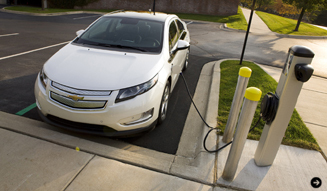
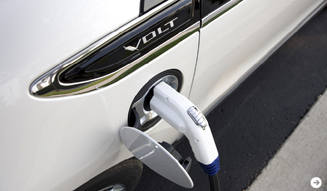
The Bolt's most significant appeal is undoubtedly its ability to operate as a pure EV for up to approximately 64km on a full charge. In Japan, as in America, many people could likely cover their daily commutes and local errands entirely within this range. Charging takes 10 to 12 hours on a 120V outlet, which should be sufficient overnight before the next day's use. It does not support rapid charging.
Furthermore, when embarking on longer journeys, there's no need to worry about the availability of charging stations. This is a distinct advantage over pure EVs like the Leaf and is one reason why rapid charging isn't included.
We Hope for an Early Arrival
However, if you frequently drive beyond the EV mode's range, the Prius PHV, with its efficient control of the engine and motor, might offer better overall fuel economy. The Bolt, with its large battery, is also naturally more expensive. For reference, in North America, the Bolt is priced at $41,000, the Leaf at $33,000, and the Prius PHV at $32,000. The price difference is not insignificant. Ultimately, the choice of vehicle will depend on individual usage patterns, not just the price.
In conclusion, the Bolt has been refined into a vehicle that makes one eager to test it thoroughly in Japan. While we may have to wait a while longer, we hope for its swift introduction.