Testing the Lamborghini Aventador with the "SV" Designation in Spain: Part Two | Lamborghini
Lamborghini Aventador LP 750-4 SV (Superveloce)
Lamborghini Aventador LP 750-4 SV (Superveloce)
Testing the Aventador with the "SV" Designation in Spain: Part Two
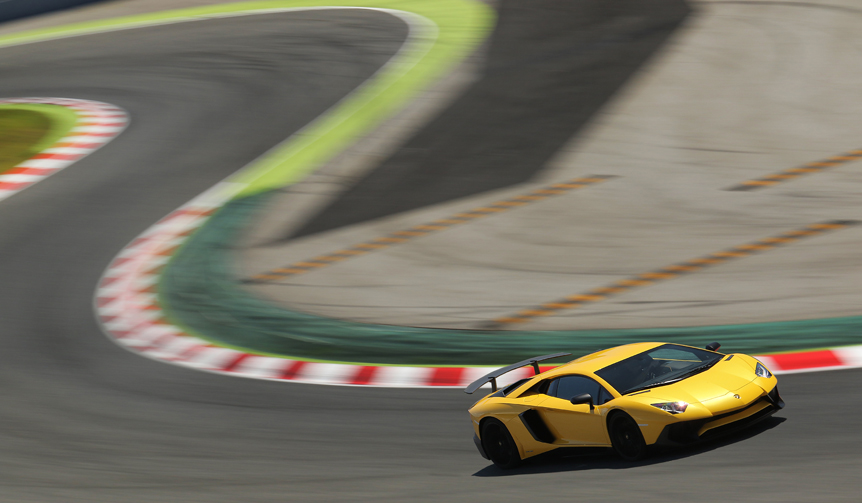
The traditional Lamborghini designation, meaning "Super Speed," has finally been bestowed upon the Aventador. Tatsuya Otani tests the 750ps output from its 6.5-liter naturally aspirated V12 engine at the Circuit de Catalunya, a venue for the F1 Spanish Grand Prix. What is the performance of this state-of-the-art fighting bull?
Text by OTANI Tatsuya
A Completely Different Beast from the Standard Aventador
Now, after a long wait, I will report on the impressions of the SV gained through circuit driving.
Lamborghini's circuit test drives follow a "duckling formation" style, where media personnel chase a lead car driven by an instructor. A transceiver connects the lead car and the test cars, providing continuous advice on driving and safety precautions.
However, a drawback of duckling formation is that if a less skilled driver is among the media personnel (usually 3-4 cars running simultaneously), the overall pace can drop, preventing us from testing the limits of the cars. In some cases, instructors may also drive too slowly based on their own preferences.
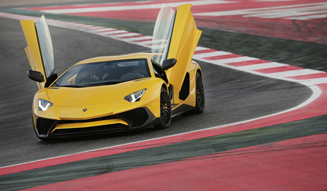
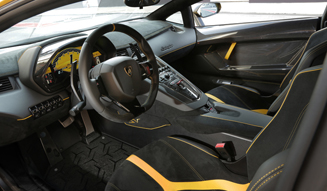
Fortunately, I was incredibly lucky this time: the media personnel in my group had exceptional skills, and the instructor trusted us and pushed us hard. As a result, I had to counter-steer the SV by the second corner after exiting the pit lane.
This might make it sound like the SV has poor cornering performance, but that's absolutely not the case. The primary reasons were my own inability to grasp the track layout and find the proper line, and my failure to fully understand the SV's characteristics.
The proof of this is that the instructor was driving a standard Aventador, and even with two people on board, their cornering form was perfectly stable. The reason I was forced to counter-steer was simply that my clumsy and inefficient driving caused the tires to lose grip at a much lower speed than the car's actual limit.
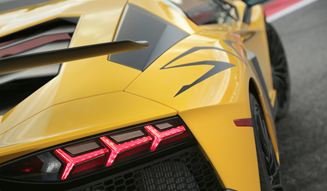
Nevertheless, what's astonishing is how this SV feels remarkably agile, completely unlike the standard Aventador. The steering effort is indeed light, but the way the nose instantly changes direction after turning the wheel is one reason it feels as if the body has lost about 200kg.
However, the actual weight difference is only 50kg, as mentioned earlier. This is likely due to the significant revisions in suspension settings accompanying the adoption of LDS (Lamborghini Dynamic Steering) and MRS (Magneto-rheological Suspension).
Subjectively, the springs felt about 20 percent stiffer, but because the dampers flexibly adjust the damping force according to the situation, there was no jarring stiffness in the suspension. It was also impressive how effectively the suspension travel seemed to be utilized.
Lamborghini Aventador LP 750-4 SV (Superveloce)
Lamborghini Aventador LP 750-4 SV (Superveloce)
Testing the Aventador with the "SV" Designation in Spain: Part Two (2)
Flooring the Throttle Pedal
The Circuit de Catalunya, which I was driving for the first time, features many medium-to-high-speed corners with wide turns, as evidenced by its past popularity among F1 teams for aerodynamic development. This is ideal for assessing cornering performance, but it's also a track where a single mistake can lead to a major accident. Our instructor drove at a brisk pace on such a circuit, and I desperately tried to keep up.
Fortunately, despite the steering being a variable control system and likely having higher gear ratios overall, it felt natural and responded very smoothly. The information transmitted through the steering was also remarkably rich, defying its purely electric power assistance. This allowed me to push close to the limit of front grip before it gave way, making it relatively easy to attack the turn-in right up to the point of understeer.
Therefore, as long as the entry speed is judged correctly and steering inputs are handled delicately, one can reliably complete the turn-in and approach the clipping point with a stable posture. At this point, by carefully operating the throttle pedal, subtle understeer or oversteer can be controlled, allowing for fine adjustments to the line.
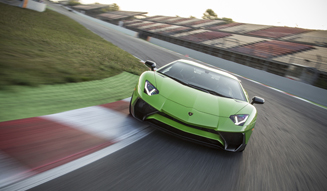
However, this is clearly an inefficient approach; relying on such corrective maneuvers will only cause you to fall further behind the instructor. It's far faster to execute a precise turn-in perfectly on the first try.
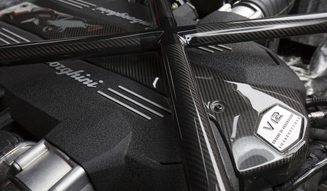
Once you clear the apex, all that's left is to floor the throttle pedal. The 4WD system with its Haldex coupling and sophisticated ESP control then transfer the 750ps of power to the road without any loss. It's completely foolproof.
This doesn't mean the driver has no room for control. As mentioned, the throttle can be used to make minor adjustments to the driving line when maximum lateral G is applied. And when approaching a low-speed chicane, by braking firmly and turning the steering wheel slightly, the rear naturally swings out, allowing entry with neutral steering. Not only does the 4WD and ESP provide stability, but you can also enjoy the thrill of maneuvering the car.
Lamborghini Aventador LP 750-4 SV (Superveloce)
Lamborghini Aventador LP 750-4 SV (Superveloce)
Testing the Aventador with the "SV" Designation in Spain: Part Two (3)
Incredibly Fast
By the time I began to grasp the SV's limits, I had a general understanding of the track layout, and my pace naturally increased. We were scheduled to run four laps in four sets that day, and by the end of the second set, our team was driving quite fast.
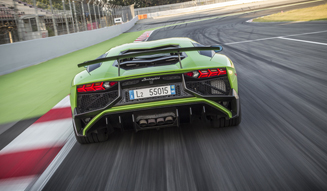
In fact, there were a total of four teams running on the track simultaneously, including ours, and it became quite common to overtake two teams within a single lap. Conversely, we were never overtaken. It seemed our team was overwhelmingly faster.
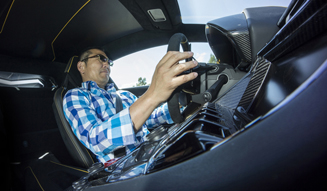
The instructor seemed to sense this as well. After each set, he would praise us over the transceiver, saying things like, "You are true professionals. Wonderful!" and we even exchanged firm handshakes when getting out of the cars. Experiencing such a connection with an instructor during a test drive is a rare occurrence.
Furthermore, before the third set began, the three drivers on our team were summoned, and we were instructed, "Listen up, our pace is already extremely fast. Maintain your concentration and strive for precise driving!" By this point, I had a good grasp of the racing line, my driving accuracy had improved, and I was able to drive with almost no unnecessary corrections.
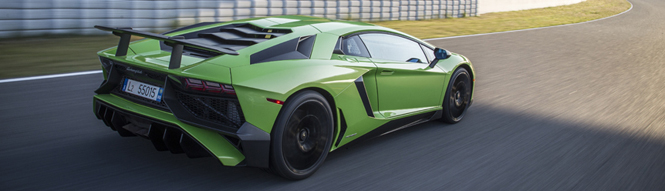
Then came the final, fourth set. Following closely behind the standard Aventador driven by the instructor, I witnessed an astonishing sight. The instructor, who had been leading us by sliding the standard Aventador to maintain the gap, was now sliding the car himself to stay ahead of us, who had been desperately chasing with tail slides.
In other words, our pace had increased to the point where the instructor had to drive the standard Aventador at its absolute limit.
Lamborghini Aventador LP 750-4 SV (Superveloce)
Lamborghini Aventador LP 750-4 SV (Superveloce)
Testing the Aventador with the "SV" Designation in Spain: Part Two (4)
Approaching the SV's Limits
I often write authoritatively about "tail slides" and "oversteer" in my articles, but driving a car without inducing such behavior at the same pace is a higher measure of a driver's skill. Therefore, I had never seen instructors, who are far more skilled than I, driving cars with slides before.
Even if it was at my limit, they were completely at ease. This means that even when the car is sliding, it's usually because the driver is at their limit, while the car itself still has more to give.
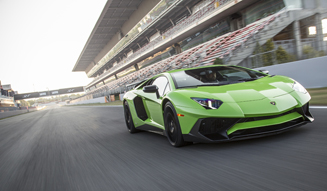
However, this time, the Aventador driven by the instructor had exceeded its limits. When I pointed this out, the instructor jokingly excused himself, saying, "Well, the tires were just worn out." But the tires on the SV we were driving must have been similarly worn.
In that regard, we were driving the SV in a realm beyond the limits of the standard Aventador. And this indicates that even I, with skills comparable to a junior high school student from a racing driver's perspective, was able to approach the SV's limits.
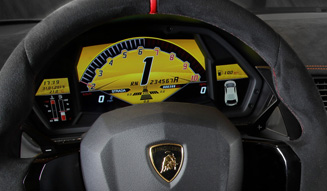
This, above all, speaks to the SV's abundant information feedback, high controllability, and excellent stability. Furthermore, it even offers a thrilling sensory experience. And all this comes with a monstrous performance of 0-100 km/h in 2.8 seconds and a top speed exceeding 350 km/h.
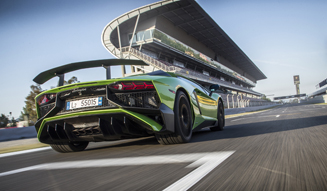
Like the Ferrari 458 Speciale I test-drove recently, I feel there's an increasing number of super sports cars that are not only sensual and fast but also allow drivers with less advanced skills to approach their performance limits relatively safely and with confidence.
While the Huracán showed this tendency, I believe the Aventador SV has further solidified this direction.
A supercar that is merely high-performance but cannot be fully utilized is a wasted treasure. Driving the Aventador SV in Barcelona reaffirmed this era.

Lamborghini Aventador LP750-4 Superveloce
Lamborghini Aventador LP750-4 Superveloce
Body Dimensions | Length 4,835 x Width 2,030 x Height 1,136 mm
Wheelbase | 2,700 mm
Tread Front/Rear | 1,720 / 1,700 mm
Minimum Turning Radius | 6.25 meters
Weight | 1,525 kg
Weight Distribution Front:Rear | 43 : 57
Engine | 6,498 cc 60° V12 DOHC 48-valve
Compression Ratio | 11.8±0.2 : 1
Bore x Stroke | 95 x 76.4 mm
Maximum Output | 552 kW (750 ps) / 8,400 rpm
Maximum Torque | 690 Nm / 5,500 rpm
Maximum Engine Speed | 8,500 rpm
Transmission | 7-speed ISR (Single-clutch semi-automatic)
Drivetrain | 4WD
Front Suspension | Horizontal magneto-rheological dampers with pushrod system
Rear Suspension | Horizontal magneto-rheological dampers with pushrod system
Front Brakes | φ400 x 38 mm ventilated discs
Rear Brakes | φ380 x 38 mm ventilated discs
Tires Front/Rear | 255/35ZR20 / 355/25R21
Top Speed | Over 350 km/h
0-100 km/h Acceleration | 2.8 seconds
0-200 km/h Acceleration | 8.6 seconds
0-300 km/h Acceleration | 24.0 seconds
100-0 km/h Deceleration | 30 meters
Fuel Consumption (NEDC Value) | 16.0 L/100km (approx. 6.25 km/L)
CO2 Emissions | 370 g/km
Fuel Tank Capacity | 90 liters