Testing the Lamborghini Aventador with the 'SV' Designation in Spain: Part 1 | Lamborghini
Lamborghini Aventador LP 750-4 SV (Superveloce)
Lamborghini Aventador LP 750-4 SV (Superveloce)
Testing the Aventador with the "SV" Title in Spain: Part 1
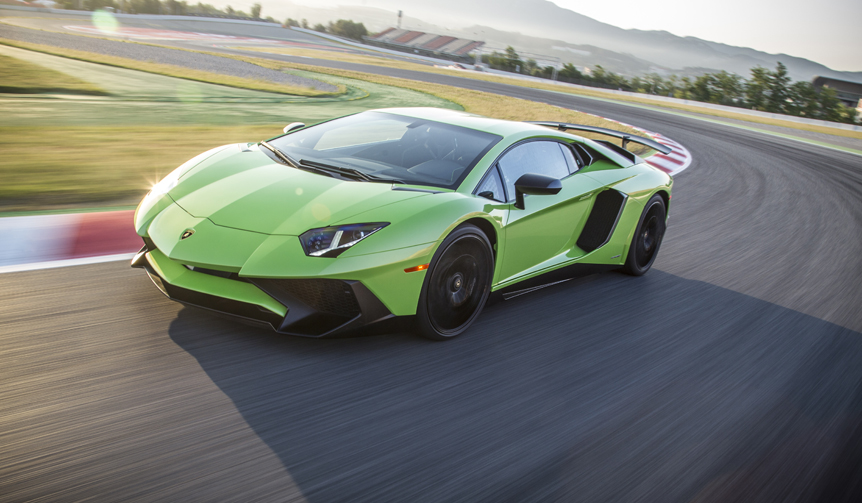
The special Lamborghini "Aventador LP 750-4 SV," boasting supercar performance with 0-100 km/h acceleration in 2.8 seconds and a top speed exceeding 350 km/h, was tested at the Circuit de Catalunya, the venue for the F1 Spanish Grand Prix. How will this cutting-edge bull, bearing the traditional "SV (Superveloce)" title meaning "super speed," perform? Tatsuya Otani reports.
Text by OTANI Tatsuya
The Traditional Superveloce
On the evening of our arrival in Barcelona, while enjoying pre-dinner cocktails on the veranda of a hotel adjacent to the beach, Lamborghini President Stephan Winkelmann and Head of Technology Maurizio Reggiani passed by and spoke to us media representatives.
I had met them numerous times before at the "Huracán LP610-4" test drive event last year and at various auto shows, but I had never seen them in such high spirits and full of confidence. So, I conveyed my feelings to President Winkelmann, and this was his reply.
"We've received many compliments from those who have test-driven the Aventador SV, saying it's the best Lamborghini ever. We believe that once you drive it tomorrow, you'll understand why we're smiling."


At that moment, my interest in the "Aventador LP750-4 Superveloce (SV)," which had brought such bright smiles to the faces of the two men responsible for a string of hits like the "Aventador LP700-4" and "Huracán LP610-4," grew rapidly.
For Lamborghini fans, the two letters SV must hold a special meaning. Starting with the "Miura SV" in the past, followed by the "Diablo SV" and "Murciélago SV," there have been three SV models so far. Considering Lamborghini's history spans over 50 years, you can appreciate how rare these SV models are.
Veloce is Italian for speed. Therefore, Superveloce means super speed. However, to add the SV designation to an already fast Lamborghini, there must be a compelling reason.
Lamborghini Aventador LP 750-4 SV (Superveloce)
Lamborghini Aventador LP 750-4 SV (Superveloce)
Testing the Aventador with the "SV" Title in Spain: Part 1 (2)
The Merits of a Naturally Aspirated Engine
So, what special tuning has been applied to the Aventador LP750-4 SV?
Its heart, the 6.5-liter V12 naturally aspirated engine, has had its maximum power output RPM increased by 150 rpm from the "standard" Aventador to 8,400 rpm, successfully achieving an additional 50 ps, for a total of 750 ps.
Even typing "750 ps" on this keyboard doesn't convey its weight, but this is an almost unrealistic figure for a road car, power that rivals or even surpasses that of many racing cars. While the difference between 700 ps and 750 ps might not seem significant, looking at the power curve, power increases linearly up to the 6,500 rpm range, suggesting a dramatically enhanced sensation in this region.

Another point that struck me as interesting during the pre-drive presentation was the difference in torque characteristics between turbocharged and naturally aspirated engines. Generally, turbocharged engines are thought to "produce thick torque from low speeds" due to their lower peak torque RPM. However, according to their simulations, while the torque of a turbocharged engine drops sharply below 3,500 rpm, a naturally aspirated engine experiences a gentler decline. For instance, below 2,500 rpm, a naturally aspirated engine generates stronger torque.
Indeed, we know from experience that a naturally aspirated engine responds more immediately to throttle input in the lower rev range than even the most responsive turbocharged engine. Seeing the torque curves they presented felt like our own empirical knowledge was validated by objective data.
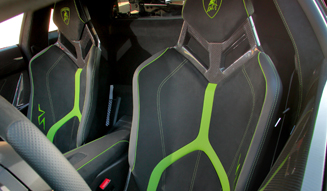
The vehicle weight has been reduced by 50 kg, but this is also a minor difference compared to the SV's curb weight of 1,525 kg. While the press release states this was achieved through extensive use of carbon composites and omission of sound-deadening materials, the majority of the 50 kg reduction was likely due to the switch from electric seats to manual bucket seats.
However, these seats visually appear very lightweight, and their support and comfort are superb. For this type of model, creating a sense of lightness is surprisingly important. The SV's use of red leather ribbons to pull down the dihedral doors when open is also an effective touch to inspire the driver.
Lamborghini Aventador LP 750-4 SV (Superveloce)
Lamborghini Aventador LP 750-4 SV (Superveloce)
Testing the Aventador with the "SV" Title in Spain: Part 1 (3)
Aventador SV Aerodynamics
The test drive venue was the Circuit de Catalunya, also the stage for the F1 Spanish Grand Prix. While waiting for the test cars in the garage, the Aventador SV slid into the pit lane. Just by looking at its body sides, I could tell that the SV had a completely different styling from the standard model.
The most significant reason for this is the blacked-out side sills, which further emphasize the Aventador's wedge shape. This is remarkably effective, making the Aventador, which previously had a somewhat heavy image, appear like a compact and extremely lightweight racing car.
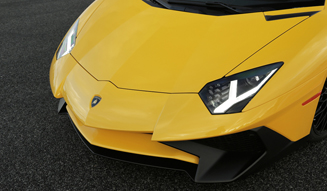
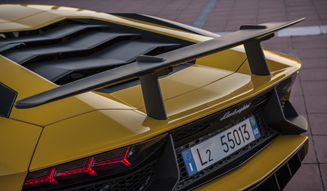
Other notable exterior features include the two-tiered front section that looks like stacked wings, the rear wing mounted high on stays extending from the tail end, and the massive rear diffuser with a total of six slits. Needless to say, these are devices added to generate greater downforce.
The SV boasts 170% more downforce and 150% improved aerodynamic efficiency compared to the standard Aventador. Aerodynamic efficiency is the ratio of downforce to drag, essentially indicating how effectively downforce is generated. Even with immense downforce allowing for high-speed cornering, if the drag also increases, top speed will decrease and fuel economy will worsen.
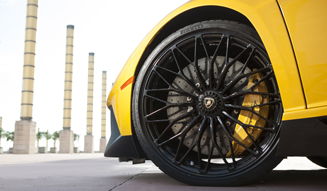
Therefore, generating downforce efficiently is crucial. The SV improves its fundamental aerodynamic characteristics by adding panels to streamline airflow beneath the car. Combined with the aforementioned devices, this creates an aerodynamic package that delivers high downforce with low drag.
While it would be endless to explain all these technical features, there are two more new features I'd like to introduce before discussing the impression from the track test.
One is the Magneto-Rheological Suspension (MRS), which encloses magnetic particles in the damper's hydraulic circuit to instantaneously and continuously vary the damping force. This is effective in balancing high cornering performance with ride comfort and is already used in the Huracán. The difference here is that the Aventador combines it with a pushrod suspension, which is effective for smooth operation and reducing unsprung weight.
The other is the adoption of Lamborghini Dynamic Steering (LDS), which provides variable steering gear ratios. While also introduced in the Huracán, it comes as standard equipment on the SV and has undergone specific tuning.
Part 2: Finally, onto the track with the Aventador SV

Lamborghini Aventador LP750-4 Superveloce
Lamborghini Aventador LP750-4 Superveloce
Body Dimensions | Length 4,835 x Width 2,030 x Height 1,136 mm
Wheelbase | 2,700 mm
Tread Front/Rear | 1,720 / 1,700 mm
Minimum Turning Radius | 6.25 meters
Weight | 1,525 kg
Weight Distribution Front:Rear | 43 : 57
Engine | 6,498 cc 60° V12 DOHC 48-valve
Compression Ratio | 11.8±0.2 : 1
Bore x Stroke | 95 x 76.4 mm
Maximum Output | 552 kW (750 ps) / 8,400 rpm
Maximum Torque | 690 Nm / 5,500 rpm
Maximum Engine Speed | 8,500 rpm
Transmission | 7-speed ISR (Single-clutch semi-automatic)
Drivetrain | 4WD
Front Suspension | Horizontal magneto-rheological damper with pushrod system
Rear Suspension | Horizontal magneto-rheological damper with pushrod system
Front Brakes | φ400×38mm Ventilated discs
Rear Brakes | φ380×38mm Ventilated discs
Tires Front/Rear | 255/35ZR20 / 355/25R21
Top Speed | Over 350 km/h
0-100 km/h Acceleration | 2.8 seconds
0-200 km/h Acceleration | 8.6 seconds
0-300 km/h Acceleration | 24.0 seconds
100-0 km/h Braking | 30 meters
Fuel Economy (NEDC) | 16.0 ℓ/100km (approx. 6.25 km/ℓ)
CO2 Emissions | 370 g/km
Fuel Tank Capacity | 90 liters