March 6, 2015
FIAT 500 Twin Air | The Fiat 500 Twin Air: What About Its Real-World Fuel Economy?
FIAT 500 Twin Air
How About the Real-World Fuel Economy of the New Engine? (1)
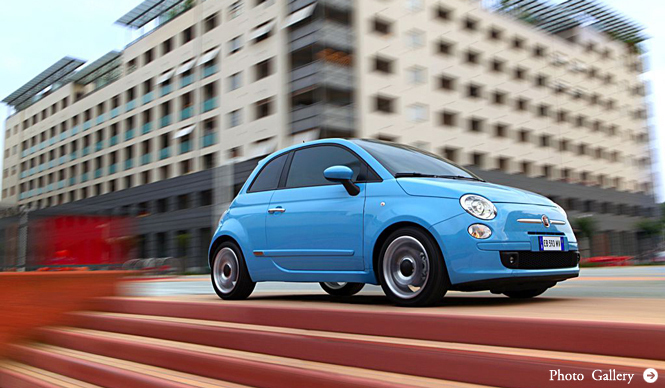
We took the Fiat 500's new variation, the TwinAir equipped with an 875cc 2-cylinder turbo engine, on a day trip from Tokyo to Nagoya.
By Dai Matsuo
The 2-Cylinder Engine Makes a Comeback!
The 500, which has received 52 awards worldwide and sold 500,000 units in 31 months, now carries the Fiat brand on its shoulders. The new "TwinAir" model, equipped with an 875cc 2-cylinder turbo engine, has been released in Japan. The TwinAir engine in this new model was also adopted by the Alfa Romeo MiTO last year and features the world's most advanced engine control technology, "MultiAir."
Following the recent major earthquake, the automotive industry suffered a significant blow, and users of automobiles also faced serious difficulties. With fuel shortages and soaring prices, fuel efficiency has once again come under the spotlight. We decided to borrow the Fiat 500 TwinAir, which has just arrived in the Japanese market, to see what kind of car it is, and to assess its environmental and performance capabilities.
Upon arriving at the Fiat Group Automobiles Japan garage, not far from the Kōnan exit in Shinagawa, we soon heard a sound approaching, a "patapata patapata" reminiscent of the Suzuki Cervo we often heard as children. That was a 3-cylinder, but this 500 TwinAir has an even smaller 2-cylinder engine. Once inside the car, the interior layout is unchanged from the usual 500, but the engine sound is distinctly different. While not expected for a car in this class, it is certainly not a luxurious sound.
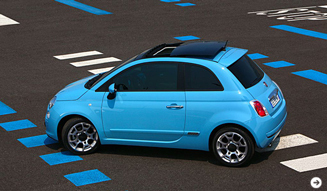
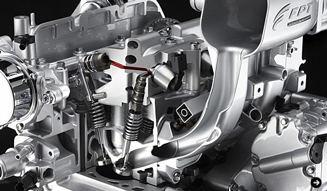
When starting off, it accelerates surprisingly smoothly. Although it's 875cc, it's turbocharged, so with a turbo factor of 1.4, it equates to 1,225cc. This is more than adequate for a body weighing nearly a ton. In city driving, where you don't rev the engine, the economy mode might be sufficient. In this mode, maximum output is reduced by 6kW (8ps) and maximum torque by 45Nm (4.6kgm), but even so, it's not so slow as to feel stressed during initial acceleration.
Furthermore, it is equipped with a "START & STOP system" to reduce fuel consumption. Like other idling stop systems, the engine stops when the car comes to a complete halt and the brake pedal is pressed. In situations requiring frequent stops and starts, such as turning or merging from a side road, the engine restarts simply by moving the shift lever from neutral to the '+' or '-' position. However, there is a slight delay, so it is necessary to account for the time lag before the engine restarts when operating.
With these technologies combined, the 10-15 mode fuel economy for the POP model is a favorable 21.8 km/ℓ. This is approximately a 14% improvement compared to the conventional 1.2 POP's 19.2 km/ℓ, and a remarkable 58% improvement compared to the 1.4 POP's 13.8 km/ℓ. However, small displacement cars like this tend to have surprisingly poor fuel economy when driven continuously at high average speeds on highways. Therefore, we decided to make a round trip from Shinagawa to Nagoya, a distance of about 360km one way.
FIAT 500 Twin Air
How About the Real-World Fuel Economy of the New Engine? (2)
It Ran About 630km on a Full Tank!
To head onto the Tomei Expressway, we entered the Shuto Expressway from Ikebukuro. We had been driving in economy mode, continuing from city driving, but for merging onto the highway, it felt a bit underpowered, so we switched back to normal mode. This allowed for some acceleration, but it didn't feel entirely sufficient. Like other 500s, it is equipped with the 5-speed sequential transmission Dualogic system, but the gear ratios are significantly different. The 4th gear is overdrive at 0.974, and the 5th gear is 0.766. Considering that the 4th gear for both the 1.2 and 1.4 is 1.121 and the 5th gear is 0.897, it's clear that the gearing is set quite high with fuel economy in mind. Consequently, in the Shuto Expressway section with frequent acceleration and deceleration, we primarily used 3rd and 4th gears. Even after entering the Tomei Expressway, we didn't consistently cruise in 5th gear; there were also long stretches where we drove in 4th gear.
For reference, the official specifications for the European market state a top speed of 173 km/h and a 0-100 km/h acceleration time of 11 seconds. Also, at 100 km/h in 5th gear, the engine speed was around 2,600 rpm, so noise and vibration were not bothersome. When accelerating, we downshifted to 3rd gear and revved it up to just before the red zone at 6,000 rpm several times. The engine's light and responsive revving and its pleasant sound were impressive. Unlike hybrid cars designed solely for fuel efficiency, this car doesn't forget to provide an enjoyable driving experience for car enthusiasts. While driving in normal mode does reduce fuel economy, the allure of spirited Italian driving might be irresistible...
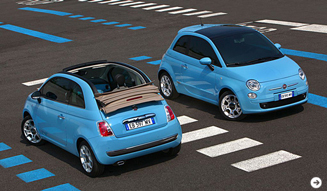
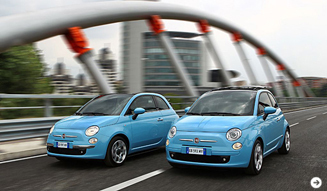
The journey to Nagoya took over four hours due to significant traffic congestion along the way. Perhaps due to cultural differences compared to Japan, where average driving distances are shorter, even the seats in a popular car like the 500 are well-made. The author, who has experienced severe sciatica several times, found that their back did not ache even after an approximately eight-hour round trip drive, which is noteworthy. However, the elevated seating position, a result of being based on the Panda, is a bit of a concern.
On the outbound journey, we drove in normal mode, repeatedly shifting gears. For the return trip, we decided to drive more leisurely in economy mode. To our surprise, we noticed that the fuel level had barely decreased. After leaving Tokyo, making several stops within Nagoya city, and then driving back on the Tomei Expressway, we were able to reach the Ashigara Service Area without refueling. Checking the trip meter, it read 629.7 km. This remarkable range was achieved with approximately half the distance driven in normal mode and half in economy mode. Although the fuel tank capacity is 35 liters, we refueled 36.75 liters. We don't know the reserve capacity, but it seems we had nearly emptied the tank. Given that approximately 90% of the total distance, about 580 km, was highway driving—a challenging pattern for a small displacement car—it's difficult to make a direct comparison of fuel economy. However, achieving 17.1 km/ℓ, which is about 80% of the catalog value, is commendable. Furthermore, it is reported that the TwinAir engine was designed from the outset to be compatible with hybrid technology, so the introduction of even more fuel-efficient models can be expected. For those who want to maintain a stylish lifestyle while being environmentally conscious, this car is definitely worth considering.

FIAT 500 TwinAir LOUNGE
Body | Length 3,545 x Width 1,625 x Height 1,515mm
Engine | 0.9-liter inline 2-cylinder intercooled turbocharger
Maximum Output | 63kW (85ps) / 5,500rpm
*Economy Mode | 57kW (77ps) / 5,500rpm
Maximum Torque | 145 Nm (14.8kgm) / 1,900rpm
*Economy Mode | 100Nm (10.2kgm) / 2,000rpm
Vehicle Weight | 1,040kg
Drivetrain | Front-wheel drive
Seating Capacity | 4 people
10-15 Mode Fuel Economy | 21.2km /ℓ
CO2 Emissions | 110g/km
Price | 2,450,000 yen