OPENERS' 2014 Picks for Our Readers
OPENERS CAR Selection 2014: Tatsuya Otani Edition
As 2014 draws to a close and the next year comes into view, we present a considered look back: "OPENERS Selection 2014." Among the many cars that debuted last year, these are the models that caught Mr. Tatsuya Otani's attention.
Text by OTANI Tatsuya
A New Pinnacle for Super Sports Cars Arrives
In 2014, what left a particularly strong impression on me were the ascendance of eco-cars and super sports cars. With calls for CO2 reduction and warnings about over-reliance on petroleum resources from an energy security perspective, it's natural that attention would focus on next-generation eco-cars like plug-in hybrids, EVs, and fuel cell vehicles. Yet, interestingly, it feels as though a significant number of super sports cars also emerged last year, rivaling, and in some cases even surpassing, the momentum of eco-cars.
Furthermore, the super sports cars that debuted in 2014 were characterized by their remarkable ability to balance seemingly opposing values—ease of use and comfort with overwhelming performance—at an exceptionally high level.
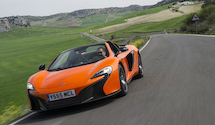
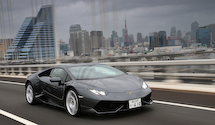
Prime examples include the McLaren "650S" and the Lamborghini "Huracan LP 610-4." Both boast over 600 horsepower and exceed 325 km/h (the 650S reaches 333 km/h), yet their ride comfort is surprisingly smooth, and they are remarkably easy to drive without any fuss. I personally see this "democratization of super sports cars" as a gradual process that has been unfolding over the past two decades, and I consider the 650S and Huracan to be noteworthy achievements, representing a new peak for this category.
But why, one might wonder, are super sports cars appearing one after another at this particular time? With emissions regulations becoming increasingly stringent, and with discussions about a future not too distant where obtaining gasoline might become difficult, potentially rendering super sports cars unusable, it's hardly surprising if people wish to enjoy them to the fullest before such a "dark age" arrives. Could the current vibrancy of the super sports car market be supported by these very individuals? I find myself contemplating this possibility.
Regardless, from the perspective of a pure car enthusiast, the current situation, with a succession of uniquely characterful products emerging, is a cause for great joy. And to ensure that the era of enjoying super sports cars to their fullest continues for as long as possible, I believe it's important not to forget our daily efforts to reduce CO2 emissions with eco-cars.
Tatsuya Otani's 2014 Top 5
This innovative super sports car represents a thorough refinement of the "MP4/12C," the first model from the reborn McLaren Automotive, achieving significant improvements in comfort, ease of use, and dynamic performance. Its cornering capability as a rear-wheel-drive vehicle is remarkable, and its manageability at the limit is astonishing. When you think about it, high-performance yet easy-to-handle rear-wheel-drive cars are precisely what I imagine modern F1 machines to be. In that sense, this super sports car truly reflects the philosophy of an F1 team.
Its focus on high performance and ease of use aligns with the 650S, but the Huracan notably differs by employing all-wheel drive. To be clear, AWD does not inherently make a Lamborghini sluggish. However, it's also true that AWD significantly enhances stability. This allows for predictable handling characteristics even at the limit, exhibiting a demeanor that is ideal for public roads. In my testing on the short course at Paul Ricard, I observed a tendency towards neutral steering that shifted to mild understeer as I increased throttle input. Regardless, this high level of stability will undoubtedly be welcomed by many drivers.
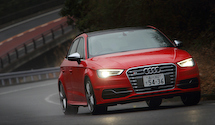
I secretly refer to the Audi S3 as the "Little Huracan." It achieves comfort, usability, and agile handling while employing AWD (or Quattro, in Audi's case) to ensure stability. This not only results in high performance limits but also leaves room for the driver to control the car within those limits. Recently, during a press drive, I was able to navigate a series of high-speed complex corners—which I had never managed to clear at the exact right speed before—while consistently pushing to the very edge. While its price tag of ¥6 million is not insignificant, it undoubtedly offers value commensurate with that cost.
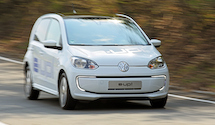
I currently own an "up!" privately, and after test-driving the e-up!, I felt it was such an ideal city car that owning both might be a viable option. While I previously noted a tendency for the ride comfort to break down over significant bumps during a test drive in Germany, this issue has been completely resolved in the Japanese specification. The acceleration is strong enough for everyday needs. The handling feels more stable than the standard up!, likely due to its lower center of gravity. Moreover, its exceptional quietness is truly captivating. If I could afford two cars, I would use the e-up! for most journeys, only resorting to the gasoline-powered up! when its range was insufficient, and otherwise strive to minimize CO2 emissions by driving the e-up! as much as possible. Unfortunately, primarily for financial reasons, this scenario seems unlikely in the near future.—.
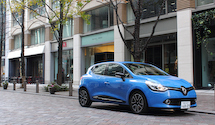
This compact car is equipped with a 3-cylinder, 0.9-liter turbocharged engine. With its downsizing, it can be considered an eco-car that reduces CO2 emissions. However, what I particularly appreciate about this car is its straightforward, no-frills approach, typical of a basic car. This unadorned simplicity is an irresistible charm for fans of fundamental vehicles. The decision to offer it exclusively with a manual transmission is also commendable. Furthermore, it offers the intellectual sport of driving with a manual transmission, requiring thoughtful engagement. The initial stiffness in the ride comfort, which was noticeable when the Lutecia first debuted, has been resolved, allowing for the enjoyment of Renault's characteristic ride quality.