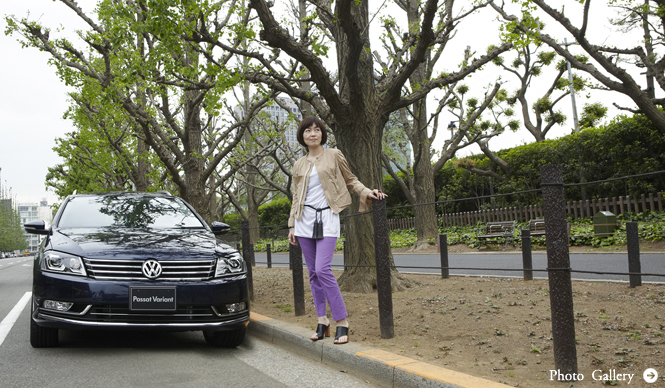
Volkswagen Passat | Technology Elevated to Product
Volkswagen Passat
Chapter 4: Passat × Product Designer Fumie Shibata
Technology Elevated to Product (1)
A car is an integration of technology. The new Passat is a vehicle where cutting-edge technologies, including an engine based on the downsizing concept, are condensed. Expressing technology as a product is an extremely challenging task. In particular, cars are products that demand sophisticated design to express the identity of their occupants, yet this Passat is masterfully completed as an authentic saloon. Therefore, we asked product designer Fumie Shibata, who has created numerous masterpieces, to discuss the product design of the Passat, which expresses cutting-edge technology in a single form.
Text by Masao MatsuoPhotos by Kenta Yoshizawa
Honest Design
“When it appeared before me, I was immediately drawn to its front mask, which seemed a little stern, or rather, serious. It truly captured the Volkswagen essence, and while the car as a whole gives a very approachable impression, it also possesses a dignified presence. I don’t think we often see this sense of weight and structural depth in Japanese cars.”
Fumie Shibata, who has produced many hit works as a product designer, had a very positive first impression of the Passat. Her design work spans a wide range of fields, from thermometers to sofas and hotels.
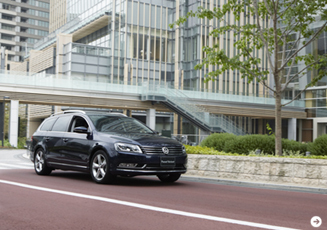
Tokyo Midtown is visible behind the Passat. Shibata says this is the best place to understand all the product design currently in Japan. As it is close to her office, she visits frequently.
This sentiment extends to the interior. The model she test-drove this time was the "Highline," an upper-grade model of the Passat Variant. “The interior is also very good. Despite its relatively reasonable price in the 3 million yen range, I was surprised by the quality of the leather seats and the sense of luxury. The seat design is also excellent, with neat piping that creates a solid, robust image. It’s consistent with the impression of the front mask.”
Furthermore, she found the instrument panel to be a design of great integrity. “Many recent car designs, especially around the dashboard, feel overly designed. Some look like DJ booths. For someone like me who enjoys driving, these feel superfluous. But the Passat’s design suits the word ‘honest.’ Honest design is easy to say, but difficult to achieve. This Passat is a new model, its seventh generation, right? At times like this, designers might be tempted to create something entirely new just because it’s a new model. However, this Passat finds the new while leveraging what has been accepted before, and gives it form.”
A Car That Expresses Its Owner
Shibata typically designs products with a broader target audience than cars, such as home appliances and furniture. “For example, when designing a refrigerator, clearing the volumetric efficiency problem is part of the design. Refrigerators with the same capacity have nearly uniform external dimensions in width, height, and depth. The design must fit within those constraints. Cars, too, cannot be made arbitrarily larger for the sake of design. Moreover, while home appliances are unlikely to be taken out of the home, cars are driven by users to various places, which demands higher design standards. Since they are seen by others, a car itself can be said to represent its owner.”
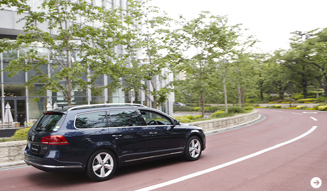
The new Passat is packed with cutting-edge technology, featuring a 1.4-liter TSI single-charger engine adhering to the downsizing concept—one of the latest trends in automobiles—paired with a state-of-the-art 7-speed DSG dual-clutch transmission, and equipped with BLUEMOTION TECHNOLOGY, including a Start/Stop system (idling stop) and a brake energy regeneration system. However, without overtly emphasizing these features, Shibata saw in Volkswagen’s completion of the Passat as an authentic saloon a reflection of mature European design.
Volkswagen Passat
Chapter 4: Passat × Product Designer Fumie Shibata
Technology Elevated to Product (2)
A Message from the Passat
Regarding the message conveyed by the Passat’s design, Shibata commented, “It’s a car that makes a good first impression. If someone I know drove this Passat, I feel like we could become friends. It’s trustworthy, and I don’t think anyone would have a negative impression. For instance, if my sister or best friend asked for car recommendations, I would suggest it. Especially, when a woman drives a Passat, it conveys a sense of ‘intention.’ You can tell it wasn’t chosen or bought for her, but that she made the choice herself. It’s easy to drive for its size, fuel-efficient, and reasonably priced. It makes you think she bought it with a good understanding of cars. It’s perfect for independent, working women.”
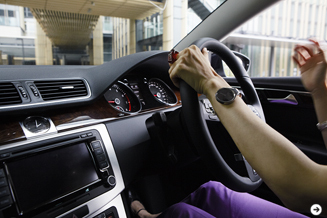
Shibata reflects on the automobile itself: “When I first got one, I felt I had become free. For example, I didn’t have to worry about the last train. I had this exhilarating feeling of ‘I can go anywhere, anytime.’ This Passat, I believe, is a car that fosters happy communication. It’s a happy tool that allows you to envision doing things with specific people, like family or friends. For a product, the ability to suggest a slightly richer life through ownership is important, and the Passat carries that message.”
Design That Accompanies Life
Her high praise remained unchanged even after actually driving it. Although Shibata usually drives a large-displacement sports car, she was impressed by the 1.4-liter engine, which, thanks to downsizing technology, achieves both the power of a 2-liter class car and high fuel efficiency. “I was surprised at how smoothly it ran despite the small engine size. This electric power steering also makes maneuvering very easy.” She ended up driving for longer and further than planned.
“Even while driving, I noticed how pleasing the use of wood, aluminum, and leather in the interior is. The optimal material is used in the optimal place. The metallic parts aren’t overly flashy. This is important. For women, it’s like nail polish. Done to a degree that others might not notice. Conversely, nail polish that’s so noticeable you remember it even if you don’t see the nails means it’s out of place. What I feel with recent cars is that only the details are beautiful. Yet, the occupant should be the star. Parts that assert themselves too much are not good design. This Passat has nothing superfluous. Certainly, flashy elements might connect to a sense of ‘excitement,’ but such excitement is fleeting. In contrast, the Passat’s design gradually becomes a part of your life as you spend more time with it. The engine and suspension are well-executed, and the design is also good. Like with home appliances and furniture, the key is how to design while ensuring high practicality. The Passat is made with this principle firmly in mind.”
After her drive, in honor of the Passat’s fuel efficiency of 18.4km per liter, she proposed a 18.4km short trip course from the perspective of a product designer to better understand the past and present of product design.
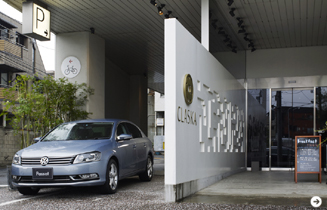
One of the courses Shibata recommends for a drive in the Passat is CLASKA. She uses it as a base when searching for furniture along Meguro Dori. She also finds the exhibitions at its gallery always interesting.
The starting point is CLASKA in Meguro. This establishment functions not only as a hotel but also features a restaurant and a gallery showcasing works by young designers, making it a noteworthy spot. Next, she visits BALS TOKYO NAKAMEGURO. This store often features home appliances designed by Shibata, as well as new products, so she checks it regularly. From there, heading into the city center, she visits the Nezu Museum. It’s an unmissable museum for casually experiencing traditional Japanese beauty. Finally, Tokyo Midtown. It’s a place where you can quickly grasp the “now” of Tokyo design, with a variety of shops gathered, allowing for efficient browsing. It also houses 21_21 DESIGN SIGHT and the Suntory Museum of Art, making it her top recommendation if time is limited.
However, when designing products, it is important to check what constitutes standard design. For this reason, Kappabashi Kitchen Town in Asakusa is indispensable. The possibilities and hints for design are often hidden in products favored by professionals.
“Although products are artificial, they become integrated into a person’s life through use. At some point in that process, they transform from mere objects into a part of oneself. Leather goods are a good example. With use, the color deepens, wrinkles form, and affection grows. The role of a product designer is to create form, but the act of design is not about imposing the designer’s ego into form; it’s about supporting the user. I feel a design philosophy in the Passat that allows it to become part of you. It’s made with consideration for how the user lives and what experiences they will have with the Passat. Styling alone is not design. Within various constraints, it’s about envisioning a rich life and shaping it to maximize functionality. Downsizing the engine significantly improves environmental performance without compromising drivability. It is truly an excellent car. I believe the Passat is a product that exudes intelligence in both its appearance and all its functions.”

Fumie Shibata
Representative of Design Studio S. After graduating from Musashino Art University’s Department of Industrial Design, she joined Toshiba Design Center. In 1994, she went independent and established Design Studio S. While involved in product design for a wide range of items, from electronics to daily goods and medical devices, she also engages in total direction for projects such as the hotel “nine hours.” Her major works include the “Combi Baby Luv Series,” “MUJI Body Fit Sofa,” “Zojirushi ZOJIRUSHI ZUTTO Series,” “Omron Electronic Thermometer Kenonkun,” “9h nine hours,” and the “Next-generation Vending Machine acure.” Awards include the Good Design Gold Award / German iF Design Gold Award / Asia Design Award Grand Prize, Special Culture Prize, and Gold Award / JCD Design Award Grand Prize / German red dot design award.
Store Data
CLASKA
1-3-18 Chuo-cho, Meguro-ku, Tokyo
Tel. 03-3719-8121
URL: http://www.claska.com/
Tokyo Midtown
9-7-1 Akasaka, Minato-ku, Tokyo
Tel. 03-3475-3100
URL: http://www.tokyo-midtown.com/