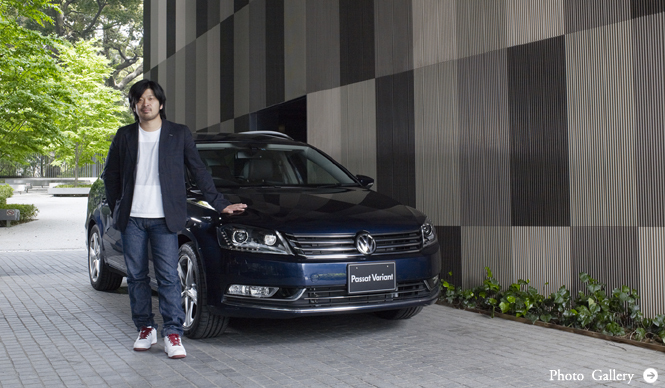
Volkswagen Passat | Offering a Sense of Comfort and Well-being
Volkswagen Passat
Chapter 3: Passat × Chef Keisuke Matsushima
The Essence of Providing a Comfortable Time (1)
The Passat's strengths extend beyond environmental performance. Since its debut, it has boasted exceptional spaciousness and utility, crafting an environment that brings comfort to its occupants. This legacy is carried forward in the newly reborn seventh-generation Passat. What does it truly mean to provide a comfortable space? We invited Keisuke Matsushima, a world-renowned chef recognized with Michelin stars for his restaurants in both France and Japan, to discuss "comfortable spaces" from the perspective of a spatial design professional. He also shared his thoughts on the Passat's performance and creativity.
Text by Dai MatsuoPhotos by Kenta Yoshizawa
Creating Space
"It's quite challenging to pinpoint what's common between creating a restaurant space and a car interior. However, understanding what customers seek from a space might be a shared crucial element."
The prestigious 'Le Guide Michelin,' a restaurant guide with a long history in France and Europe, awarded Keisuke Matsushima his first star in 2006, making him the youngest foreigner to receive the honor. He has maintained this star for six consecutive years. Furthermore, in 2009, he opened 'Restaurant-I' in Jingumae, Tokyo, which also earned a star. He was also the first Japanese chef to be awarded the French Order of Arts and Letters (Chevalier) by the French government.
Michelin's recognition of Matsushima was not solely based on the deliciousness of his food. Restaurants awarded stars by Michelin are evaluated not only on the taste, presentation, and plating of the dishes but also on the overall ambiance of the establishment and its service. Similarly, the French government's bestowal of the Chevalier award acknowledged his broader contributions through his culinary endeavors.
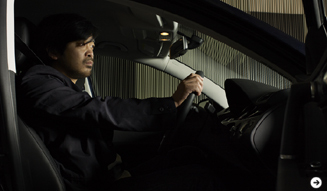
"What kind of person is the guest, and what is their purpose in seeking out this space? Understanding their intentions is the most vital aspect of creating that space. For instance, the situation changes from the moment we receive a reservation. Is it for a week later, three days from now, or perhaps for the same day? Or did they happen upon us by chance? Even as they enter, we need to assess every detail: who are they with, did the man open the door, or the woman?"
While the chefs in the kitchen cannot directly observe the dining room, they act faithfully upon the information relayed by the service staff. "The crucial element is timing – discerning whether they desire a leisurely experience or are in a hurry. French cuisine operates with the chef issuing commands, and the team moving in unison. It's akin to directing a team." This approach involves orchestrating not just the food itself, but also skillfully utilizing timing for a comprehensive dining experience.
Choosing a Car in Europe
"Isn't the same true for cars? What do customers seek from a vehicle? For example, in Nice, where I live, you see surprisingly many small cars. These are used solely for navigating the local area, never venturing far from the city. However, on the other hand, Europeans often drive to neighboring countries, covering perhaps 1,000 km in a single day. I fall into the latter category, so my primary requirement for a car is comfort during long journeys. This includes the fit and material of the seats. When sitting for extended periods, materials that don't trap moisture are also important. Of course, fuel efficiency is a significant concern. Even small details, like the position of the armrest, can be a deciding factor when choosing a car."
The Passat is a model that has withstood the demanding conditions of European use and received high praise. "It has a solid, no-nonsense impression, characteristic of German engineering, and I believe it would suit Japanese drivers very well. Moreover, its fuel efficiency is remarkable, achieving 18.4 km per liter of gasoline. This offers a significant advantage even in Europe, where fuel economy and taxes are stringent. As a Japanese person, I was considering a Japanese car next, but I might need to reconsider."
Volkswagen Passat
Chapter 3: Passat × Chef Keisuke Matsushima
The Essence of Providing a Comfortable Time (2)
Pursuing Hospitality
What Chef Matsushima has pursued in building his restaurants is hospitality. To achieve this, he emphasizes the importance of enjoying the process himself. He travels extensively, gaining firsthand experiences, and believes that increasing the number of things he personally deems "good" is crucial. He views restaurants as part of the hospitality industry and finds himself considering even the simplest elements, like the destination display on a bus, questioning whether it reflects hospitality for the passengers.
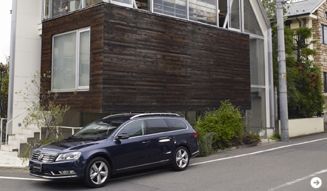
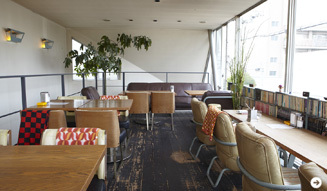
To explore various places with the Passat, we departed from Restaurant-I for a short 18.4 km trip, showcasing the car's fuel efficiency. Along the way, we stopped at 'Adito,' a cafe near Komazawa Park. "This is a perfect spot for a break after a stroll in Komazawa Park. While not a sprawling cafe, it offers a very calming atmosphere."
After enjoying a lunch called 'Otonasama Teishoku' here, the recommended 18.4 km route continues to 'Farmers Market Futakotamagawa' for locally grown Setagaya vegetables, and then to 'Nakasei,' a specialty aged meat shop in Denenchofu, to purchase beef with concentrated umami, aged for 10 weeks. Matsushima expressed his positive impressions of the Passat after this drive: "The seats are excellent. They are firm, making long drives comfortable and preventing any stuffiness. Although the car's size is not small, the design with its squared-off corners and good visibility makes it easy to drive."
Creation Born from Constraints
Chef Matsushima was particularly drawn to the Passat's excellent fuel economy. "Restaurant-I" champions the theme of local sourcing. "By having zero mileage, we foster connections with the local community and build close relationships with producers. They then visit the restaurant, which in turn attracts more regular customers from the neighborhood, stabilizing the restaurant's revenue. Ecology, in this sense, generates economy."
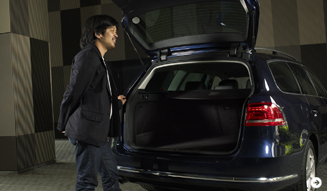
"Moreover, when people are given too much, they tend to do what everyone else is doing. By imposing constraints like local sourcing, we are compelled to find solutions within that framework. Ideas emerge from limitations. By making this a habit, one can become a true creator. Perhaps the Passat has evolved into such an excellent car through a similar process. A small, fuel-efficient engine, an accessible price, a comfortable space for five large Germans, and ample luggage capacity—everything was conceived within constraints, shaped through ingenuity."
"Furthermore, setting limitations makes the message easier for customers to understand. 'Restaurant-I' is a farm-to-table restaurant using Tokyo ingredients. Our job is to collaborate with producers and create value in their work."
The Passat, he notes, conveys a similar message. It offers a clear proposition: a new era of premium sedan that is fuel-efficient, spacious, comfortable, quiet, and boasts significant luggage capacity.
"In Japan, we must properly praise good things. We tend to over-praise the process, becoming too result-oriented. We are not adept at complimenting others. It seems one must achieve an extraordinary level of success to be praised. While Japan tends to 'hammer down the nail that sticks out,' they will praise you if you set a record overseas that no one else has achieved. I want to bring a new perspective. Isn't this Passat bringing a new wind to Japanese sedans?"
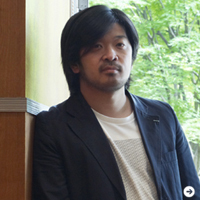
Keisuke Matsushima
Born in Fukuoka in 1977. After graduating from high school, he studied the fundamentals of French cuisine at 'Ecole Tsuji Tokyo.' Following a stint at the French restaurant 'Vincennes' in Shibuya, he moved to France at the age of 20. At 25, he opened 'Kei's Passion' in Nice. In 2006, his third year of operation, he received his first star in the Michelin Guide France, becoming the youngest foreigner to do so. In November of the same year, he renamed the restaurant 'KEISUKE MATSUSHIMA' and reopened with an expanded space. He has maintained his star for six consecutive years since then. In June 2009, he opened 'Restaurant-I' in Jingumae, Tokyo. Recently, he was awarded the French Order of Arts and Letters (Chevalier), the first Japanese chef to receive this honor.
Store Data
Restaurant-I
Park Court Jingumae 1F, 1-4-20 Jingumae, Shibuya-ku, Tokyo
Hours: 11:30–15:00 (Last Order 13:30) | 18:00–22:00 (Last Order 21:00) | Irregular holidays
Lunch from ¥3,800 | Dinner from ¥6,800
Tel. +81-3-5772-2091 (Reservations) / +81-3-5772-2151 (Inquiries)
URL: http://www.restaurant-i.jp/
Adito
5-16-1 Komazawa, Setagaya-ku, Tokyo
Hours: 12:00–24:00 (Last Order 23:30) | Closed Wednesdays
Otonasama Teishoku ¥880 | Homemade Brown Rice Black Vinegar Drink from ¥700
Tel. +81-3-3703-8181
URL: http://www.adito.jp/
Farmers Market Futakotamagawa
3-18-8 Kamata, Setagaya-ku, Tokyo
Hours: 9:00–16:30 | Closed Mondays
Tel. +81-3-3708-1187
URL: http://www.farmersmarket-ja.com/futagotamagawa/
Nakasei
2-8-1 Tamagawa Denenchofu, Setagaya-ku, Tokyo
Hours: 11:00–19:00 | Closed Mondays
Tel. +81-3-5755-5678
URL: http://www.naka-sei.com/