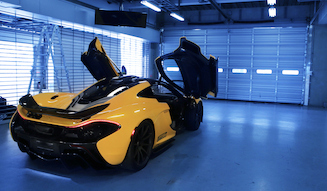
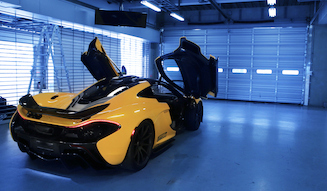
Testing the McLaren P1 at Fuji Speedway | McLaren
McLaren P1 | McLaren P1
Driven by McLaren Test Driver Chris Goodwin
Testing the McLaren P1 at Fuji Speedway
The opportunity has finally arrived to test drive the "P1," unveiled by McLaren at last year's Geneva Motor Show as their new generation of supersports car. The stage chosen for this was Fuji Speedway, one of the world's premier high-speed circuits. Tatsuya Otani reports, having been fortunate enough to join Chief Test Driver for McLaren Automotive, Chris Goodwin, for a ride-along.
Text by OTANI TatsuyaPhotographs by ARAKAWA Masayuki
Astonishing Performance
Chris Goodwin, a former racing driver, is now the Chief Test Driver for McLaren Automotive, where his driving prowess and analytical skills are valued in the development and tuning of all the company's products. It goes without saying that the McLaren flagship model, the "P1",
was also refined under his guidance. The chance to ride along with Goodwin driving the P1 came my way. There was no reason to refuse. I rushed alone to Fuji Speedway, where the "McLaren Track Day Japan 2014" was being held.
It was agreed that I would only have two laps in the P1. However, the most significant feature of this supersports car is its ability to provide a comfortable ride on public roads and racecar-like performance on the circuit. Therefore, I wanted to try at least two modes: the most spartan race mode and the normal mode for public roads.
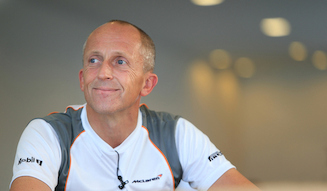
McLaren Test Driver Chris Goodwin
When I proposed this to Goodwin just before getting into the cockpit, he readily agreed with an "OK." However, at that moment, I had no idea that this would lead to breaking the original agreement.
The P1 is a supersports car that achieves astonishing performance—a top speed of 350 km/h (electronically limited), 0-100 km/h in under 3 seconds, 0-200 km/h in under 7 seconds, and 0-300 km/h in under 17 seconds—by skillfully utilizing the engine, gearbox, and monocoque developed for the "MP4/12C",LaFerrari" and the Porsche 918 Hybrid are the only cars that can match this performance.
McLaren P1 | McLaren P1
Driven by McLaren Test Driver Chris Goodwin
Testing the McLaren P1 at Fuji Speedway (2)
The P1 Onboard
Without further ado, let's begin driving around Fuji Speedway with Goodwin. In fact, this was Goodwin's first experience at Fuji Speedway when the video you can watch on OPENERS was recorded. This is evident from the fact that he drove almost on the inside line (running along the inside of the course) for the first lap.
So, from the passenger seat, I found myself explaining the course, mentioning things like "long sweeping right corners" and "tricky reverse bank corners." The様子 (yōsu - appearance/state) of this is clearly captured in the aforementioned video.
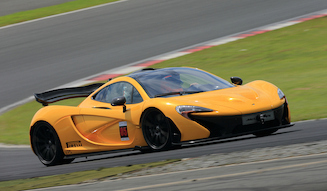
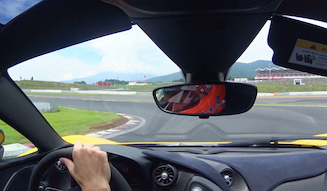
So, what was my impression of riding along in the P1? As I mentioned at the beginning of the video, the P1 is exceptionally comfortable, even in race mode. This is based on my experience driving on the pit lane at Fuji, but truly uncomfortable cars are immediately apparent. Despite this, the P1 gives no impression of discomfort even in race mode. It truly feels like a new generation of supersports car.
Although Goodwin said it was his first time at Fuji, as a former racing driver, his ability to learn the track was frighteningly fast. You can see this from the fact that on the second lap, he was already following a trajectory close to the record line.
Driving for two laps in race mode, I understood that by lowering the ride height and stiffening the suspension to 300 percent of normal mode, the P1 gains the agile handling of a racing car. Thanks to this, even when Goodwin pushed too hard and the car began to oversteer, it could be quickly corrected with simple adjustments.
Even from the passenger seat, it was clear that he was handling the P1 like an extension of his own body. Of course, I don't have that level of skill, but I felt a slight jealousy sitting next to him, thinking how much fun it would be to control the car with such precision and agility.
McLaren P1 | McLaren P1
Driven by McLaren Test Driver Chris Goodwin
Testing the McLaren P1 at Fuji Speedway (3)
From Race Mode to Normal Mode
What surprised me next happened after completing two laps in race mode. Naturally, Goodwin brought the P1 into the pit lane. I thought the test drive was over, as the promised number of laps had been completed. However, as the P1 stopped on the pit lane, he spoke to me:
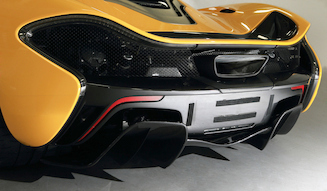
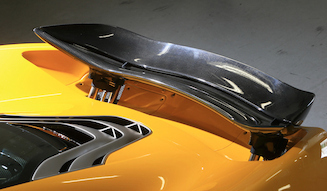
"It takes about 30 seconds to switch from race mode to normal mode. During this time, the wing retracts, the ride height is raised, and the suspension is softened." It was only then, hearing his explanation, that I understood that to switch from race mode to any other mode, the P1 must be stopped.
Even though he had to return to the pit lane for this, Goodwin had agreed to my request with an "OK," knowing this. His kindness deeply moved me.
"Alright, it's switched to normal mode now. Shall we go?" With that, he started driving the P1 again. Honestly, I couldn't tell from the ride quality alone that the suspension had softened to one-third of its previous stiffness, but when Goodwin turned the steering wheel left and right before corner A, I noticed the roll had clearly increased.
Moreover, in the hairpin, even with the same steering input as before, the nose didn't turn in as much as I expected. Although there seemed to be plenty of margin before reaching the car's limit, it was tuned to clearly understeer within that range.
"Probably, within the range you'd experience on public roads, the P1 wouldn't feel like it's understeering," said Goodwin. "Even so, we've set the normal mode to have an understeer tendency. That's definitely safer."
McLaren P1 | McLaren P1
Driven by McLaren Test Driver Chris Goodwin
Testing the McLaren P1 at Fuji Speedway (4)
The P1 Has No Brake Regeneration Function
According to Goodwin's explanation, the P1's normal mode is equivalent to the "Sport" mode of the "650S", so it should still be a high-performance car. However, after experiencing race mode, everything felt sluggish, and the car seemed to react a beat after the driver's input.
Therefore, the shift from understeer to oversteer would likely occur slowly, and correcting it would take time, making it perhaps less suitable for enjoying dynamic driving. This tendency did not change significantly even when switching to sport mode, which keeps the ride height high but slightly stiffens the suspension.
To reiterate, these impressions were only felt because I had experienced race mode first. If I had only tried normal mode, I would never have noticed them. That's how high-performance the P1 is, and how much its character changes with mode switching for a supersports car.
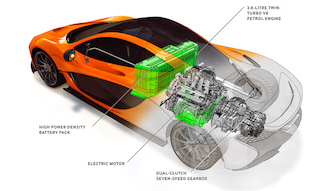
There is one final point I would like to add. According to Goodwin, the P1 does not have a brake regeneration function. In other words, it does not have the ability to convert the kinetic energy from deceleration into electrical energy to charge the battery.
So, when does it charge the battery? It charges when the throttle pedal is not fully open, meaning when the engine has surplus power. This means the hybrid system can hardly be used to improve fuel economy, but Goodwin explained the reason: "If we implemented brake regeneration, the brake feel would inevitably worsen, and you wouldn't be able to fully enjoy the driving experience. The P1 is not an eco-car. That's why we didn't include regenerative braking."
In his words, I felt that the essence of the P1 was encapsulated.

McLaren P1 | McLaren P1
Body Dimensions | Length 4,588 x Width 1,946 x Height 1,188 (1,138 in Race Mode) mm
Wheelbase | 2,670 mm
Tread Front/Rear | 1,658 / 1,604 mm
Weight | 1,395 kg
Engine | 3,799cc V8 Twin-Turbo
Max Output | 737 ps / 7,500 rpm
Max Torque | 720 Nm / 4,000 rpm
Motor Output | 179 ps
Motor Torque | 260 Nm
System Max Output | 916 ps
System Max Torque | 900 Nm
Transmission | 7-speed Automatic (SSG)
Drivetrain | MR
Suspension | Hydraulic Proactive Suspension (RaceActive Chassis Control (RCC))
Tires Front/Rear | 245/35ZR19 / 315/30ZR20
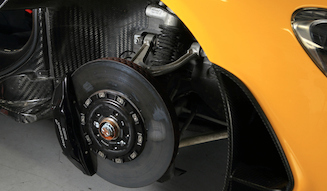
Brakes | Carbon Ceramic Discs
Top Speed | 350 km/h (electronically limited)
0-100km/h Acceleration | Under 3 seconds
0-200km/h Acceleration | Under 7 seconds
0-300km/h Acceleration | Under 17 seconds
CO2 Emissions | Under 200 g/km
Price | 96,615,000 Yen (Sold as a limited edition of 375 units worldwide, already sold out)