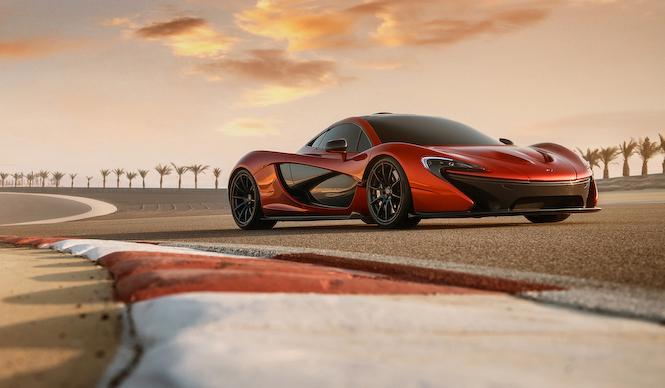
The Birth of the Ultimate Supercar: The McLaren P1 | McLaren
McLaren P1 | McLaren P1
The Ultimate Super Sports Car
This is How the McLaren P1 Was Born
Following the release of the MP4-12C, which marked a new beginning for McLaren as a sports car brand, the flagship model " P1" made its debut.Geneva ShowAt the Geneva Motor Show 2013, Tatsuya Otani interviewed the men behind the creation of this ultimate road racer.
Text by OTANI Tatsuya
Photographs from Geneva by MOCHIZUKI Hirohiko
Why the Name P1?
McLaren might be perceived as meticulous and serious, or perhaps rigid and inflexible. However, Paul McKenzie, the program director, and Frank Stephenson, the design director, who were interviewed for the launch of the flagship model "P1," were both cheerful, outgoing, and full of laughter. In short, they possessed personalities that challenged the company's image.
For instance, when McKenzie was asked about the origin of the P1 name, his response was something like this:—
"We were looking for a short name. We wanted a simple name, like the F1 road car McLaren made in the past. In that regard, P1 is perfect. Originally, it signifies Position 1 in racing, meaning number one, victory. Also, the internal code for the F1 road car during development was P1. So, it also expresses the connection to F1. Well, we just wanted a short name. P1 is really good. Hahahahahaha…"
Perhaps there were comments that the model name was too long compared to theMP4-12C?
"Some people apparently found the MP4-12C too long. That's why we made P1 shorter, but since P1 is the flagship, we don't think all future car names need to be short. Although, the MP4/12C Spider is a bit too long, so we call it the 12C Spider. Hahahahahaha…"
And so it went, with everything discussed in this manner.
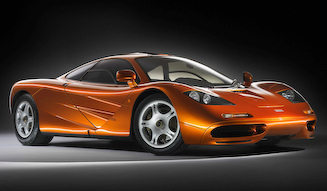
McLaren F1 | McLaren F1
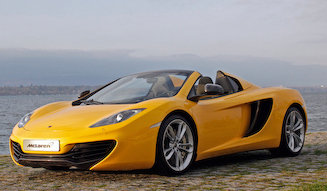
McLaren MP4-12C Spider | McLaren MP4-12C Spider
The P1 Aimed for the Best in Every Aspect
P1 Prototype UnveiledLast year's Paris SalonAt last year's Paris Salon, McLaren described the P1 as "the best driver's car on both road and track." However, since "best driver's car" is somewhat vague, we asked McKenzie for a more specific explanation.
"Performance, drivability, comfort – everything. The P1 aimed for the best in all of them. Of course, roads require different suspension than circuits. So, we developed a suspension that can be adjusted for both road and track use."
This is called Race Active Chassis Control (RCC), a system that switches between Normal, Sport, Track, and Race modes for spring rate, damping rate, and ride height with a single switch. What's novel is that it's based on conventional coil springs and dampers, rather than air suspension.
The dampers are similar to the Proactive Chassis Control (PCC) found in the MP4-12C, and the method for adjusting the damping rate is basically the same.
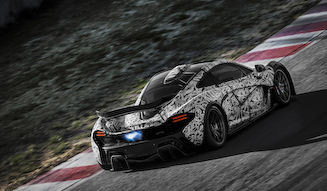
Meanwhile, by using progressive rate springs, the adjustment of ride height is directly linked to the adjustment of spring rate. This allows the spring rate in Race mode to be 300 percent higher than in Normal mode, delivering optimal performance on both roads and circuits.
McLaren P1 | McLaren P1
The Ultimate Super Sports Car
This is How the McLaren P1 Was Born (2)
Power Performance Beyond a Road Car
It's not just the suspension that switches between road and track modes; the aerodynamics do as well. McKenzie explains:
"The P1 features active aerodynamics. This is also a type of variable system; in road mode, the rear wing height is a maximum of 120mm from the body, but in race mode, this increases to a maximum of 300mm. Furthermore, in race mode, the ride height is lowered, creating ground effect between the underfloor and the road. Combined with the effect of the rear wing, this generates a total downforce of 600kg."
This downforce of 600kg is on par with sports cars competing in the 24 Hours of Le Mans. Consequently, the maximum lateral G-force during cornering reaches an astonishing 2G for a road car (most conventional road cars achieve less than 1G, and even the highest-performance sports cars are said not to reach 1.5G).
Meanwhile, the maximum output of 737ps, achieved by increasing the boost pressure of the MP4-12C's 3.8-liter V8 twin-turbo engine from 2.2 bar to 2.4 bar, can be boosted to 916ps through a hybrid system called IPAS (Instant Power Assist System).
"This electric motor enables fantastic sports driving,"
says McKenzie.
"Turbo lag is often an issue with turbo engines, but by utilizing the instant torque of the electric motor, we can eliminate that."
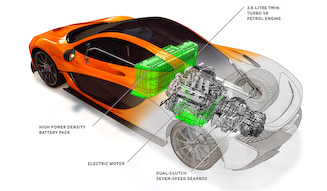
The P1's Hybrid System
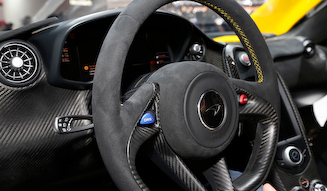
The red button is the IPAS button.
Furthermore, by pressing the IPAS button located on the steering wheel, the driver can access an "extra torque" of 260Nm at any time. The duration for which the motor can assist depends on the battery's charge level, but according to McKenzie, it could be "30 seconds, or perhaps even a minute."
Additionally, by utilizing the energy stored in the battery, it's possible to drive in full EV mode with the engine off.
"The range is about 10km, but even in this mode, it can reach speeds of around 150km/h. Hahahaha… Also, the battery can be charged from an external power source, and a full charge takes about 2 hours."
McLaren P1 | McLaren P1
The Ultimate Super Sports Car
This is How the McLaren P1 Was Born (3)
I Dislike Designs Without Purpose
Stephenson, the designer, was as much of a character as McKenzie, perhaps even more so. His remarks were often too outrageous to be published here. However, there is one anecdote I would like to share.
In fact,The prototype unveiled at the Paris SalonandThe production model that appeared at the Geneva Showdiffer only in the presence or absence of an air intake duct just before the front wheels; all other design elements are identical.
It is rare for a prototype designed with styling as the priority to be mass-produced without changes. In that sense, the design of the P1 prototype can be considered a great success. So, when I asked Stephenson if he was satisfied that the prototype became the production model as is, his answer was:
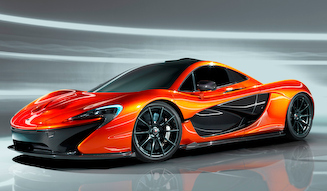
The prototype unveiled at the Paris Motor Show
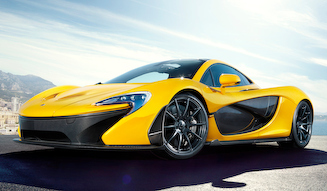
The production model unveiled at the Geneva Motor Show
"There are only three people, including myself, responsible for design at McLaren. Therefore, we don't have the luxury of designing a prototype car that has no relation to the production car. Besides, I like designs that faithfully reflect the technology actually in use. That's why I'm constantly in discussion with the engineers during the design process, and the prototype unveiled in Paris already met all the technical requirements. In other words, the prototype didn't need any further changes."
There Are No Ugly Animals
Stephenson also burst into laughter multiple times during the interview, but his sensibility was delicate, and he stated that he values the beauty of nature above all else.
"I design surrounded by pictures of trees, leaves, insects, and animals. These have been refined over hundreds of thousands of years, and they are all beautiful. Fundamentally, there are no ugly animals in this world."
Stephenson's motto seems to be the following statement: "People often say 'Form follows function,' but that's wrong. It should be 'Form equals function.'"
Compared to the "LaFerrari" and Lamborghini's "Veneno" that also debuted at the Geneva Motor Show, Stephenson's P1 might seem understated. However, I secretly believe that when many years have passed, the P1 will be the one that is genuinely considered more beautiful.

McLaren P1 | McLaren P1
Body Dimensions | Length 4,588 x Width 1,946 x Height 1,188 (1,138 in Race Mode) mm
Wheelbase | 2,670 mm
Tread Front/Rear | 1,658 / 1,604 mm
Weight | 1,395 kg
Engine | 3,799cc V8 Twin-Turbo
Maximum Output | 737 ps / 7,500 rpm
Maximum Torque | 720 Nm / 4,000 rpm
Motor Output | 179 ps
Motor Torque | 260 Nm
System Maximum Output | 916 ps
System Maximum Torque | 900 Nm
Transmission | 7-speed Automatic (SSG)
Drivetrain | MR
Tires Front/Rear | 245/35ZR19 / 315/30ZR20
Brakes | Carbon Ceramic Discs
Maximum Speed | 350 km/h (electronically limited)
0-100 km/h Acceleration | Under 3 seconds
0-200 km/h Acceleration | Under 7 seconds
0-300 km/h Acceleration | Under 17 seconds
CO2 Emissions | Under 200 g/km
Price | £866,000 (approx. ¥124,860,000)