McLaren's Latest Machine, the Senna, Arrives in Japan for the First Time | McLaren
McLaren Senna
McLaren's Latest Machine, the Senna, Arrives in Japan for the First Time
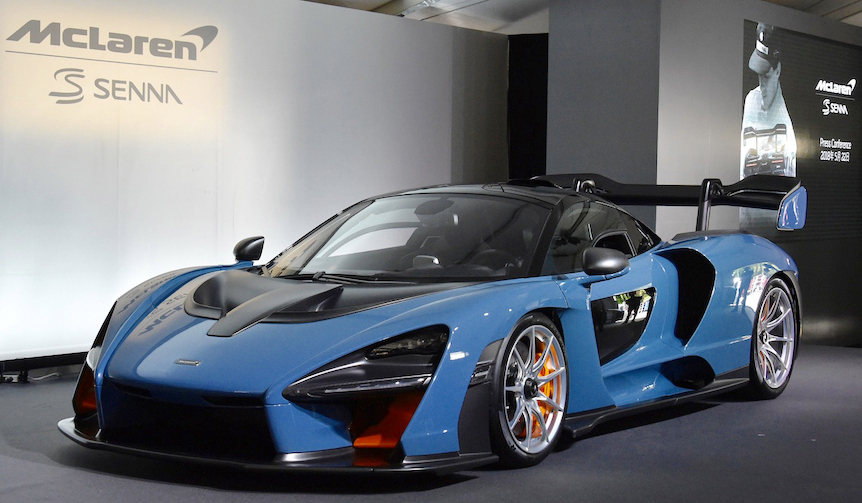
On May 22nd, McLaren Automotive held the first public unveiling in Japan of its latest circuit-focused road car, the Senna, which made its world debut at the Geneva Motor Show in March. The event took place at a special venue at Zojoji Temple in Shiba, Tokyo.
Text & Photographs by HARA Akira
Why It Bears the Name of the Legendary Driver, Senna
McLaren'sSennais the latest model in the company's Ultimate Series, developed as a road-legal circuit specification model with the highest performance in McLaren's history. Priced at approximately 100 million yen, it garnered significant attention not only for its price but also because all 500 limited production units were sold out at the time of announcement.
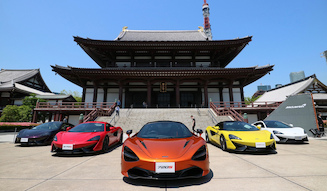
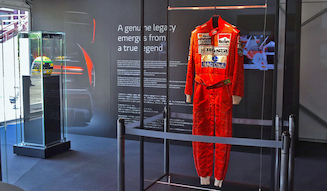
In the plaza in front of the main hall of Zojoji Temple, which served as the venue for its domestic debut, a lineup of McLaren models was displayed, including the720S, the570S, and the "540C." Furthermore, at the venue entrance, helmets and racing suits worn by Ayrton Senna during his F1 golden era with McLaren-Honda in 1992-93 were exhibited. The display was fitting for the unveiling of a new car that promises ultimate performance.
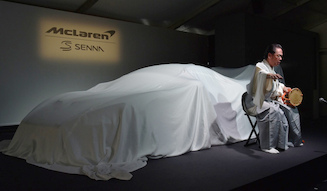
The press conference began with a taiko drum performance by Masanosuke Okura, a Noh actor and Living National Treasure, to pray for the event's success.
Next, Yoshihiro Masumoto, Representative Director of McLaren Automotive Asia Japan, took the stage and commented, "The McLaren and Senna brands share not only a bond built through a glorious motorsport history but also a DNA of continuous challenge in every era."
He stated that the Senna is the latest version at the pinnacle of McLaren's Ultimate Series, representing the culmination of decades of accumulated racing technology and the essence of the latest technology and materials, merging tradition and innovation.
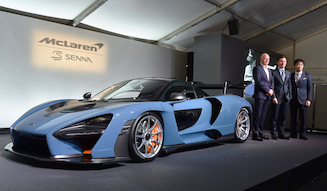
Following a screening of a film showcasing Ayrton Senna's prowess, George Biggs, Managing Director for Asia Pacific, stated, "As you saw in the video, Ayrton's (Senna's) relentless pushing of the limits in racing serves as the standard we aim for."
He also reported on the sales front, noting that McLaren car sales have increased for four consecutive years, with 3,340 units sold globally last year. Two-thirds of these were from the new Sports Series lineup, largely to new customers. The company currently has a production capacity of 20 cars per day.
Furthermore, he announced that Japan is a crucial strategic market, with Sports Series sales ranking third globally in 2017. To strengthen its presence, McLaren plans to open a second dealership in Tokyo in the latter half of this year.
McLaren Senna
McLaren's Latest Machine, the Senna, Arrives in Japan for the First Time (2)
Emphasis Placed on Lap Times, Not Top Speed
Dan Parry-Williams, Engineering Design Director, provided a detailed explanation of the technical design of the McLaren Senna, now unveiled. "A product begins with its concept," he stated, explaining that the objective for the Senna was very simple: to create the ultimate road-legal racing car. The four defining attributes were vehicle weight, aerodynamics, ergonomics, and performance.
Regarding weight, he referenced Isaac Newton's "Second Law of Motion," which states that acceleration (a) equals force (F) divided by mass (m). He explained that lighter vehicles achieve greater acceleration.
Specifically, through meticulous refinement of every component, including a 660g carbon fiber front fender, a large 4.87kg rear wing, and 3.35kg racing seats, they achieved a dry weight of 1,198kg. "To achieve acceleration, the power-to-weight ratio must be optimized. While it may seem simple, it was a fundamental challenge," he noted.
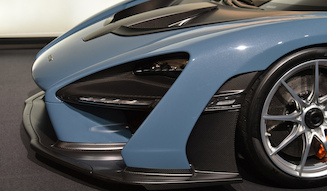
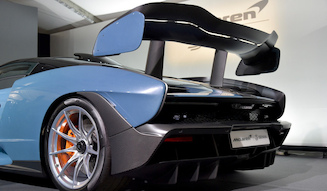
In terms of aerodynamics, active front aero blades and an active rear wing, among other features, achieve both efficient cooling and a downforce of up to 800kg. For ergonomics, he highlighted the driver-focused cockpit.
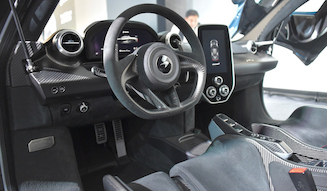
Upon entering through the dihedral doors, one notices the minimalist interior with exposed carbon fiber parts. The simple steering wheel, movable instrument cluster, shift controls (D/N/R) located to the driver's right and fixed to the seat with a satisfying click, and the start button and door levers on the roof are all positioned perfectly for intuitive reach, even with a full-face helmet on.
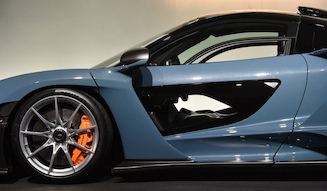
Furthermore, the Monocage III body, slim roof pillars, and glass sections below the doors provide an unusually wide field of vision for a car of this type, which is also remarkable.
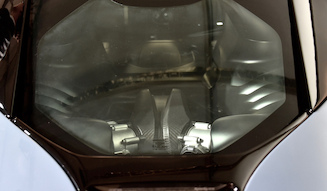
In terms of performance, the mid-mounted, codenamed M840TR, 4.0-liter V8 twin-turbo engine produces a maximum output of 800ps at 7,250rpm and a peak torque of 800Nm between 5,500-6,700rpm. Power is sent to the rear wheels via a 7-speed SSG dual-clutch gearbox.
Thanks to McLaren's most powerful engine and lightest chassis to date, the power-to-weight ratio is 668ps/ton. This allows for acceleration from 0 to 100 km/h in 2.8 seconds, 0 to 200 km/h in 6.8 seconds, and 0 to 300 km/h in 17.5 seconds. The stopping power is equally impressive, with the ability to halt from 100 km/h in just 29.5 meters, from 200 km/h in 100 meters, and from 300 km/h in 215 meters.
Williams explained, "There's no mention of top speed because the Senna is a track car. What matters is not the maximum speed, but the lap time on a circuit. To achieve that, acceleration, deceleration, and cornering speed are crucial."
According to the specifications, the Senna measures 4,744mm in length, 2,051mm in width (mirrors folded), and 1,229mm in height. Its top speed is officially stated as 340 km/h.
McLaren Senna
McLaren's Latest Machine, the Senna, Arrives in Japan for the First Time (3)
Pursuit of Driver and Car Synergy
Williams, who has been with McLaren Automotive for over 10 years and oversees the engineering design and development of all its products, shared in an interview immediately after the press conference, "Actually, when we started development, we hadn't decided to name this car the Senna. But as we worked on it, we felt the name Senna was a perfect fit, and that's how the decision was made."
He added, "McLaren's people resonated with Senna's attitude towards driving and his complete dedication to racing. There was a connection between Senna and the development team."
"We design cars for drivers. Our focus is on the driving experience – the feel of the brakes, the steering response, how the throttle changes with gear shifts, the sounds and vibrations within the cabin – we aim to provide a comprehensive driving experience."
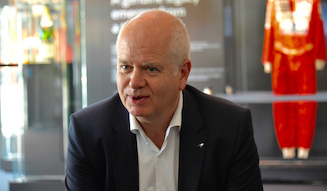
Williams confidently stated, "From a performance perspective, I believe McLaren cars are superior to all competitors. However, what we prioritize even more than performance is the engagement between the driver and the car. We strive to create an intuitive experience where a bond with the automobile can be felt." This is how the McLaren Senna came to be.
When asked about McLaren's future, he said, "P1" and other hybrid models are a trend, and we will continue to pursue them. On the other hand, while autonomous driving is a remarkable technology, it doesn't align with our core business as we are not in the transportation business. We offer a lifestyle and the joy of driving.
Regarding the much-anticipated McLaren SUV model, the answer was a clear "No!" He concluded, "We are developing cars with great passion for sports cars, and we want Japanese users and fans to further understand the McLaren brand and its value, to see it, and to enjoy it."