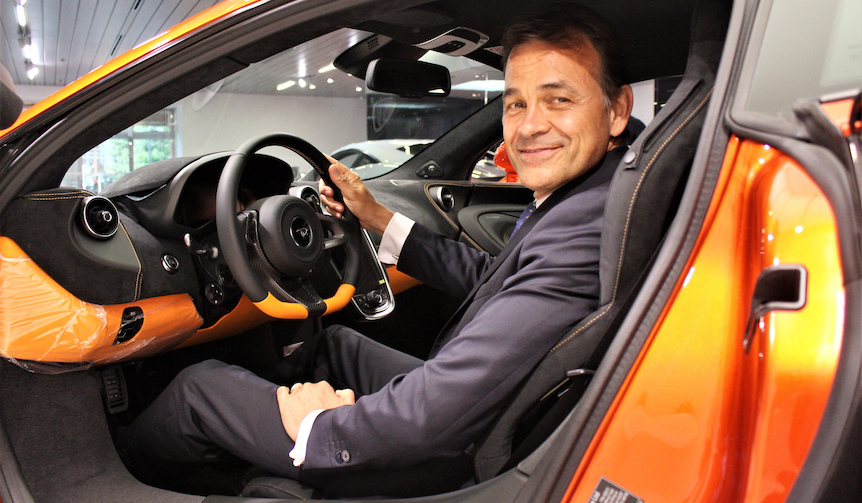
An Interview with McLaren Automotive's Head of Sales & Marketing.
McLaren
The Pride of a Sports Car Maker: McLaren's Vision for the Future
McLaren is actively expanding its dealership network in Japan, with locations in Tokyo, Nagoya, Osaka, and Fukuoka. Recently, the Nagoya showroom and service factory underwent a renewal and grand reopening. To mark the occasion, Jolyon Nash, McLaren Automotive's Global Sales & Marketing Executive Director, visited Japan. He is the executive who oversees global sales and marketing directly under CEO Mike Flewitt. We took this opportunity to ask him about McLaren's current status, and about trending topics such as electric vehicles and autonomous driving.
Interview & Photographs by UCHIDA Shunichi
The Japanese Market Shows Significant Growth
—McLaren is currently actively expanding its dealer network in the Japanese market. From the perspective of headquarters, could you tell us about the characteristics of the Japanese market?
Jolyon Nash(Hereafter omitted) Yes. The Japanese market sold 179 units last year, showing a growth of 198 percent year-on-year (JAIA figures for 2015 show 90 units sold), and is growing rapidly. Japan is our fourth-largest market, following the United States, the United Kingdom, and China.
The biggest factor behind this growth is the introduction of the Sports Series. Launched in 2015, the Sports Series was sold for the full year in 2016. The appeal of the Sports Series is that it allows customers to purchase a supercar at the price point of a sports car.
Another key point is that 75 to 80 percent of Sports Series customers are first-time McLaren buyers.
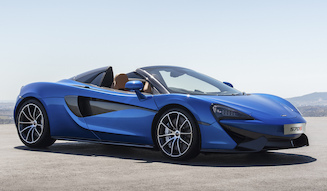
The latest model in the McLaren Sports Series, the570S Spider—
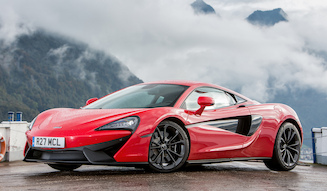
The entry-level model in the Sports Series, the540C Coupe—
—Where do these new customers typically transition from? What segments or cars are they trading in?
They come from almost all manufacturers in the sports car segment. Examples include Aston Martin, Porsche, Audi, and Mercedes-Benz, but we also have customers coming from Ferrari and Lamborghini. Overall, customers from German brands, in particular, are choosing McLaren.
Porsche users, in particular, seem to find McLaren a car they can consider as a replacement. Until now, there hasn't been a direct rival for Porsche, but with the advent of the Sports Series, Porsche customers are seriously considering a trade-in. Users of core models in the 911 series, such as the "Turbo," "Turbo S," "GT3," and "GT3 RS," appear to be particularly inclined towards this.
McLaren
The Pride of a Sports Car Maker: McLaren's Vision for the Future (2)
McLaren Will Not Build an SUV
—In recent years, many high-performance and luxury car brands, with the exception of Ferrari, have introduced SUV models. How does McLaren view this trend?
Certainly, the SUV market is a growing segment, and if a brand can afford it, there's no reason not to enter it. For example,Bentleyhas already introduced the Bentayga, and if that decision proves correct for Bentley, thenRolls-Roycewill likely also venture into SUVs. However, from the perspective of a supercar and sports car manufacturer, it raises questions.
SUVs are neither lightweight nor high-performance. Therefore, they do not align with McLaren's concept. Furthermore, while most cars today are designed with efficiency in mind, SUVs are inherently far removed from efficiency. Of course, we cannot stop customers from purchasing them.
In essence, McLaren is a manufacturer of lightweight, high-performance sports cars, or lightweight, high-performance supercars. They must also be luxurious. Consequently, we have absolutely no intention of building an SUV.
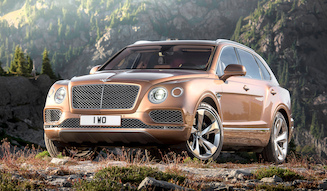
Bentley's first SUV, the "Bentayga"
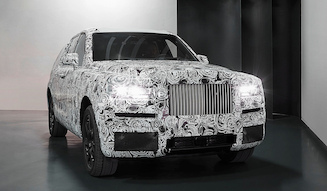
Rolls-Royce is also developing an SUV model, "Project Cullinan"
—What are your thoughts on autonomous driving?
For us, technology and innovation must always serve to enhance the driving experience. With that in mind, we must carefully consider whether autonomous driving truly enhances the driving experience.
On the other hand, if certain autonomous driving functions become mandatory in specific markets, we believe we will need to adapt and implement them.
Let's consider a somewhat extreme example. Imagine a future where technology and regulations permit it: you're in central Tokyo, driving a McLaren. You input your destination, say, to Fuji Speedway, and the car navigates through the city and highways autonomously. Then, upon arrival at Fuji Speedway, you disengage the autonomous mode and drive on the circuit yourself. Such scenarios are conceivable.
However, personally, I hope that era never arrives. This is because McLaren customers purchase our cars for the act of driving, for the thrill it provides. If it becomes autonomous, it will simply be a means of transportation. If that happens, perhaps it would be better for them to use public transportation rather than buy a McLaren.
While we're at it, let's discuss electric vehicles. The automotive industry is undoubtedly heading towards electric vehicles sooner or later. Therefore, we must consider what kind of electric vehicle would be suitable for McLaren. Firstly, does a supercar EV possess emotional appeal? And secondly, is it a car that allows the driver to actively participate in the driving experience? In other words, does it engage the senses in the same way as driving a contemporary McLaren? That is the crucial point.
There's also the issue of batteries. Currently, there are no solutions that balance range and power. Therefore, we intend to build prototypes and explore how electric vehicles can become, or have the potential to become, supercars.
McLaren
The Pride of a Sports Car Maker: McLaren's Vision for the Future (3)
The Era of Pre-War Coachbuilders Returns!?
—McLaren offers MSO (McLaren Special Operations), which handles personalization, and it's utilized by about 20 percent of customers in Japan. As other luxury brands also focus on such bespoke customer service and personalization, do you believe this will become increasingly important for McLaren as well?
It's not just important; it's essential. In today's luxury market, personalization is a must for customers. It's the 'money can buy' mentality – they want to buy whatever they can with money. I believe the current customer's mindset is to leave their 'fingerprint,' their personal mark, on their car.
Customers want to differentiate their vehicles. This is why MSO's popularity is rapidly increasing.
I feel that the current luxury market is returning to the 1920s and 1930s. That was the era of coachbuilders, wasn't it? It feels like we are returning to that period.
—So, is it possible for customers to commission McLaren to build designs they envision themselves?
First, they need to have sufficient funds (laughs). It's not that McLaren wants to profit, but if we are to engage in modern-day coachbuilding, we must meticulously assess aspects like ensuring adequate safety and environmental compliance for one-off builds, which naturally incurs costs.
In 2013, we introduced the McLaren "X-1." This was a one-off car built by MSO based on a customer's request. While based on the "12C," it was reborn with a completely new body. MSO is capable of such creations. Of course, it involves a significant investment.
The X-1's design was inspired by the good old days of the 1930s, and this is also a valid form of personalization.
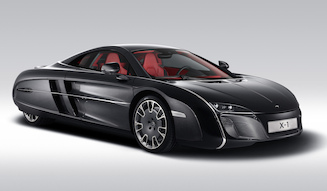
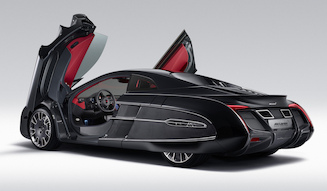
—We understand very well that personalization, including one-offs, is possible at McLaren. However, to protect the McLaren brand image, are there any restrictions in place?
Regarding the extent of what MSO can do, let's say the limit is 'the customer's imagination.' Fundamentally, it must not affect performance, and it absolutely must not compromise safety. As long as these two conditions are met, it's up to the customer. For example, if a customer brings in a design, we won't say, 'Oh, that's not going to work' (while making a face). If the customer approves, we will build it.
—So, if it doesn't impact performance or safety, would you build an SUV?
It depends on whether it fits our platform. That's the first question.
Typically, customers don't come to MSO with a blueprint and say, 'Build this for me.' Instead, the customer and MSO designers collaborate closely. We listen to the customer, understand their inspirations, and then we propose designs. From there, we refine it through iterations, getting closer to the customer's vision.
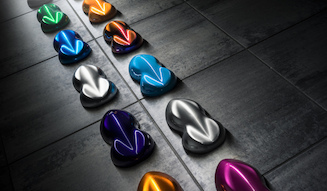
We also receive many requests regarding color. We are currently building a car at our factory based on a customer's request to paint it the exact color of a flower they brought in.
There was also a request from a father and son, each owning a "P1." One wanted theirs made to resemble Ayrton Senna's helmet, and the other to resemble Prost's. MSO makes such diverse possibilities a reality.
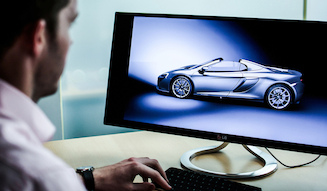
The Lineup May Expand
—Regarding the lineup, you currently have three categories: Ultimate, Super, and Sports. Will this change in the future – will you add or reduce models?
We will not reduce it. It's possible we might expand it, but unfortunately, we cannot yet provide a definitive answer regarding targets or specifics.
—Can we expect something by 2022?
Within the framework of Track22, you will be able to see the direction in which this product series will evolve.
—Finally, what kind of company is McLaren to you?
I believe it's a wonderful place to work. Being in a position to oversee the sales and marketing of a global brand, and also being involved in the decision-making regarding product strategy, is a fantastic role.
Moreover, I love cars and driving. Since joining McLaren, I've also obtained a circuit driving license. For sports car enthusiasts, is there any better place to work than McLaren?