Why Not? Why Must We Drive Sports Cars?
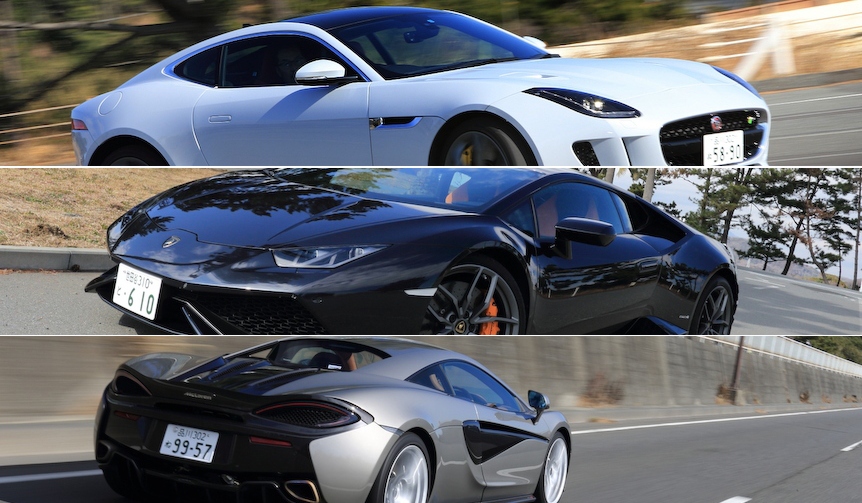
McLaren 570S
Jaguar F-Type R AWD
Lamborghini Huracan LP610-4
Why Not? Why Must We Drive Sports Cars?
The lineup of imported cars is becoming more substantial. In the realm of sports cars, which are truly sports cars, interesting models are continuously appearing in Japan. Fumio Ogawa proposes that we should not be bound by conventional values and should make choices that suit our own tastes.
Why Not? Why Must We Drive Sedans?
Text by OGAWA FumioPhotographs by ARAKAWA Masayuki
Cool, Cool Sports Cars
Why Not a Ferrari?—McLaren 570S
McLaren is a very interesting company. It all started in 1963 with Bruce McLaren's Formula 1 team. McLaren Cars was spun off from this in 1990, with the aim of manufacturing and selling sports cars.
McLaren Automotive was established in 2009 with new capital investment. While inheriting the philosophy of McLaren Cars, it initially aimed to be independent from the McLaren Group, which focused on F1 activities. However, in reality, they are relatively close in terms of management structure.
McLaren Automotive offers a rich lineup. Broadly divided into three categories. At the top is the "Ultimate Series." Next is the "Super Series," which excels on the circuit, and then the "Sports Series," aimed at a wider audience. The "570S" belongs to the Sports Series. The previously released "650S" is from the Super Series. To create such a variety of models, even for sports cars that warrant the "super" designation. Personally, I find some overlap in image between ultra-luxury watch brands and McLaren Automotive, perhaps due to the sense of devotion to precise mechanisms and this kind of product development strategy.
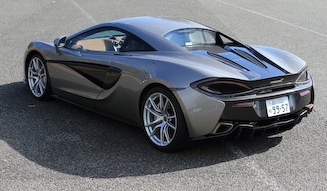
The appeal of the McLaren 570S lies in its incredibly precise engineering. It truly feels like a finely crafted watch. In terms of price, the 570S at 25.56 million yen would have the Ferrari California T, which also converts to open-air driving,California T(24.5 million yen) as a rival. The Ferrari is equipped with a 3,855cc V8 engine producing 412kW (560ps) mid-ship, achieving 0-100 km/h in 3.6 seconds. In contrast, the 570S features a 3,799cc V8, also mounted behind the cockpit, with a maximum output of 419kW (570ps), and accelerates from 0 to 97 km/h in 3.1 seconds.
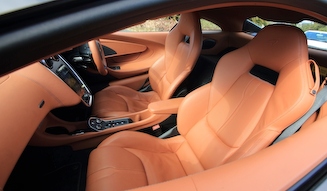
If the appeal of Ferrari lies in its ability to instantly exhilarate the driver, then McLaren is cool. As its unpretentious styling suggests, the impression it gives is one of "quietness." Yet, it is incredibly fast, and the handling is precise. While numerically less powerful than the 650S, which does 0-97 km/h in under 3 seconds, and potentially inferior on the track, this is only when compared to the "top tier." Considering the high quality of the interior, it's undeniable that you'll grow to love it more and more.
It lacks ostentatious flashiness. If you can appreciate that, it's a sports car that brings joy and pride to its owner. Furthermore, it offers a comfortable ride, making it suitable for long journeys as a GT (though untested). McLaren Automotive has recently begun adding high-performance models (similar to Porsche's strategy). The 570S's appeal also lies in its ability to satisfy the "this is enough" sentiment. It's a sports car that suits the Japanese palate.

McLaren 570S Coupe
Body Size | Length 4,530 x Width 2,095 (incl. mirrors) x Height 1,202 mm
Weight | 1,344 kg (1,313 kg with lightweight options)
Engine | 3,799 cc V8 Twin-Turbo
Maximum Output | 570 ps / 7,500 rpm
Maximum Torque | 600 Nm / 5,000-6,500 rpm
Transmission | 7-speed Automatic (SSG)
Drivetrain | MR
Suspension | Double Wishbone (Adaptive Dampers)
Tires Front/Rear | 225/35R19 / 285/35R20 (Pirelli P ZERO Corsa)
Brakes | Carbon Ceramic Discs
Top Speed | 328 km/h
0-100km/h Acceleration | 3.2 seconds
0-200km/h Acceleration | 9.5 seconds
CO2 Emissions | 258 g/km
Fuel Economy | 11.1 ℓ/100 km (approx. 9.0 km/ℓ)
Price | 25.56 million yen
Why Not? Why Must We Drive Sedans?
McLaren 570S
Jaguar F-Type R AWD
Lamborghini Huracan LP610-4
Why Not? Why Must We Drive Sports Cars? (2)
Cost Performance and Enjoyment
Why Not a 911?—Jaguar F-Type R AWD Coupe
Jaguar's sports model, the "F-Type" comes in a rich variety of configurations. The body is available in two types: coupe and convertible. The engine specifications are even more diverse.
The base model "F-Type" (from 8.87 million yen) features a 340ps (240kW) 3-liter V6. The "F-Type S" (10.79 million yen) is basically the same V6 but with a maximum output of 380ps (280kW). The "F-Type R" (from 13.73 million yen) is powered by a 550ps (405kW) 5-liter V8. Soon, a "F-Type SVR" with 575 horsepower (473kW) (17.79 million yen) will be added.
Another characteristic of the F-Type lineup is the availability of both rear-wheel-drive and full-time all-wheel-drive (called AWD by Jaguar) models. This was added in 2015 as the "F-Type R AWD." Normally, most of the torque is distributed to the rear wheels. The engine is a 5-liter V8, and both coupe and convertible body styles are available.
The appeal of the Jaguar F-Type lies, in essence, in its rich variety. There is also a model with a manual transmission (F-Type S). Among them, the F-Type R AWD demonstrates outstanding all-around performance.
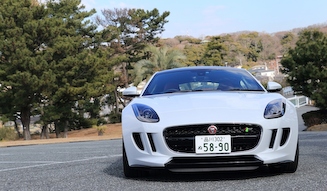
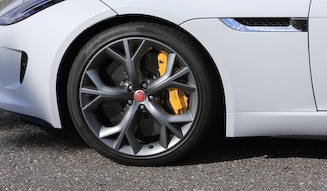
The appeal of the F-Type R AWD lies in its balance of power and comfort. Moreover, the AWD system is quite reliable on snowy roads (when combined with winter tires). The ground clearance is only slightly increased, so while snow-covered roads might be challenging, it can handle packed snow with ease. This is fitting for the F-Type, a sports car that adapts to all lifestyles and possesses luxury.
Considering the price and model range, the F-Type's rival would likely be Porsche's "911" series. While the 911 has been increasingly downsizing its engines (or 'right-sizing,' as it's apparently called) recently, the F-Type is pursuing higher performance, and their directions feel similar.
The 911 is priced considerably higher than the F-Type. The basic "Carrera" model is 13,091,000 yen, close to the F-Type R. It features a 370ps (272kW) 3-liter 6-cylinder engine with rear-wheel drive, accelerating from 0 to 100 km/h in 4.5 seconds. In contrast, the F-Type R does it in 4.2 seconds. If you opt for the slightly less powerful V6 F-Type S, the acceleration is 5.5 seconds, but the enjoyment gained makes up for the nearly 3 million yen price difference.
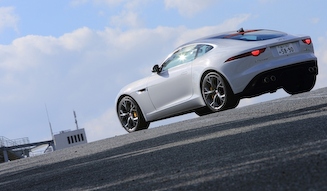
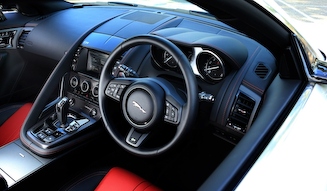
To truly enjoy the F-Type, the F-Type R AWD, which allows you to utilize its power to the fullest, is the best choice (SVR untested). From its stability at high speeds to its acceleration out of corners and when applying power, it fully leverages the high traction provided by all four wheels. It doesn't push outwards when cornering either.
Another advantage of the F-Type R AWD is its suitability as a long-distance tourer. You feel no fatigue even on long drives. While the ride might feel slightly stiff, its exceptional stability ensures that you arrive at your destination without feeling tired, even after covering great distances. It's very well-executed.
The seats are not only visually appealing (another advantage of the F-Type) but also likely offer excellent cushioning. After driving for extended periods, I was reminded of its high performance.
Jaguar F-Type R AWD Coupe
Body Size | Length 4,470 x Width 1,925 x Height 1,315 mm
Tread Front/Rear | 1,600 / 1,650 mm
Wheelbase | 2,620 mm
Weight | 1,860 kg
Minimum Turning Radius | 5.5 m
Engine | 4,999 cc V8 DOHC Supercharged
Bore x Stroke | 92.5 x 93.0 mm
Maximum Output | 495 kW (550 ps) / 6,500 rpm
Maximum Torque | 680 Nm / 3,500 rpm
Compression Ratio | 9.5:1
Transmission | 8-speed Automatic
0-100km/h Acceleration | 4.1 seconds
Top Speed | 300 km/h
Fuel Economy (JC08 mode) | 8.1 km/ℓ
CO2 Emissions | 269 g/km
Tank Capacity | 310-408 ℓ
Price | 14.44 million yen
McLaren 570S
Jaguar F-Type R AWD
Lamborghini Huracan LP610-4
Why Not? Why Must We Drive Sports Cars? (3)
A First-Class Production That Rejects Rationality
Why Not an Audi R8?—Lamborghini Huracan LP610-4
The Lamborghini "Huracan" is an exceptionally well-balanced model among sports cars that can be called "super." It excels in on-road performance, offers a diverse range extending to track models, and possesses a unique, striking design. Furthermore, with winter tires, it handles packed snow admirably (especially the full-time 4WD model designated with a "4" at the end).
Debuting in 2014 as the successor to the "Gallardo", the Huracan is a mid-engined sports car powered by a 5.2-liter V10 engine. It comes in two output variants: 580ps (427kW) and 610ps (449kW), which are reflected in the model name. The body styles are coupe and spyder. As for the drivetrain (currently),LP580is rear-wheel drive, while the LP610 is full-time 4WD.
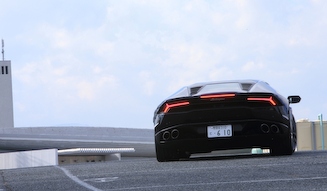
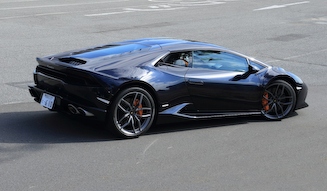
As is well known, the Huracan shares its platform with the new "R8" from its parent company, Audi. This significantly contributes to its exceptionally stable driving performance within its class. Despite its exotic appearance, its ease of handling is remarkable. While rearward visibility can be somewhat challenging, this is now covered by electronic warning systems. It is a car that can be used daily.
Even so, the performance is extraordinary, as evidenced by the 0-100 km/h acceleration of 3.2 seconds. The handling is quick and sporty, including the steering, which has a slightly heavier feel. It might feel a bit overwhelming for those unaccustomed to it, but drivers familiar with large-displacement sports cars from the past will surely exclaim, "This is it!" It's built with an understanding of sports car heritage.
The fascination of the Huracan lies in its interpretation and reconstruction of the desired image of a sports car (to put it somewhat circuitously). At first glance, its appearance seems far removed from rationality, its overall height of 1,165mm is lower than the McLaren 570S, and the combination of thick, narrow tires with expensive-looking wheels all contribute to a strong sense of specialness.
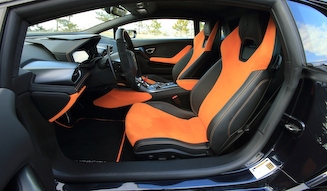
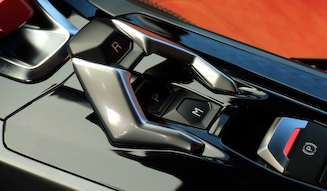
This is evident in its proportions with the cabin pushed forward, the use of hexagonal motifs—a design icon of the brand—throughout, the electronically amplified, dry exhaust note, and so on. By mobilizing all their knowledge to discover the intricate details, fans can enjoy a competition of "loyalty" towards Lamborghini's developers and the brand itself.
Finally, it's worth noting that the 5.2-liter V10 is naturally aspirated. While many sports car manufacturers, including Ferrari and (though not direct rivals) Porsche, are moving towards turbocharging, Lamborghini is sticking with a large displacement. The surge of power as the revs climb is exquisite. It's a super sports car for those "in the know."
Lamborghini Huracan LP 610-4
Body | Length 4,459 x Width 1,924 x Height 1,165 mm
Wheelbase | 2,620 mm
Tread Front/Rear | 1,668 / 1,620 mm
Vehicle Weight | 1,422 kg
Engine | 5,204cc V10
Bore x Stroke | 84.5 x 92.8 mm
Maximum Output | 449 kW (610 ps) / 8,250 rpm
Maximum Torque | 560 Nm / 6,500 rpm
Transmission | 7-speed LDF (Lamborghini Doppia Frizione)
Drivetrain | 4WD
Suspension Front/Rear | Double Wishbone
Tires Front | 245/30R20 (Pirelli P Zero)
Tires Rear | 305/30R20 (Pirelli P Zero)
Brakes Front | Ventilated Carbon Ceramic Discs φ380 x 38 mm
Brakes Rear | Ventilated Carbon Ceramic Discs φ356 x 32 mm
Top Speed | 325 km/h
0-100km Acceleration | 3.2 seconds
0-200km Acceleration | 9.9 seconds
Fuel Economy | 12.5 ℓ/100 km (approx. 8.0 km/ℓ)
CO2 Emissions | 290 g/km
Price (incl. tax) | 29.70 million yen