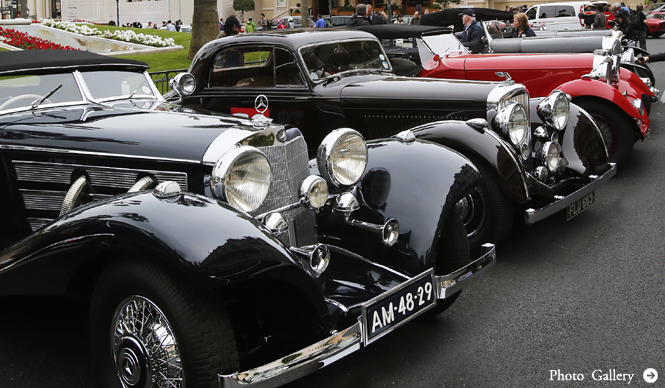
Louis Vuitton Classic Serenissima Bag (1)
Louis Vuitton or The Art of Travel
Foreword: Louis Vuitton Classic Serenissima Run
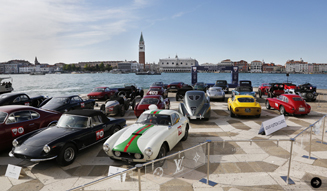
From April 24th to 28th, 42 classic cars raced 1,400 km from Monte Carlo, Monaco, to Venice.
Text by SUZUKI Fumihiko (OPENERS)
Travel, Automobiles, and Louis Vuitton
In 1854, the world's first luggage store opened.Louis VuittonThe brand, Louis Vuitton, began as a trunk manufacturer using a grey canvas called 'Trianon canvas.' In 1858, Louis Vuitton created a flat trunk that was light, closed securely, and could be easily stacked. This masterpiece set the standard for all subsequent travel trunks, and the brand's reputation became immortal within years of its founding.
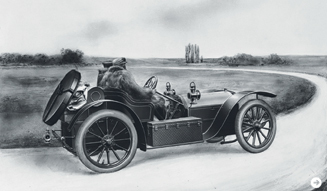
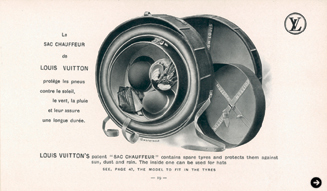
Louis Vuitton's identity lies in its travel luggage. Therefore, the brand never forgets, and always emphasizes, its connection to travel. In 1892, the founder Louis Vuitton passed away, and his son Georges took over. In 1896, the brand introduced the 'Monogram,' which still characterizes Louis Vuitton bags today, and grew into a global brand. Around the same time, in 1898, Louis Vuitton presented trunks for automobiles, which were gradually becoming more practical as a means of travel replacing horse-drawn carriages. The unveiling took place at the world's first motor show, the Paris Motor Show. These Louis Vuitton car trunks, in addition to their high practicality, were also waterproof. They were cherished as indispensable companions for protecting essential items and personal effects during long-distance journeys known as grand tours by car or carriage, or during arduous adventure travel. From then on, Louis Vuitton's luggage continued to accompany the history of rapidly advancing automobiles—
From Monte Carlo to Venice
The "Louis Vuitton Classic," a classic car rally organized by Louis Vuitton, is dedicated to the bond between automobiles and Louis Vuitton that has continued since the dawn of the automotive era. It consists of the "Run," a rally, and the "Awards," where prestigious cars are selected by a special jury. The Awards have been considered one of the world's most valuable car awards since 2005. While details will be covered in subsequent articles, it honors cars that possessed innovative and complete qualities, holding timeless value as benchmarks—both classic cars of the past and the latest cars that will undoubtedly receive the same recognition 40 years from now.Last year,the "Talbot-Lago SS T150C Aero Coupe" andJaguar C-X75received awards.
Meanwhile, this year's Run, which marks its seventh running since the "Vintage Ecurie Run" in 1993, has been named the "Serenissima Run." It departs from Monaco, passes through Switzerland, and heads towards Serenissima, meaning "The Most Serene Republic" (Serenissima Repubblica di Venezia), Venice.
A total of 42 vintage cars participated, traversing 1,400 km over four days, passing through Annecy Lake in France, Mont Blanc, Stresa on Lake Maggiore, the medieval town of Verona, and Fiesso d'Artico, the birthplace of Louis Vuitton's shoe-making expertise.
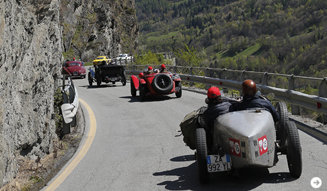
Grand Prix Winner: Bugatti Type 23
On April 28th, the participating vehicles were transported by boat to the island of San Giorgio Maggiore, adjacent to Venice, for the awards ceremony.
From the 42 cars, the Grand Prix was awarded by Yves Carcelle, Chairman and CEO of Louis Vuitton Malletier, Christian Philippsen, Chairman of the Jury, and René Mége, Sports Director, to a 1923 Bugatti Type 23 "Brescia Modifiée."
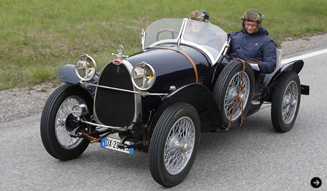
The history of this car, designed by Ettore Bugatti, dates back to the Type 13. After the prototype Type 10, the Type 13, completed in 1910 as Bugatti's first car, was a lightweight racing car weighing only 300 kg, equipped with a highly advanced 1.5-liter, four-cylinder, 16-valve engine with four valves per cylinder for its era. Not only was it technically superior, with this engine producing approximately 22.4 kW at 2,700 rpm and the use of lightweight alloys, but it was also aesthetically exceptional, reflecting the uncompromising aesthetic sensibility of Ettore, a member of the artistic Bugatti family, down to every rivet. Although production was hampered by the turmoil of World War I, Ettore buried parts for three Type 13s near the factory and evacuated to Milan with one completed car. After the war, five Type 13s were manufactured.
In 1921, this Type 13 demonstrated its unrivaled performance by sweeping the top four positions at the Italian Brescia Grand Prix, earning it the nickname "Brescia." The Type 23, also known as the "Brescia Modifiée," is the production model of the Type 13. Approximately 2,000 units were manufactured between 1920 and 1926, and it is known for being the first production car to feature a multi-valve engine.
With its completion, embodying both elegance and technology, it truly stands as a worthy recipient of the Louis Vuitton Classic award.