Commentators Discuss the Automotive World Post-3.11—Part 2
Experts Discuss the Post-3.11 Automotive World
Special Roundtable: Part 2
What Kind of Car to Choose After the Earthquake?
Regarding cars that will lead society in the future, not only EVs but also fuel cell vehicles,a lively discussion took place in the previous roundtable.This time, we asked them to share their thoughts on more practical car selection and other topics.
Speakers: Fumio Ogawa, Yasuhisa Shimashita, Toshifumi Watanabe, Koichi Yamaguchi (Editor-in-Chief)Photos: JAMANDFIX (portraits)Summary: Dai Matsuo
Contactless Charging for EVs, Expected by 2015
YamaguchiAre electric vehicles ready for widespread adoption? I'd like to hear your thoughts on the reality and future of this. In our previous discussion, it was mentioned that within a few years, fuel cell vehicles, which use electricity generated from reformed hydrogen to power a motor, might become available. Certainly, utilizing inexhaustible hydrogen energy would be wonderful. However, considering the infrastructure like hydrogen stations, it seems that rechargeable EVs are more realistic at the moment. So, my question is, do EVs still have room for improvement?
WatanabeWhile not about the EV itself, as we touched upon briefly last time, there's a possibility of wireless power transfer, isn't there?
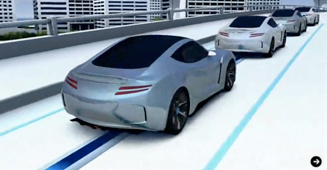
YamaguchiContactless charging, right? The current charging method involves plugging a cord into a car, but this technology allows charging simply by parking in a designated spot. Some automakers are aiming for this as early as 2015. Further ahead, there's a vision of enabling charging while driving by installing contactless charging lanes on roads. If the infrastructure for contactless charging is established, will EVs become more widespread?
EV Share Around 10% Even in 2020
OgawaIt will likely increase somewhat. However, the more crucial factor will be an extended driving range. If charging becomes possible while driving, then all our needs could be met by electric vehicles. It's precisely because this is seen as difficult that automakers are focusing on fuel cell vehicles in parallel with EV development. Fuel cell vehicles also leverage EV technology, and instead of charging, they can be refueled with hydrogen like gasoline cars, making them more convenient.
WatanabeFor example, in nine years, by 2020, electric cars are projected to account for at most about 10 percent of the market. Even Nissan, which sells the Leaf, anticipates a similar figure. However, if we can increase that small 10 percent share to around 12 to 13 percent, EVs will become more familiar. I believe we in developed countries are responsible for driving this adoption.
Experts Discuss the Post-3.11 Automotive World
Special Roundtable: Part 2 (2)
What Kind of Car to Choose After the Earthquake?
Challenges of the Nissan Leaf
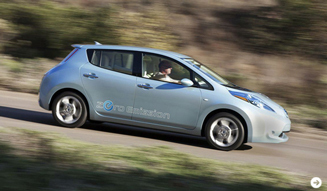
"Nissan Leaf"
OgawaIn terms of EV potential,the Nissan Leafis very well-made. You don't feel like you're making compromises. It really makes you think, 'EVs are impressive.'
WatanabeFirst of all, it's quiet, and I felt it had the potential to create a ride quality that surpasses any luxury sedan.
ShimashitaThe torque is available from anywhere. You can truly tune it as you wish.
OgawaI actually quite like the Leaf.
ShimashitaI like it too. However,the "Golf Blue e-Motion," an electric vehicle based on the Golf currently being developed by Volkswagen,which I drove last year. What I felt was that the Leaf's strengths are rooted in it being an EV. Its fundamental performance as a car, such as handling and ride comfort, is close to the Tiida, and if both became EVs, the discussion would be about which is better, the Golf or the Tiida. It's natural to think the one based on the Golf is better. If the Leaf remains complacent as it is, EVs based on the Golf and Ford Focus will emerge. The situation is constantly changing.
EVs Create Synergistic Effects Through Miniaturization
YamaguchiSo, if being an EV is no longer an advantage, then its appeal and fundamental performance as a car will be questioned.
WatanabeI also drove the Golf EV, and I strongly agree with what Shimashita-san said. However, I think it would be difficult to bring it to market as is.
ShimashitaIt won't be released in that exact form. The base will likely be the next-generation Golf. Although it's a prototype made without regard for cost, the general direction should remain similar.
WatanabeIf Volkswagen were to produce a commercial EV, I suspect the shape would be entirely different.
Much like the BMW i3 currently under development. I believe the ideal shape will converge in that direction. If you achieve a package that is simply small and light for the transportation of two adults, the battery can naturally be smaller. A smaller battery means a shorter charging time... In the case of EVs, being smaller creates synergistic effects exponentially.
Experts Discuss the Post-3.11 Automotive World
Special Roundtable: Part 2 (3)
What Kind of Car to Choose After the Earthquake?
Will EVs Change Traditional Car Design?
YamaguchiShould the basic structure and packaging of EVs, which are designed with electric motors in mind, differ from conventional cars designed for internal combustion engines?
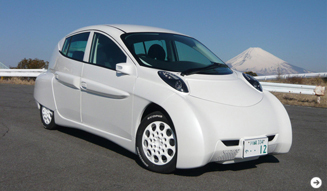
OgawaElectric motors are not as large as engines, but batteries need to be installed. However, there's no need for a fuel tank, and if small electric motors are integrated into each wheel, a large drive system becomes unnecessary. Freed from physical limitations, the benefits of an electrically controlled system will manifest as spacious interiors, for example.
There's also the possibility of being constrained by conventional styling due to current regulations on collision safety and pedestrian protection.
WatanabeIan Callum, Jaguar's chief designer, said, 'The back of the head isn't where a person's head is. Unless the human form changes significantly, the car's shape won't change' (laughs).
OgawaWell, even after more than 100 years since British cars evolved from horse-drawn carriages, their proportions haven't changed much. Perhaps with EVs, it will be a package with electric motors instead of horses (laughs). Rather, I'd like to see innovation from Japanese automakers who aren't bound by such conventions.
Is the Engine's Presence Fading?
YamaguchiSpeaking of which, will the shift from internal combustion engines to electric motors create a sense of unease for users?
WatanabeI believe there will be an emotional aspect. After all, there's the enjoyment unique to automobiles, stemming from the feel of an engine burning 'oil'.
ShimashitaI used to think so too. However, nowadays, when I rent a new car from a manufacturer and it doesn't have an idling stop function, I find myself thinking, 'Huh, it doesn't have one?' My feelings have changed that much. I wonder if eventually I'll start thinking, 'Huh, it has an engine?'
WatanabeI do wonder if people driving a Prius might eventually feel like they're missing out (laughs).
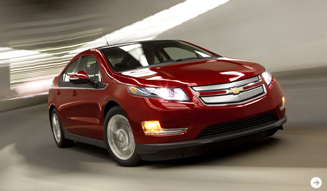
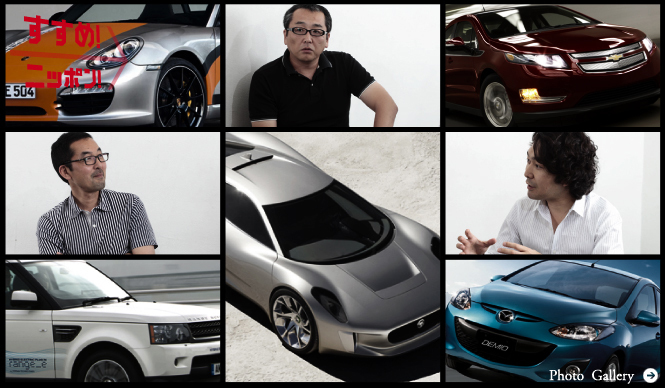
The Chevrolet Volt. It's a plug-in hybrid vehicle, often called a range extender, where the engine primarily serves to charge the battery, assisting the motor.
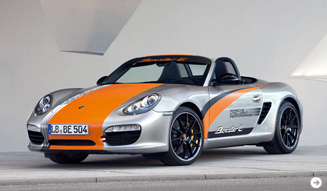
An EV version of the Porsche Boxster. With motors on both the front and rear axles, it outputs a maximum of 180 kW and a maximum torque of 540 Nm at a high rotation of 12,000 rpm. Its maximum range is 170 km.
OgawaPerhaps the engine's presence is becoming less significant due to downsizing. The performance of engines is rarely discussed in the context of hybrids. As car enthusiasts, we want engines to be properly implemented if they are to be included, but perhaps the general user isn't looking at that. Some cars, like theChevrolet Volt,even have engines solely for charging the battery. The nature of cars is definitely changing in certain segments.
Furthermore, German automakers don't seem to be focusing much on hybrids. They are serious about EVs, viewing hybrids as a transitional phase towards internal combustion engine vehicles. It's a way to appeal to the public and shareholders, saying, 'We are seriously considering a low-carbon society.' BMW has createdthe EV sub-brand 'i',and Porsche is enthusiastic about both hybrids and EVs.
WatanabeRegarding Porsche,the Boxsterhas the potential for various applications. Its center of gravity is very low, and it possesses an excellent fundamental structure for creating drivability, which has been a challenge for EV development so far. In that sense, it holds immense potential.
Experts Discuss the Post-3.11 Automotive World
Special Roundtable: Part 2 (4)
What Kind of Car to Choose After the Earthquake?
Has Your Mindset as a Journalist Changed Since the Earthquake?
YamaguchiReturning to our previous topic, as an automotive journalist, has your perspective changed at all after experiencing this earthquake?
WatanabeWhat was truly symbolic this time was the gasoline panic. 99% of people relying on cars were unable to move. Therefore, I believe we should consider making about 20% of Japan's cars diesel and creating policies that allow them to operate even in emergencies. We should be mixing various approaches like this.
OgawaHow can we escape a situation where our economy is dictated by oil-producing nations raising prices or by the oil we import? This was, in part, the background driving the promotion of nuclear power. Car owners were not very conscious of the fact that oil is imported. It seems we deliberately tried to forget. I regret that. However, even fuel cells use many rare earth components, and China, the largest producer of rare earths, is now restricting exports, with speculative money flowing in and driving up prices. While it's dependent on others, I have high hopes for the advancement of technologies utilizing geothermal and natural energy for power generation.

Motorization and Urban Development
ShimashitaMy perspective hasn't changed much. I've been thinking about how we can address issues of local communities and depopulation from the perspective of automobiles, and solving these requires considering energy. Especially concerning energy, smart grids and similar initiatives might have been suppressed and not progressed well if the pre-earthquake situation had continued. So, while I shouldn't say it's good, I feel like we've reached a point where we can say, 'Because we overcame these hardships, we've moved in a positive direction as a result.'
OgawaAlong with passenger cars, the efficiency of public transportation like buses in urban areas also seems to be a challenge. It's not always about cars. In Europe, 'park and ride' is frequently discussed. As societal systems change, cars will change. This is unavoidable. Isn't this the aspect we should be seriously considering regarding automobiles?
ShimashitaIn that case, we inevitably have to talk about urban planning. Will it be car sharing, or small EVs?

If a town were to have small EVs running around, even the issue of where to charge them would arise. However, if the infrastructure of existing large cities cannot be altered, perhaps these changes will start in regional cities, and that could become a catalyst for revitalizing those areas.
Experts Discuss the Post-3.11 Automotive World
Special Roundtable: Part 2 (5)
What Kind of Car to Choose After the Earthquake?
Anticipation for SKYACTIV!
YamaguchiCould you tell us if the criteria for choosing a car have changed at all since this earthquake?
WatanabeFuel efficiency is definitely on my mind.
OgawaThe core of this roundtable, the low-carbon society, and the move away from oil, underpinned by efficient electricity usage, emerged after the nuclear accident. Some say that if everyone charges their EVs, there will be a power shortage, and infrastructure development is still needed, but I'm looking forward to it. Unfortunately, I live in an apartment building, so there's currently no charging facility. Perhaps it's time to start discussions with the residents' association about setting aside funds for solar power generation and EV charging infrastructure for the near future.
WatanabeHowever, compared to ten years ago, the fuel efficiency of new cars released in the last one to two years has significantly improved across the board.
OgawaUnfortunately, regarding domestic cars, there hasn't been much significant change in internal combustion engines.
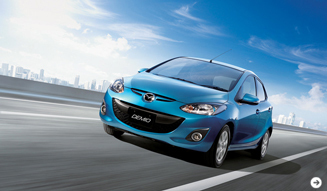
Watanabethe Demio's SKYACTIVis a prime example. They revisited the high compression of gasoline engines, which was previously deemed impossible through theoretical calculations or experience, and found an unexpected breakthrough with current solutions. It's a very 'engineer-like' and distinctly Mazda approach.
OgawaExactly! That looks promising! European cars are increasingly introducing environmental technologies suited to their circumstances, such as downsizing and dual-clutch transmissions, pioneered by Volkswagen and others.
ShimashitaSo, among Japanese manufacturers, only Mazda is doing this.
Shifting Values in the Automotive World
WatanabeIn any case, environmental performance is crucial for modern cars. Generally, driving a large car can make you seem unintelligent. Moreover, the basic performance of today's smaller cars is adequate. They aren't so loud that you can't converse, nor are they so impractical that they can't carry any luggage. It's becoming difficult to reconcile the idea of a car as a vehicle for personal hobbies with the concept of a car as a purely functional tool for transportation. To bridge this gap,the Cayenne S Hybridmight be a viable option.
YamaguchiIf an electric sports car that can store solar-generated power in its batteries becomes a reality, wouldn't that be not just for the owner's enjoyment, but also a socially relevant presence?
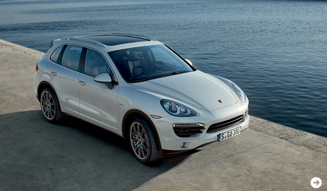
The Porsche Cayenne S Hybrid. It shares the same hybrid system as the Panamera S Hybrid, achieving fuel economy of 8.2 L/100km and CO2 emissions of 193 g/km.
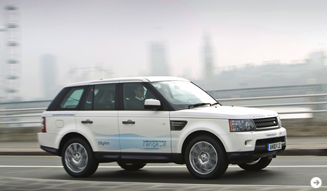
Land Rover unveiled the "Range e" plug-in hybrid at the Geneva Motor Show. Its powertrain combines a 3-liter TDV6 diesel engine with an electric motor, achieving CO2 emissions of 89 g/km.
ShimashitaWhen choosing a car, don't we have a desire to be told it looks cool or that we've bought something nice? In that sense, the concept has changed significantly. People now prioritize being told, 'You bought something that fits the times,' rather than 'It's cool.' Therefore, it's natural that the Prius is popular among those who aren't deeply passionate about cars.
WatanabeThe queues at gas stations during the earthquake certainly changed the mindset of those who could afford multiple cars. The coveted combination of a Porsche 911 Turbo next to a Range Rover collapsed. That's why both Porsche and Land Rover are desperately seeking fuel efficiency. Manufacturers are now facing a race against time, not only to anticipate trends but also to rapidly deploy environmental technologies.

Fumio Ogawa | OGAWA Fumio
After working for about 20 years at the editorial department of the car magazine "NAVI," which merged automotive culture with cars, he served as its editor-in-chief. He then became editor-in-chief of "Motor Magazine" and "Arigatto," and is now a freelance journalist. He writes for numerous magazines, including automotive publications like "ENGINE" (Shinchosha) and "EDGE" (Recruit), as well as lifestyle magazines covering a wide range of topics such as gourmet ("Shukan Post"), hotels, and fashion.
Blog "Fumio Ogawa's Work" | http://bluemeanie.cocolog-nifty.com/


Yasuhisa Shimashita | SHIMASHITA Yasuhisa
Motor journalist. His writing covers not only driving performance but also advanced environmental and safety technologies, brand theory, driving, and all other social phenomena surrounding automobiles. He also gives lectures and works as an instructor on eco & safety driving. He was a juror for the 2010-2011 Car of the Year Japan. His recent publications include "Gokuraku Hybrid Car Driving Techniques" and "Gokuraku Gasoline Diet" (both published by Nigen-sha).
Blog "Blog Named Desire" |
http://minkara.carview.co.jp/userid/362328/blog/

Toshifumi Watanabe | WATANABE Toshifumi
Born in Fukuoka Prefecture in 1967. After working in the editorial departments of motorcycle and car magazines at Kikaku-shitsu Neko (now Neko Publishing), he became a freelancer. His serialization "Car-nabe" in "Shukan Bunshun" is very popular among women as a piece that vividly dissects social trends and lifestyles through the lens of automobiles. In addition to specialized automotive magazines, he also writes for many general interest magazines such as "MEN'S EX" and "UOMO," gaining popularity.