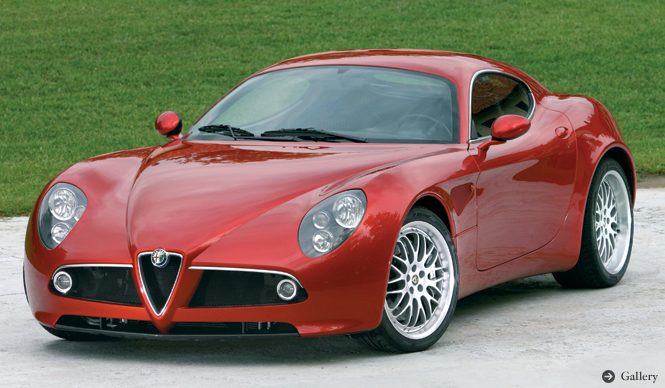
Alfa 8C Competizione / 8C Spider
ALFA 8C COMPETIZIONE/8C SPIDER
ALFA 8C COMPETIZIONE/8C SPIDER
A Pure Two-Seater Sports Car
In 1923, the brilliant Vittorio Jano was invited to Alfa Romeo. The eight-cylinder engine he developed was called the "8C" and brought Alfa Romeo numerous victories in the racing world.
Meanwhile, "Competizione" evokes the coupe "6C 2500 Competizione" driven by Fangio and Zanardi in the "Mille Miglia" race held in 1950. The "Alfa 8C Competizione," which debuted at the 2006 Paris Salon, was developed to revive these two glorious histories in the modern era.
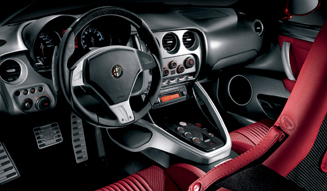
The two-seater pure sports car was designed by the Alfa Romeo Style Centre, blending beauty and aerodynamics with modern technology. The body combines a steel frame with carbon fiber panels to achieve both lightweight construction and high rigidity.
The engine is a 4.7-liter 90-degree V8, derived from Ferrari and Maserati, boasting 450 ps and 470 Nm of performance. It is paired with a 6-speed, two-pedal system. The transaxle configuration, placing the gearbox directly behind the rear differential, optimizes front-rear weight distribution for the handling befitting an Alfa super sports car.
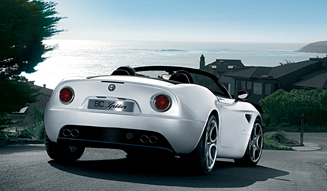
The open-top "8C Spider" was unveiled at the 2008 Geneva Motor Show, but unfortunately, reservations for both the Competizione and Spider have already closed.

ALFA 8C COMPETIZIONE
Body | Length 4397 x Width 1892 x Height 1340 mm
Engine | 4.7-liter V8
Max Output | 336 kW [450 ps] / 7000 rpm
Max Torque | 470 Nm [48.0 kgm] / 4750 rpm
Drivetrain | FR
Transmission | 6-speed, 2-pedal
Price | ¥22,590,000
(As of May 26, 2008)
BRAND HISTORY
From sedans to open-top sports cars, ALFA ROMEO boasts overwhelming popularity in Japan due to its stylish Italian design and sporty performance. In 1910, Italian entrepreneurs acquired the automobile assembly plant of the French company Darracq in Milan, establishing A.L.F.A. The name A.L.F.A. is an acronym for "Anonima Lombarda Fabbrica Automobil," meaning "Lombard Automobile Manufacturing Company."
A.L.F.A. soon introduced its own model, the "24HP," and began to distinguish itself as a sports car manufacturer through racing participation. However, its financial situation was not robust, leading to a significant change in management in 1915. It was at this time that businessman Nicola Romeo took the lead. In 1918, the company name was changed to Nicola Romeo & Co., and in 1920, after World War I, the first model bearing the Alfa Romeo emblem, the "Torpedo 20-30," was released.
In 1922, the company introduced the "RL," a full-fledged sports model. A 1-2 finish at the 1923 Targa Florio brought recognition to the Alfa Romeo name. In the same year, 1923, the racing car "P1" was developed, featuring a DOHC on its 1990cc 6-cylinder engine, a technology that would become characteristic of Alfa Romeo. However, the P1 itself was a failure. Consequently, Alfa Romeo recruited the brilliant engineer Vittorio Jano from Fiat to develop the Grand Prix car "P2," which left a brilliant mark on racing history.
After World War II, the company transitioned to mass-producing cars, releasing iconic models such as the "Giulietta Sprint" in 1954 and the "Giulia" in 1962. After being acquired by Fiat in 1986, models like the "Alfa 156," "Alfa 145," and "Alfa 147" became hits in Japan, further increasing Alfa Romeo's popularity.