An Interview with Marco Visconti, Designer of the Alfa 4C
Alfa Romeo
A True Alfista
Interview with Maccolini, Designer of the Alfa 4C
The newly unveiled pure sports car,Alfa Romeo "4C"coincided with its introduction in Japan, and the Chief Exterior Designer visited from Italy. How was its breathtakingly beautiful body created? Let's find out through this interview.
Interview & Text by OGAWA FumioPhotographs by ABE Masaya
The 4C's Designer is a Born Alfista
──First, could you tell us about your life and your connection with Alfa Romeo?
Mr. MaccoliniI've been with Alfa Romeo exclusively as a designer. My personal connection with Alfa Romeo began with my father. He was a huge Alfa Romeo fan, an "Alfista," as they say. He owned a succession of Giulietta, Giulia, and GTV models. My father, being from Milan, constantly instilled in me the charm of Alfa Romeo, a Milanese manufacturer. This led me to believe that anything other than an Alfa Romeo wasn't really a car.
──To be precise, the GTV you mention, was it the "1750 GTV" introduced in the 1960s? The beautiful coupe styled by Bertone?
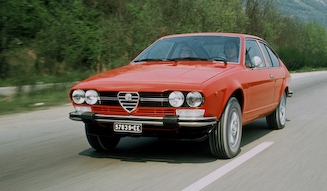
Mr. MaccoliniMy father owned theAlfetta GTVdesigned by Giugiaro. Even before I got my driver's license, I loved sitting in the passenger seat while my father drove, pretending to steer and shift gears, imagining I was in control. Alfa Romeo is the kind of car that makes you feel that way.
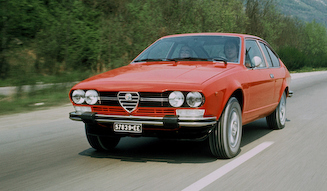
Alfetta GTV 2.0 (1976-1980)
──For Milanese people, is Alfa Romeo positioned above brands like BMW or Porsche?
Indeed, ALFA stands for "Anonima Lombarda Fabbrica Automobili" (Lombard Automobile Factory Company), and for Alfistas, it's a special existence. It's the closest thing to your heart, you understand? For some people, Alfa Romeo is in a league of its own. I believe we've now entered an era where Alfa Romeo is creating cars that everyone acknowledges as superb, going beyond mere image or sentiment. That is the 4C.
Alfa Romeo
A True Alfista
Interview with Maccolini, Designer of the Alfa 4C (Part 2)
Please View It with Three Keywords in Mind
──The 4C's style is captivating not only for Alfa Romeo fans but for all car enthusiasts.
Mr. MaccoliniThe primary role of this car is to be the flagship of Alfa Romeo. My job was to incorporate elements of both past and present Alfa Romeos while showcasing the future. While references to past models are often made, I never intended to create a mere copy of the past.
──Could you elaborate on what we should pay attention to?
Mr. MaccoliniI'd like people to focus on three keywords: "Proportion," "Elegance," and "Treatment." Proportion refers to the balance between the wheels and the body, and the balance of length, width, and height. Elegance is self-explanatory. Treatment refers to how the surfaces and lines are crafted, and the finishing of the details.
Another consideration when creating the styling was to make its impression change depending on the viewing angle. As you walk around the car, you'll notice that we consciously aimed to convey distinct aspects: sensuality, power, and dynamism.
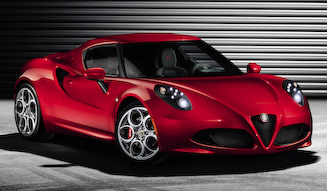
Alfa Romeo 4C
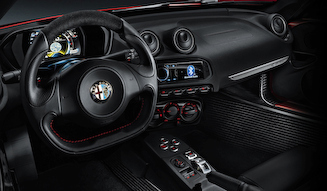
Alfa Romeo 4C
──The interior also has a unique character.
Mr. MaccoliniIn the interior, we've emphasized three elements: the dashboard, the floor, and the seats. The dashboard strongly conveys a sporty and high-tech image. The floor, made of carbon fiber, is also high-tech.
Conversely, the leather-upholstered seats evoke a sense of craftsmanship. We call this "super-mix technology." While Ferrari and Lamborghini might be a bit excessive, and competitors like Lotus'sElisedon't use carbon fiber and have a very tight interior, the 4C also offers comfort.
Alfa Romeo
A True Alfista
Interview with Maccolini, Designer of the Alfa 4C (Part 3)
The "Heart" of Alfa Felt in Its Past Masterpieces
──Recently, many car manufacturers have been actively featuring their past models, emphasizing their heritage through platforms like Google+. They also show enthusiasm for classic car rallies and concours d'elegance. From a designer's perspective, did you consciously incorporate similar elements into the 4C?
Mr. MaccoliniAre you asking if I consciously incorporated past imagery? I certainly acknowledge its importance. For instance, we put considerable effort into the design of the grille for the 4C. The style where the tip of the Scudetto (Alfa Romeo's shield-shaped grille) pierces the bumper, for example, is a motif inherited from models like the "GTV" and "166." It expresses a unique Alfa Romeo style while conveying a strong sense of energy.
──Are past models always a subject of study for you?
When I speak to aspiring design students about Alfa Romeo's style, I often show them images of many historical models. It's not about saying that copying past styles is important. Rather, I want them to have an opportunity to consider why Alfa Romeo has captivated us. I believe that by feeling the "heart" of Alfa Romeo, it becomes the foundation for creating future masterpieces.
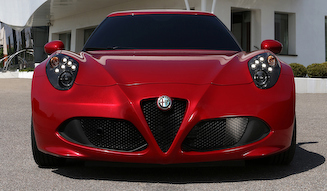
Alfa Romeo 4C
──The 4C certainly conveys that "heart."
Mr. MaccoliniBut between us, the design process was incredibly challenging. We sketched it in September 2010, and if it was approved, we presented a prototype at the Geneva Motor Show in March of the following year. It was an extremely rapid pace. Then, in 2013, the production model was unveiled. Furthermore, in 2014, we produced a prototype of the Spider version, with a planned release in 2015. It was a non-stop project.
──It certainly conveys a sense of momentum.
Mr. MaccoliniThere was so much work involved that I'm not sure if I could do it all again, but if you like it, I would be extremely happy.

Fiat Chrysler Group, Alfa Romeo Exterior Chief Designer
Alessandro Maccolini
In 1997, he worked on the exterior of the "147" at Alfa Romeo Centro Stile (Design Center). Subsequently, he served as the exterior designer and chief designer for numerous Alfa Romeo models, including the "156 Sportwagon," "8C Competizione Concept," "159," "MiTo",and "Giulietta."For the "4C",he was involved as the exterior designer and chief exterior designer, from the "4C Concept" unveiled in 2011 to the production model "4C", and the "4C Spider" announced at this year's Geneva Motor Show in March.