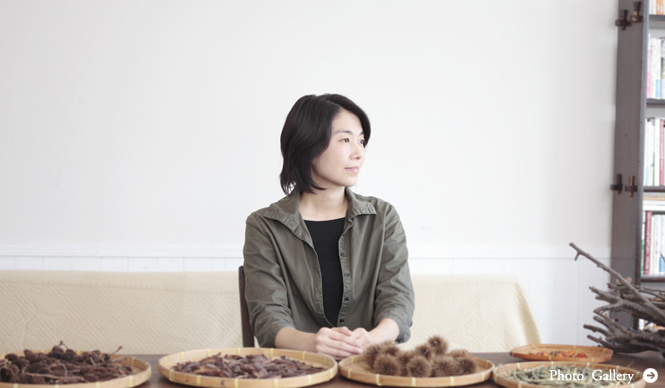
THREE: Textile Artist Mayuko Shimizu on the Allure of "Hand & Arm Cream AC"
THREE
Textile Artist Mayuko Shimizu on the Power of Plants (1)
The history of dyeing and weaving with plant-based dyes is ancient, with silk dyeing techniques said to have developed alongside the introduction of Buddhism. Woven fabrics born from vibrant silk threads were symbols of nobility, and in medieval Japan (Kamakura to Azuchi-Momoyama periods), there were even dedicated dyers who served the Emperor. Mayuko Shimizu, a textile artist who carries on this long-standing traditional craft, studied under Fukumi Shimura, a Living National Treasure for Tsujigahana silk weaving, and after training in Kyoto, she now works based in Kamakura.
Text by Yuka KobayashiPhotos by JAMANDFIX

An Encounter with Dyeing and Weaving, Like Touching One's Own Roots
When I was studying textiles at art university, 'everyone assumed I would go into fashion or interior design,' says Shimizu. 'Back then, I never imagined I'd end up in the world of traditional crafts myself.'
'It was when I saw Ms. Shimura's work that I had a unique experience. Of course, I had been moved by various works of art before. But when I saw Ms. Shimura's pieces, I felt not just admiration, but also a sense of comfort. I didn't understand why at the time, but recently I've come to think that perhaps, in that moment, I was touching upon my own roots. Seeing her work, I felt a sense of relief, as if I had awakened and found something dormant within me.'
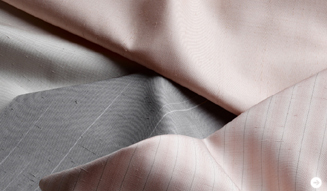
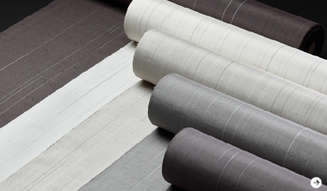
'I always liked touching soft things like fabric and thread. That's why I was interested in textiles from around the world, but when it comes to materials, my encounter with silk thread was significant. The luster and suppleness of thread spun from cocoons, its pure, unblemished white, is exceptional. I was first drawn to the charm of the material, and then became interested in the colors of plants used to dye it. It's said that plant-based dyeing and weaving techniques were similar in the early stages across many countries. From there, local climates and the character of different peoples were added, and I believe their individuality emerges even in a single thread. In that sense, while there are many wonderful overseas textiles, Japanese dyeing and weaving feels more familiar to the skin, or perhaps it's accepted so naturally that it's hard to explain. Of course, the beauty and excellent functionality of the kimono as an attire also attracted me.'
Maintaining the Sensitivity of Hands That Trace Each Thread's Outcome
Dyeing can be done year-round, but Shimizu says, 'I feel the colors become clearer when using cold water in mid-winter.' Naturally, this can lead to rough hands.
'But I can't afford to have rough hands. The dyed threads are then woven into fabric on a loom, and if my hands are rough, I might snag the threads on hangnails or small cuts during this process. Of course, if blood gets on the thread, it's ruined. So, hand care is always about prevention.'
As her creations rely on plants, it's natural that she prioritizes natural ingredients for her hand care cream.
'I've used natural products before, but the high percentage of natural ingredients inTHREE Hand & Arm Cream ACfeels better than other hand creams. It absorbs quickly, provides long-lasting moisture, yet leaves a smooth finish immediately after application, so I can use it without hesitation during the day. The fact that it's plant-derived and contains ingredients I recognize, like yuzu and plum, also gives me a sense of security.'


THREE
Textile Artist Mayuko Shimizu on the Power of Plants (2)
Using 'Living Things,' Not Just 'Materials'
THREE Hand & Arm Cream ACShimizu uses plum, from which the fruit water is derived, in her dyeing almost every year.

'Plum trees are pruned to encourage abundant flowers and fruit, so I receive fallen branches every year. The colors extracted differ between red and white plum blossoms, but the red plum branches I received previously had a cross-section that was a vibrant red, and the threads dyed with it took on that color. In Ms. Shimura's books, there's a passage about dyeing with cherry blossoms, where it says that dyeing with the pale, beautiful petals resulted in a light green, while dyeing with the bark produced a cherry blossom pink. That stayed with me. Later, when I actually dyed threads with cherry branches and achieved a subtle cherry blossom hue, I was deeply moved.'
'I was impressed by the colors not apparent on the surface, the life force stored within the plants. Each time a color emerges, I'm reminded that I'm receiving living things, not just 'materials' for my creations.'
There are as many colors as there are plants, and the colors should also vary depending on the land and season where the plants grew. Isn't it the most difficult aspect of creation that you don't know what color will emerge until it's dyed?
'Actually, I failed repeatedly at first because of that. The more I chased the color, the more it seemed to elude me. For example, I'd sketch a design, imagine a color to match it, and think, 'I want a grayish-brown with a hint of red,' then choose the dye, but it wouldn't turn out as I intended. I'd struggle to make it work, but the color would just slip away. I felt the difficulty and also sadness. But as I repeated these experiences of the color eluding me the more I pursued what I wanted, I realized I should try to adapt to the plants, to focus on bringing out the best in the plants themselves.'
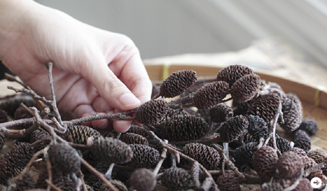
Experiencing Daily Wonder by Believing in and Respecting the Power of Plants
'Ultimately, I was trying to control living things for my own creations. Now, I dye threads thinking, 'What color will this produce?' and then consider what I can make with it.'
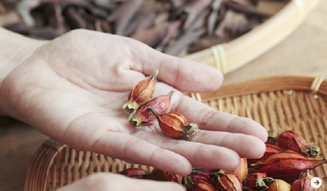
'I adapt to the colors of the plants. When I do that, I often feel I've brought out the best in the plant, achieving colors with a transparency I hadn't seen before. That's truly delightful. They are vibrant, each with its own warmth and depth. It also stimulates my creativity. In my work, the colors of plants bring daily surprises and discoveries. It's a continuous stream of the unexpected, and I've come to feel that trying to imagine 'this color will come out' is presumptuous, or rather, not something to be imagined. Even when I do imagine it, it surprises me in a good way (laughs).'
THREE
Textile Artist Mayuko Shimizu on the Power of Plants (3)
The 'Sense of Touch' That Reverses Thought and Action
In addition to her own creative work, Shimizu also holds workshops where people can experience dyeing. While it's difficult to complete the process in a limited time, participants get to touch the plants used as dyes, smell the decocted dye liquid, and experience the dyeing process.
'They are surprised that such common materials can create color. I don't want to make dyeing seem like something special. After all, chemical dyes were only introduced after the Meiji era; before that, plant-based dyes were the norm. I want people to experience the joy of dyeing various materials with plant-based dyes, not just silk thread. ... The things you learn through the sense of touch are important.'

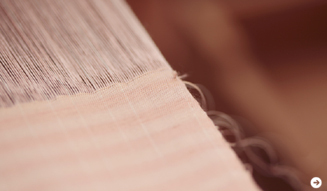
'When I first started this work, I felt like I was moving my hands based on what I decided in my head, and that's why I often struggled. But as I practiced, my hands began to keep up with what my mind was trying to do. It was like my mind and hands moved in unison. I think this is close to how children learn. And if you continue, your hands start to move first. In this work, where I trace threads with my fingertips and touch the fabric, I keenly feel that change. So, I absolutely don't want to dull my sense of touch.'
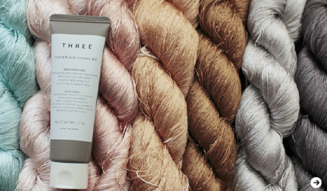
It's understandable why she needs to be extra careful with hand care.THREE Hand & Arm Cream AChas a subtle, pleasant citrus scent after application, and hand care has become a relaxing time for me.
Standing Between the Plants and the Wearer of the Work
At Shimizu's home, where the interview took place, there is a room with a loom. An old-fashioned loom is set up with warp threads stretched across it, and the weft threads are repeatedly passed through the warp threads, which are separated into upper and lower sections, using a tool called a shuttle. Shimizu says she progresses at a pace of about 3 shaku (1 shaku is approximately 37.8 cm) per day, but a bolt of fabric for a kimono typically requires around 32 shaku (about 12 meters). Her patience and concentration are immeasurable.
'Dyeing threads with plants, weaving them, and making them into a single kimono is a challenging process, but I always want to approach every step with care. It's not just about me wanting to do this or wanting to create something, so I use this. I feel that my role is to stand in between, gently embracing both the plants from which I receive the colors of life, and the people who will wear the finished product.'
Her sincere acceptance of nature's blessings and her guidance in utilizing them fully resonate deeply with THREE's philosophy.
'That's why I was truly delighted when someone who wore my kimono said, 'It's easy to wear,' or 'It doesn't just feel like a kimono, it feels like *I* am wearing it.' That's when I knew this was what I wanted to do. Perhaps it's the role of an 'artist' to express themselves through their work, but I believe there can be an artistic identity that doesn't focus on self-expression. My role is to be there between the plants and the wearer. I believe that's where my careful approach comes from.'
—Thank you very much.

Mayuko Shimizu
Born in Tokyo in 1972. After graduating from university in 1996, she apprenticed under Fukumi Shimura, a Living National Treasure for Tsujigahana silk weaving. She studied dyeing and weaving at the Shimura's Kyoto studio. In 2000, she became independent and moved her base to Kamakura. She focuses on creating kimonos using plant-based dyes and also conducts dyeing workshops.
http://mayukoshimizu.jp/