
April 13, 2015
Miyoji Okabe: Vol. 5, Dispelling Myths About Facial Massage and Its Importance
Simple, Effective, and Truly Necessary
Vol. 5: Misconceptions and the Necessity of Facial Massage
Miyoji Okabe has been involved in the creation of numerous outstanding cosmetics through her work in the research and product development divisions of major cosmetic manufacturers. Drawing on her unyielding pursuit of beauty, sharp insight, and deep knowledge as a researcher, she will explain various "beauty questions" from a scientific perspective.
Narration by Miyoji OkabeSummary and Illustrations by Yuka KobayashiPhoto by Jamandfix
Many people probably feel that facial massage is difficult. Various manufacturers propose their own massage methods with each new product, and magazines and TV are constantly abuzz with groundbreaking (or sometimes bizarre) massage techniques. In the end, without knowing which ones are truly effective, facial massage is relegated to the status of "special care" received at a salon. However, just as applying cosmetics is a daily skincare habit, massage also seems to yield results only when practiced continuously. If that's the case, let's properly learn a massage method that can be done daily without strain and is reliably effective.
Q. First of all, is massage necessary for daily skincare?
Yes. Massage has effects that cosmetics alone cannot provide. It's not about making the cosmetic's beauty ingredients work on the skin; the purpose of massage is to improve blood circulation in the skin and provide relaxation. Of course, massage cream or oil is necessary. But this is simply to place something between the skin and your fingers to improve glide.
Q. Why do you, Ms. Okabe, a "cosmetic" developer, emphasize the "action" of massage?
It's not just that massage creams and oils contain ingredients that affect blood or lymph circulation. I have a background in biology, so I've thoroughly studied the basic principles of living organisms and the nature of skin tissue. What I can say from that is that skin fundamentally cannot survive without taking in oxygen and nutrients from the body's interior. Furthermore, it is a basic biological principle that physically moving the entire skin is effective. In the skin, the most fundamental basis for this is the circulation of blood and lymph. That's why massage is absolutely essential.
Q. So you had a realization during your cosmetic research?
Yes. Hair growth tonics were a prime example. Every hair growth tonic loudly proclaims that it improves blood circulation in the scalp. And even though they contain many active ingredients to improve scalp circulation, they are always accompanied by instructions for massage. Also, when I observed people visiting cosmetic counters and esthetic salons, I noticed that there are quite a few elderly individuals with beautiful skin.
And what these people have in common is that they enjoy massage and do it regularly. Theoretically, to improve blood and lymph circulation, there's no cosmetic that can match the act of "kneading" or "pressing" the skin—isn't brushing your gums with a toothbrush for dental health the same principle? To invigorate the skin and the hair growing from it, massage is fundamental. Therefore, to consistently supply the skin with proper nutrients and oxygen and remove waste products, one must continue. This is my conclusion. If you want to effectively utilize the benefits of cosmetics, massage is indispensable.
Therefore, to consistently supply the skin with proper nutrients and oxygen and remove waste products, one must continue. This is my conclusion. If you want to effectively utilize the benefits of cosmetics, massage is indispensable.
Q. But doesn't adding massage to your daily routine seem difficult in itself...?
Massage is an act that, while recognized as effective skincare, is actually not done very often. It tends to be perceived as difficult. So, to incorporate massage into your daily life, you can simply consider the act of applying cosmetics to your skin as a form of massage.
Then, you'll start touching your skin with care, won't you? At that moment, you're touching your skin while wishing for the cosmetic to penetrate, but the act of evenly and carefully applying the cosmetic is also, in fact, massaging the entire skin. Therefore, by simply rethinking how you apply cosmetics, you can perform light massage on a daily basis.

Q. If I just press and knead my skin as I please, won't it sag or develop more fine lines?
That's an urban legend (laughs). From both a biological and medical standpoint, skin is inherently a robust tissue. It exists to protect the body, so it's designed not to break even if pulled a little (laughs). Therefore, with normal massage, you won't get sagging or wrinkles.
Q. Although different from facial massage, is the massage that "breaks down cellulite" truly effective, even though it's painful?
While cellulite is recognized in the beauty industry, the concept itself doesn't exist in the medical or biological fields. Certainly, some cellulite is lumpy and hard, but it's not necessarily true that it breaks down just by being worked on, as the beauty industry claims. Therefore, I believe that the act of "pain" is separate from massage. Massage is not about breaking down cellulite.
Q. Skincare product companies and estheticians propose various methods, don't they?
Of course, each likely has their own theories, but there are only three basic concepts to keep in mind for massage. The first is "comfortably sustainable." Even the act of applying cosmetics is fine as long as you find it comfortable. There's no need to be particular about the way your fingers move or the direction. The second is that "the purpose of massage is to improve blood and lymph circulation in the dermis." And the last is that "massage consists of only three patterns: rubbing, pressing, or kneading." Tapping (patting) is included within the action of "pressing." If these are performed in a way that feels good, you will achieve results.
The second is that "the purpose of massage is to improve blood and lymph circulation in the dermis." And the last is that "massage consists of only three patterns: rubbing, pressing, or kneading." Tapping (patting) is included within the action of "pressing." If these are performed in a way that feels good, you will achieve results.
Q. We often see methods using devices these days.
I don't particularly recommend massage using devices. That's a kind of magic spell (laughs). Furthermore, regardless of whether the device is germanium or anything else, there is very little scientific verification that it is good for the skin. Of course, if rolling something like a round ball on the skin feels good, it can be considered a massage effect, but fundamentally, your own fingers are sufficient. By performing massage with your fingers, it's important to feel your skin's condition. You can become aware of roughness or hardness, and notice the degree of elasticity. Since you have the excellent tool of "fingers," massaging while checking your skin's condition is killing two birds with one stone, isn't it?
Q. Then, could you please tell us specifically about the massage methods you recommend, Ms. Okabe?
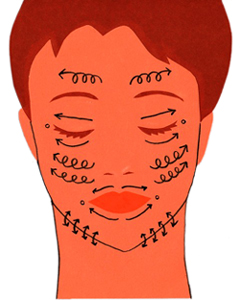
I will introduce massage methods by area. For the forehead, move your fingers from the inside to the outside while rotating them. If you have a narrow forehead, moving from the outside to the inside is also fine. For the eyes, basically flow your fingers from the inside to the outside. There's no need to press hard here either. For the eyelids, lifting the skin slightly can help prevent puffiness.
The under-eye area tends to be dry, so you might want to use an eye cream. Finally, press the acupressure points on the sides of the eyes. Although this is a thin-skinned area, massage will not cause fine wrinkles. Dark circles under the eyes are caused by poor blood circulation, melanin, or shadows from bone structure, but by improving blood circulation through massage, they can be resolved to some extent.
For the cheeks, lift them upwards while rotating your fingers. The direction of rotation, clockwise or counterclockwise, doesn't matter. Some manufacturers may recommend one over the other (laughs). The reason for rotating is to massage the wide cheek area evenly. It's also fine to rotate from top to bottom, but lifting from the bottom up is more elegant, isn't it?
Q. For the cheeks, isn't lymphatic massage also necessary?
The lymphatic massage that many people do along the jawline doesn't directly affect the lymph. The skin isn't that simple, and the lymphatic vessels are intricately intertwined, so it doesn't immediately affect lymph circulation whether you move from bottom to top or top to bottom. However, by kneading or pressing and moving the skin, it does influence circulation. The so-called lymphatic massage is made to sound convincing through its logic and elegant appearance. Skin structure is not that simple. Just think that by massaging evenly, circulation will eventually improve.
For the mouth area and face line, the muscles are constantly moving due to talking and eating, so it doesn't matter how you press. For both the upper and lower lips, flow your fingers along the lip line from the center outwards, and finally lightly press the acupressure points at the corners of the mouth. For the face line, you can gently pinch the jaw upwards with both hands. There's no need to avoid wrinkles caused by facial expressions or nasolabial folds due to aging. If it's a "comfortable" massage, it will absolutely not deepen those lines. The skin isn't that fragile. In fact, massage can slow their progression.
Q. When is it most effective to perform this massage?
In the morning, apply toner carefully and let it absorb; at night, while removing makeup, promote circulation that has become stagnant due to fatigue, allowing more nutrients and oxygen to reach the skin... However, it's best to avoid using it with rough scrubs. Scrubs that exfoliate dirt from the skin and massage that promotes blood and lymph circulation have different purposes. You don't need to do it for a long time. A duration that doesn't feel like a chore is sufficient. The important thing is the mental shift to incorporate massage into your daily skincare routine. There's no need to do it frequently throughout the day. It will just mess up your makeup (laughs).
No matter how much cosmetics evolve, products with effects that can substitute for massage will never emerge. And no matter how many new massage methods appear, from a professional's perspective, the basics are all the same.
Miyoji Okabe Official Site
The Science of "Beauty"Garden of Beauty Science
http://www.kt.rim.or.jp/~miyoharu/