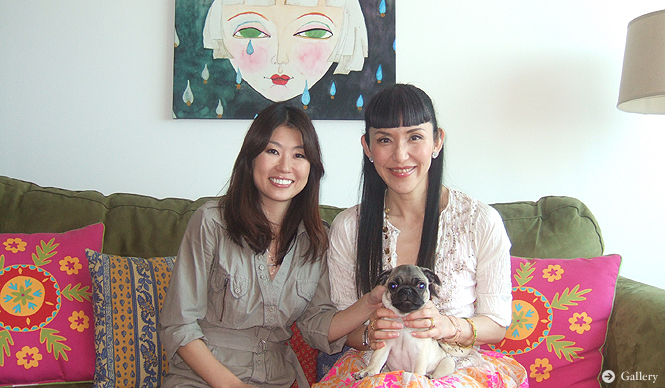
TOP ARTIST Interview in N.Y | MUNEMI meets RIMA FUJITA
TOP ARTIST Interview in N.Y
MUNEMI meets RIMA FUJITA
This time, we interview Rima Fujita, an artist based in New York. Rima, a renowned painter in Japan for her unique style, shares what she found as her life's work after much struggle and exploration.
Interview & Text by Munemi
Munemi: Hello, Rima. Thank you for having me today.
Rima:Thank you.
Munemi: I noticed some lovely towels in the bathroom earlier; are they your design?
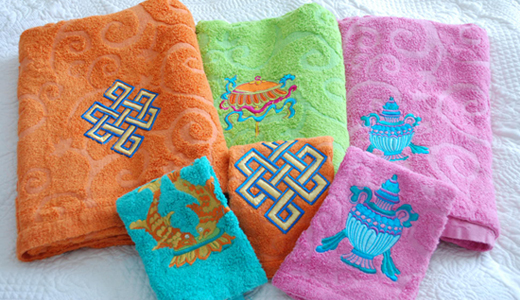
Rima:Yes, they are. The material is made from bamboo. In New York, you can find them at "ABC Carpet & Home" (http://www.abchome.com/). In Japan, my entire original line is available at "Ikeuchi Towel" (http://www.ikeuchitowel.com).
Munemi: You seem very eco-conscious, Rima. Do you have any favorite beauty products?

Rima:Rosewater, "Dabur – Gulabri." It's from a long-established Ayurvedic company in India. I've tried many rosewaters from around the world, but I'm convinced this is the best, and I've been using it for years.
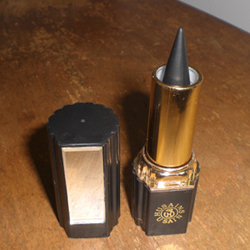
Rima:Also from India, an Ayurvedic kajal (eyeliner) called "Shahnaz Ayurvedics." It's made entirely from natural herbs, so it doesn't cause any pain or discomfort even if it gets in your eyes. I've been using this for years too.
The Vocation of "Painter" Decided, and a "Realization" in Her Twenties
Munemi: When did you come to New York?
Rima:In 1979, exactly 30 years ago. My family moved here because of my father's work. I was still a middle school student then, so I attended a local high school.
Munemi: What inspired you to become an artist? Was there something that sparked your creativity?
Rima:Perhaps it's because I was an only child, but I was always drawing at home. Even when I entered a competitive high school in New York, I had already decided I would become a painter and go to art school. So, I applied to and attended Parsons School of Design, where I majored in illustration and oil painting for four years.
Munemi: After graduation, how did your career develop?
Rima:I was very lucky; I started getting work around my third year of art school. My professor at Parsons at the time said, "Rima, you can probably get work now. I'll introduce you to some art directors." He introduced me to art directors at magazines like "Cosmopolitan," "Glamour," and "In Fashion," and I started getting jobs. In my fourth year, I had a solo exhibition at a popular gallery in the East Village, so it was a truly fortunate start.
After graduation, I continued to get work like that, but it wasn't enough to make a sufficient income. So, I took on many part-time jobs, such as coordinating for Japanese media, and working as an interpreter and translator.
Japan was in a bubble economy at the time, and there was a lot of coordination work, all very trend-focused. That work became incredibly busy, and for a while, there was a period when I didn't paint much. That work also became very interesting.
I could meet so many people, and it was a glamorous world. However, after continuing that for a while, I started to feel the transience of it all. Trend information, you know, is like 'this today, but old news tomorrow,' right? I gradually began to feel a sense of ephemerality about things that don't last. One day, I suddenly realized that what I truly wanted to do was paint, and I decided to focus on my art again.
Then, I gradually began to have solo exhibitions in New York, little by little. But it wasn't until I got a painting job for a Japanese TV show that I could truly make a living from my art.
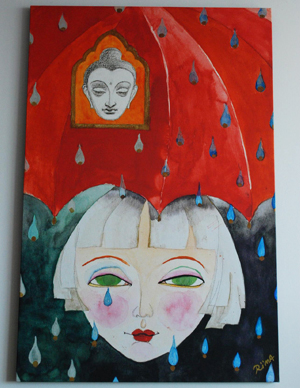
"Please protect it."
In '93, a friend from Fuji TV told me a new program was starting and asked me to show them my work. So, I went to show my paintings to the producer.
Up until then, I had often been told, "Your paintings are too unique; they're difficult for us to use," and rejected. But this producer said, "Ah, I understand. Then, please start painting," and it was decided so easily. It was for a revolutionary program at the time called "Wanderlust Garden" and "Wanderlust Adventure," which was very popular.
It was an incredibly artistic, cultural, and sophisticated program, unlike anything seen on television before. And it became a huge hit. I painted for the theme every week. My work started being broadcast nationwide every week, and that was the first time my art became widely known. From then on, I could make a living solely from my art.
Munemi: So, your breakthrough came thanks to Japan.
Rima:Yes. Because I was appearing on television, I started receiving invitations from various galleries. I began having solo exhibitions at places like Bunkamura in Shibuya and Isetan Shinjuku. This year marks my 16th solo exhibition at Isetan Shinjuku.
Munemi: Your work evokes such a fantastical world, Rima. Is there an underlying source of inspiration for it?
Rima:As I mentioned earlier, I had a very lucky start in New York. After graduating from art school, I was favored by many famous art dealers. I socialized with them every night, went to the opera, traveled by plane, and was quite doted upon. I was only about 20 years old then, you know?
But at the same time, I also saw their very unpleasant side. They were top art dealers in New York, and as I got to know them, I saw their cunning and dirty aspects. I began to wonder, why am I painting in this world, interacting with these kinds of people? I thought about this very early on. However, I didn't know what else to do, so I continued to associate with them, but I always had an inner conflict, questioning if this was the right path.
In a way, I lost my aspiration to be active in the New York art scene at a very early stage. But I still didn't know where I wanted to be, so I was struggling. I continued to paint, though.
A Strange Incident at the Airport That Radically Changed My Outlook on Life
It was in '93. When I returned to New York after a temporary visit to Japan, I had a very strange experience. It was as if my life turned upside down.
One day, when I arrived at Kennedy Airport, I had a terrible fever of around 39-40 degrees Celsius and was feeling faint. Also, I had forgotten to exchange my yen for dollars, so I had no dollars on me. The airport was extremely crowded, and in my daze, a woman I hadn't seen before suddenly appeared in front of me and took my hand. I didn't know her. Then, I realized I had just enough dollars to get home by taxi, even though I hadn't said anything. I was just standing there, and she gave me money.
She said, "I know you need this right now." When I said I couldn't possibly accept it, she replied, "I know you need this the most right here, right now." She insisted I take it. Honestly, I was happy, so I thought, "Okay, I'll borrow it for now and thank her later." I said, "Thank you," and when I looked up to ask for her contact information, she was gone. It happened in just a second or two. The airport was unusually crowded at the time, like a packed train in Japan. So, it was hard to move, and she couldn't have gone far in such a short time. I searched desperately, but she was nowhere to be found. I asked people around me about the blonde woman who was just there, but everyone said they hadn't seen anyone like that. I thought it was strange, but I was tired and went home, completely forgetting about it.
A few months later, I was going to Japan again. To buy a book to read on the plane, I went to a bookstore called "Rizzoli" in SoHo at the time. All the books on the shelves were neatly arranged, but suddenly, one book fell at my feet. Curious, I picked it up and flipped through it. It was a collection of anecdotes from people who had experienced something similar to what I had experienced at the airport.
It was a collection of stories about people who, when in distress at places like train stations or airports, were suddenly helped by a stranger, only to find that the stranger had vanished when they tried to thank them. The most incredible story was about someone being helped on a moving airplane, but when they searched everywhere to thank the person, they weren't on board. That's when I remembered that experience at the airport for the first time. "Ah, it was the same as that time."
I don't know who that woman was, but I realized it was some kind of message. It was the first time my life changed, or rather, the purpose of my painting changed completely through that experience.
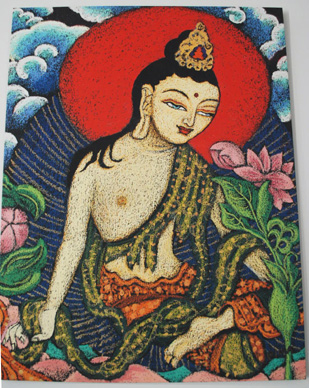
"Kannon-sama" (Avalokiteśvara)
Until then, my goal in painting was very mundane: vaguely, it was to "succeed as a painter, become rich, and be famous." Then, I realized that painting wasn't the goal; it was just a "tool."
Through that experience, I understood that my goal was to use painting as a tool to contribute something. The experience itself might have been small, but the message was profound. It taught me the importance of extending a hand to those in need, no matter the situation, and of making it my life's purpose to do something beneficial. I believe I learned this from that woman's actions. That experience became a turning point, and the vague, heavy feeling I had carried dissolved, and I understood the meaning of painting.
From then on, I felt incredibly liberated and at ease. Before that, I found myself unable to genuinely rejoice in my peers' successes, feeling jealousy or being envied, which I disliked immensely. But when I realized that painting was merely a tool, not the ultimate goal, I felt so liberated. My joy in painting multiplied. Then, one night, I had a dream. In that dream, I clearly heard a voice saying, "Do something for Tibet."
Munemi: Is that how you became involved with Tibet?
Rima:Yes. Until then, I didn't even know where Tibet was, nor was I aware of the Dalai Lama's existence.
Munemi: What year was that?
Rima:That was also in '93.
Munemi: So, in a way, '93 was a turning point for you, Rima.
Rima:Yes. And around that time, I had started to place more importance on dreams. Since I was told in a dream to do something for Tibet, I felt I couldn't ignore it. The internet wasn't widely accessible then, so I went to the library on 42nd Street to research Tibet. That's when I first learned about the tragic situation in Tibet.
But I thought, "I'm just a painter; I'm not famous or rich. What can I possibly do?" I felt uncertain for a while, but then, I started meeting Tibetans one after another. People I hadn't encountered despite living in New York for about 20 years.
They would strike up conversations on the street. It was as if these encounters were being prepared for me. I met more and more Tibetans, became friends with them, and then they introduced me to their associates like Richard Gere and Uma Thurman, and the circle expanded.
One day, while talking to a Tibetan friend, he said, "In the refugee camp where I grew up, there were no books, no notebooks, no food – nothing. We were always hungry and couldn't focus on studying." That struck me. I realized, "I'm an artist, so I can draw, and I can write. I'll create a picture book!"
I decided to make picture books and give them to the children in Tibetan refugee camps. And since I was making them, I thought they should be Tibetan folk tales, something they were losing. Many Tibetan children can't even write in Tibetan.
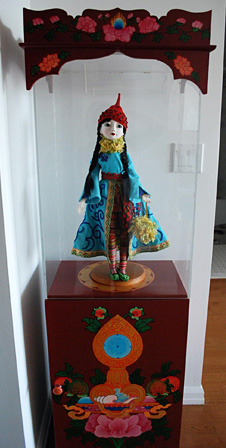
"The Tibetan Princess"
Now, everyone studies within the Chinese system. So, I decided to write Tibetan folk tales in the Tibetan language. Once I made that decision, people who could support me appeared one after another, as if they were prepared. And that's how these picture books came to be. That's how it all began.
Munemi: Could you tell us about your picture books, Rima?
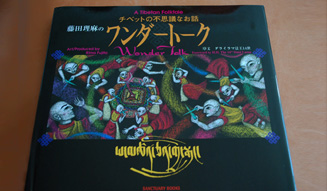
Rima Fujita's Wonder Talk: Tibetan Folktales
Illustrated by Rima Fujita, published by Sanctuary Publishing, ¥1,575
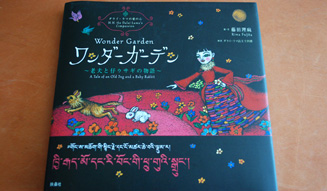
Wonder Garden, illustrated by Rima Fujita, published by Fusosha, ¥1,600
Rima:This "Wonder Talk" was the first picture book of Tibetan folk tales. In 2001, it was recognized as a recommended book for teachers worldwide by the United Nations.
The second book is "Wonder Garden." This is a very personal and true story about the 14th Dalai Lama, told by one of his close aides. It was such a heartwarming story that I wanted to turn it into a book. And the most recent picture book is "TB AWARE." This is an educational book about tuberculosis prevention. Currently, many Tibetan refugee orphans live near India, but 3,000 children die of tuberculosis every year. They have no knowledge about tuberculosis because they aren't taught about it. So, those who have it don't know, and those who have it cough and spread it. That's why they die.
Rachel von Roeschlaub, a scientist from Cambridge, approached me asking to collaborate on this book, and I accepted. She was teaching science as a volunteer to orphans in India. Witnessing so many children dying, she wanted to do something and wrote the text. Rachel, who owned my two previous picture books, contacted me one day saying, "I really want you to illustrate this." I accepted without hesitation.
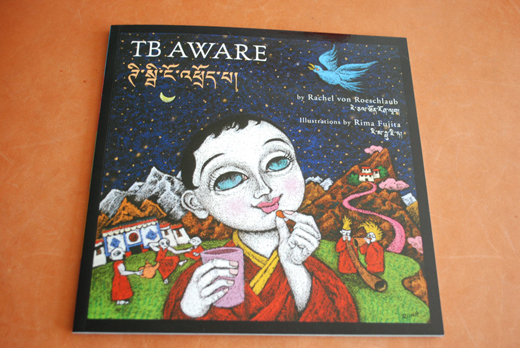
"TB AWARE" Written by Rachel von Roeschlaub, illustration by Rima Fujita
I thought about how to make a book about tuberculosis engaging, understandable, and not frightening for children. So, I set the story in Tibet. Many of the Tibetan refugee orphans have never seen their homeland. They were all born in India. So, I decided to set it in their homeland, a place they haven't seen, and made every page feature Tibetan scenery. Another thing I focused on was creating illustrations that wouldn't be scary for children who already have tuberculosis. I wanted it to be enjoyable to look at.
Tibet, and Meeting the 14th Dalai Lama
Munemi: What about your meeting with the 14th Dalai Lama?
Rima:The first time I met him was in India in 2000. I was so excited at that moment that my mind went blank, and I don't remember much. But looking at the commemorative photos, I realized it really happened (laughs). After that, I started meeting him frequently in New York and Japan, but my heart still races every time.
I'm not saying this because I truly respect the 14th Dalai Lama. I tend to be quite detached and not the type to idolize people, so I observe him calmly.
But the 14th Dalai Lama is indeed not an ordinary person. Every time I meet him, I feel a rush of heat, like opening an oven door. It's like a blast of heat coming from about two meters away. My skin tingles.
When I shake his hand, I feel a tingling sensation, like an electric current. I feel he has a very high vibrational energy. I don't know if he's a transcendent being, but I believe he is someone who practices diligently (Buddhist training or discipline). Therefore, his energy and abilities are undoubtedly extraordinary.
Also, he has excellent insight and pays great attention to detail. I believe this also comes from his practice. In 2006, I was asked to create a poster for the Hiroshima Peace Conference. For this peace summit, we invited three Nobel Peace Prize laureates: His Holiness the 14th Dalai Lama, Archbishop Desmond Tutu, and Ms. Betty Williams.
I was involved in the event, so I was near the three of them. During the luncheon party, it was arranged for them to give their autographs on the back of my original poster artwork. I stood behind His Holiness the 14th Dalai Lama with three pieces of chalk.
In my mind, I was hoping they would each sign in a different color. Suddenly, His Holiness the 14th Dalai Lama turned around and said, "You want to change the colors, don't you?" I was so surprised that I instinctively said, "No, no." I don't know if that's psychic ability, but it shows he observes things very carefully.
Munemi: What prompted your first trip to India?
Rima:It was to visit an orphanage. I wanted to see firsthand the kind of children for whom I would be creating picture books. There are 82 Tibetan refugee schools in India, and I wanted to visit each one, meet the orphans, and see what they needed.
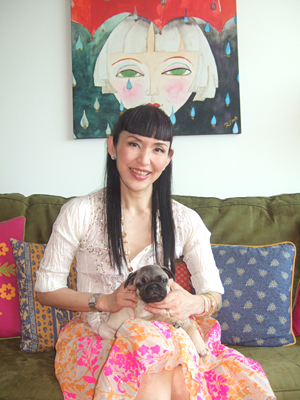
Rima Fujita was born in Tokyo. She has lived in New York since 1979. She graduated from Parsons School of Design. She has held solo exhibitions annually since 1993. In 2001, she established "Books for Children (BFC)," an organization that creates and donates picture books to underprivileged orphans and children. In parallel with her personal activities, she actively engages in educational support for Tibetan refugee orphans. Her published works include "Wonder Talk," "Wonder Garden," "TB AWARE," "Simple Meditation," and "The Little Black Box."
Munemi: It's fascinating how your life became deeply intertwined with Tibet, starting from that revelation.
Rima:That's why my reason for being in New York isn't art. The reason I want to be in New York is that most of the headquarters for Tibetan support organizations are here, making it easier to operate. In that sense, my presence here has value.
Munemi: Your latest collection last year had the theme "Go Green." What was the inspiration and sentiment behind it?
Rima:I've always leaned towards green, but a major catalyst was watching a nature program on the "National Geographic" channel. I was deeply shocked by a feature on endangered animals. I felt it was unacceptable that animals were suffering because of the crisis created by us humans.
So, what can be done? Switching to wind power, recycling – on a small scale, but doing something is better than doing nothing. That was the trigger. I am Japanese, after all, and my homeland is Japan. I also have a deep connection with Tibet. So, I wondered about the current state of Asia's ecosystem. Then, I learned that the entire Asian ecosystem depends on the Himalayas, and last summer, I went to Ladakh to research it firsthand.
Munemi: What did you see and feel when you actually went to the Himalayas?
Rima:The glaciers were melting more than I expected. The locals told me the landscape had completely changed. What used to be white on the mountaintops due to glaciers is now brown, with the rocks visible. The glaciers are melting at an incredible rate, and the water flows into the Indus River, causing frequent floods. As a result, their traditional mud houses, being made of mud, collapse. Furthermore, this impacts their crops, and in short, the local people can no longer live their lives as they used to.
What was even more shocking was the low level of environmental awareness among the local people. This is fundamentally an issue of education; they don't have the luxury of being sensitive to environmental matters.
They are preoccupied with finding food and sustaining their lives. These two aspects were deeply disappointing. It's such a beautiful place, almost like a last paradise, which made it even more disheartening. Tourists like us are also contributing to pollution, and I was pained by this helpless vicious cycle.
Munemi: I see. These kinds of issues are complex and often contradictory, aren't they?
Rima:The world is full of contradictions.
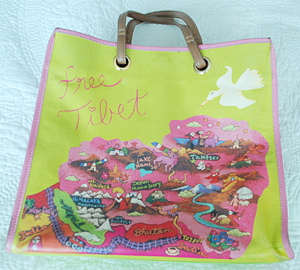
Original design bag "Free Tibet! Journey to India." Depicts the route of His Holiness the 14th Dalai Lama's escape from Tibet to India. (Produced by Isetan in 2001)
Munemi: Even if we say, "This is good, let's do it this way," there are established systems, political interests, and corporate agendas that make it difficult, aren't there?
Rima:Yes, so ultimately, we can only continue doing what we can as individuals.
Munemi: I believe that's important too. While individuals may not be able to change the situation directly, or may not have money to donate, starting by talking about it, raising awareness – I think that's crucial.
Munemi: Will your future activities continue to focus on Tibet?
Rima:Yes. My goal is to establish a proper foundation before I die, so that it can continue even after I'm gone. Not just for Tibet, but for places like Afghanistan too. There are many children in impoverished countries who don't have picture books. The theme is to create picture books that protect their culture in their own countries. This is my life's work.