February 28, 2017
Yoji Yoneyama x Yasuhiro Mihara: A Special Dialogue on "Creating Things" | M・A・R・S
M·A·R·S
Yoji Yoneyama x Yasuhiro Mihara: A Special Dialogue
On Creating Things (1)
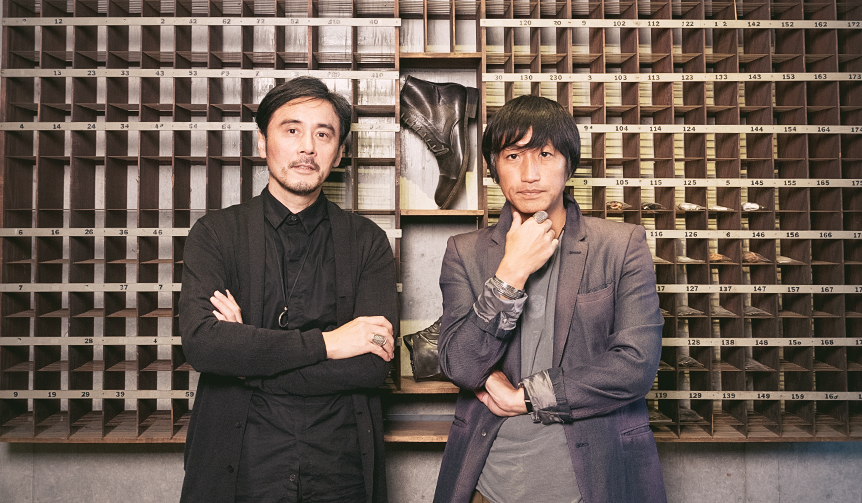
M.A.R.S (Mars), which celebrated its 25th anniversary in 2016. To commemorate this, we present a series of dialogues with designer Yoji Yoneyama. This time, our guest is Yasuhiro Mihara, a shoe designer who is also active as a fashion designer. The two recognize each other's work, with Mihara using M.A.R.S. in his coordination for the Tokyo Collection Autumn/Winter 2016-1017. As both are designers, their conversation centered on the difficulties and joys of creation. It's packed with interesting insights not often heard elsewhere.
Photographs by TANAKA TsutomuText by TOMIYAMA Eizaburo
The 90s: An Era of Mutated Designers (Mihara)
—When did you and Mihara-san first meet?
Yasuhiro Mihara (hereinafter Mihara)It's been over 10 years. We were first introduced by Shinichiro Arakawa, a fashion designer. There was a gallery and cafe called Teahouse in Ebisu back then. Shin-chan asked me, 'If you go to Teahouse often, do you know Yone-chan?' At the time, Yoneyama-san was making accessories for his brand, and he had many unusual motifs, like ironic miniature jewelry or ants trapped in acrylic resin. I thought, 'What a strange person!' (laughs).
Yoji Yoneyama (hereinafter Yoneyama)I had also heard about a shoemaker named Yacchin who made really cool and interesting things.
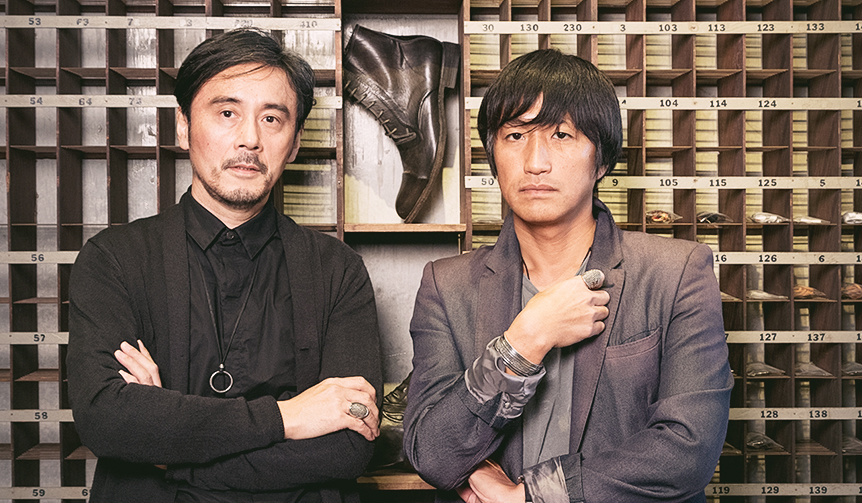
MiharaThe 90s were an era when many designers emerged like mutations—Arakawa-san, Yoneyama-san, and others. Before that, there were many who had been assistants at maison brands or had left the "Big Three" Japanese brands. But then, people started launching brands simply because they wanted to. Arakawa-san, who had been an artist in Paris, was philosophical and focused on authorship rather than business. Yoneyama-san also disliked being categorized by lineage back then. I felt the same way, as did Jun Takahashi of Undercover, Setsumasa Kobayashi of General Research, and Keita Maruyama. They were fixated on what they wanted to create, independent of fashion trends. Perhaps it was that kind of era. I was on the periphery.
YoneyamaHahaha, me too.
MiharaShoes are at the extremity of the foot, and jewelry is also on the fringes, not clothing itself, so we're on the periphery. But while there's a unique enjoyment in being on the periphery, there's also a certain dilemma, a paradox. Anything other than the shoes I make will inevitably be coordinated with jackets, pants, and socks from other brands. Jewelry is based on that premise. So, there's a certain irresponsibility in thinking, 'I can't consider how the wearer will coordinate it.' Things were chaotic back then, including clothing.
YoneyamaFor those on the periphery, it's crucial how they assert themselves. Even when coordinating with clothing, it can be adapted in countless ways through the individual's personality. That's why you need a brand's worldview, individuality, and passion to be chosen by stylish people.
MiharaExactly.
YoneyamaIt's about reaching that starting line first. It's about how much of what you want to do you can express.
Mihara-kun always talks cheerfully with artisans (Yoneyama)
MiharaFrom my perspective, M.A.R.S is a brand that executes bold ideas with delicacy. Even though skulls were popular at the time, you didn't pursue them, did you?
YoneyamaNo, no, skulls are still a staple. But we've never emphasized them.
MiharaRight, there are skulls (laughs). But they don't define the image. Yet, it's not contemporary either. What is it? It's doing absurd things very seriously. I hesitate to use the word 'artisan' these days because it's overused, but Yoneyama-san has the spirit of an artisan. However, it's not the image of someone silently engrossed in their work. Looking at the products, you can see how he assesses his collaborators and maximizes their strengths. And yet, he expresses something incredibly whimsical.
YoneyamaIt's about how to realize something that came about with a 'What if we made this?' attitude.
—Can you tell that just by looking at the finished product?
MiharaHonestly, there are things you can't tell. But now is an era where anyone can create original jewelry or accessories. In such cases, there might be two or three companies between the creator and the artisan, and those actually doing the work often don't know whose product they're making. It's not that kind of craftsmanship. You can tell when it's made with artisans who call each other by name and have a tacit understanding. Yone-chan is a man of few words, but if you look closely at his products, they speak volumes, like a novel. You can see that it's constantly evolving and aiming for an even higher level.
YoneyamaWhen I visit Mihara-kun's collections or receptions, the artisans who made the pieces are always there. Mihara-kun is always talking cheerfully with them. Seeing that scene tells me where Mihara-kun's focus lies in his work. I'm sure they're both intensely focused during the creation process. But when the piece is finished, and they're talking happily, it's very moving.
MiharaThey're also comrades in arms. Also, I play the role of a cheerleader. Making and selling things might be a continuous process, but if that's all there is, isn't my presence unnecessary? If I just hand over the design and it's done, there's no greater irresponsibility. I believe there's something more important. It might sound simple, but it's about connection, about feelings. People often talk about 'craftsmanship with soul,' but I often wonder, what does that really mean? Does it mean never letting your guard down? But I don't think so.
YoneyamaYeah.
Page02. The Only Way to Know Your Current Location Is to Hit a Wall (Mihara)
M·A·R·S
Yoji Yoneyama x Yasuhiro Mihara: A Special Dialogue
On Creating Things (2)
The Only Way to Know Your Current Location Is to Hit a Wall (Mihara)
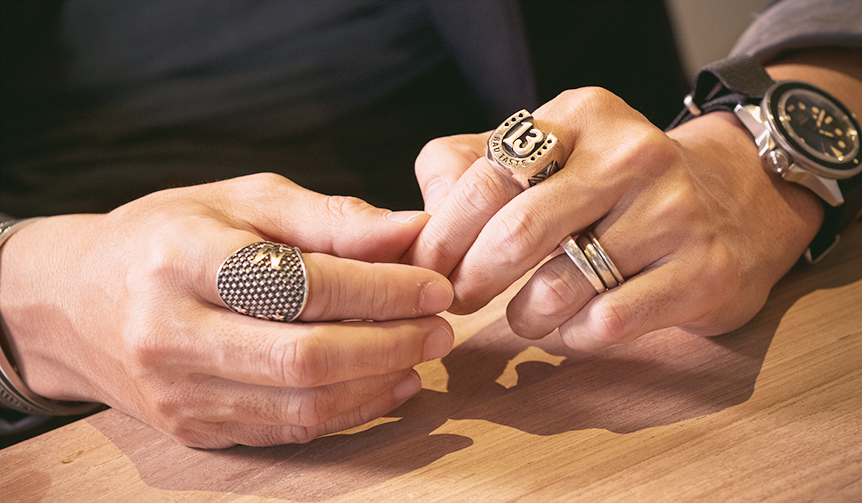
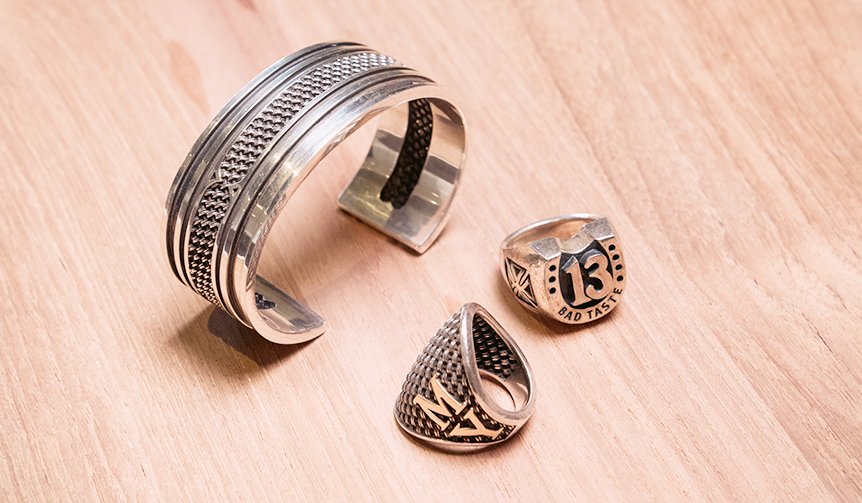
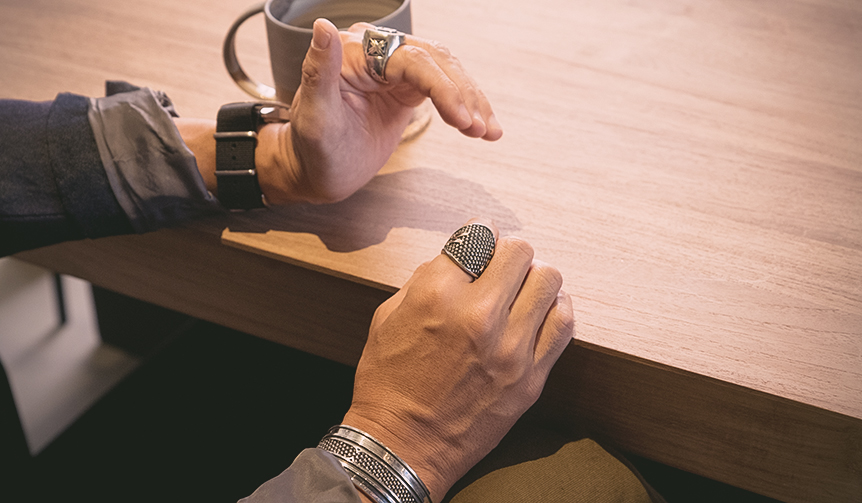
MiharaThis ring is for the band BAD TASTE. At first glance, it looks rebellious and has a substantial weight, but when you look closely, there's a skull inside the ring. This wit is effective. When I see things like this, I feel the creator's unwavering commitment. That's why, for me, cast pieces produced in large quantities are accessories. On the other hand, jewelry is something imbued with feeling. Jewelry isn't just about having stones or using expensive metals. In that sense, M.A.R.S is jewelry to me.
YoneyamaWith Mihara-kun's shoes, once you have the last, you can do a lot with computers. But after that, you inevitably have to work by hand. Even with beautiful curves, there's something slightly unsettling. He pursues that until he's satisfied with the look and feel. In other words, I believe it ultimately comes down to human sensibility. When I first saw the shoes Mihara-kun made, where he wrapped shoes in leather, I thought, 'Wow, how did he do that?'
I asked a leather craftsman I know, and he said, 'This is impossible.' He said, 'This is a perfect combination of the artisan and Mihara-san; there's no one else who would do it if you just asked them to do it normally.'
MiharaNo, that might be true.
YoneyamaEven if we offer a lot of money, artisans won't budge. It's not about that. There's a history behind it. I believe Mihara-kun also takes steps. You can't just say, 'Do this.' First, you do this, then in the second year, you do this, and in the third year, you finally say, 'I've accomplished this, so how about something like this?'
MiharaThat happens!
YoneyamaRelationships, sequence, time. Things that may not take shape immediately but must be done now. I believe he has that structure in mind. That's why he's constantly evolving. What always impresses me is that you can feel that.
MiharaThere are definitely steps taken towards what is foreseen. Of course, sometimes those steps can't be overcome, or a different approach is found in the meantime. But it's like asking how to use a map. You open the map, decide on your destination, and think about the route, right? But if you don't know your current location, you can't use the map at all.
YoneyamaYes.
MiharaThe only way to know your current location when creating something is to hit a wall. You challenge your limits and fail. Only then do you know where you are. If you only do things below your limit, you lose track of where you are. Then you can't even distinguish between good and bad. Just doing something because it sells won't reveal the map. Thinking about it that way, the route doesn't matter—whether you take a taxi or a train to your destination. What matters is technique, the desire to create, and the passion you put into it.
YoneyamaThat's right.
Sensibility Changes with a Trigger; How to Convey That Sensibility (Yoneyama)
MiharaBut, cruelly, there are fewer artisans these days. Things that were possible before, things that we thought could be surpassed, are now impossible to achieve. This is a serious reality facing Japanese craftsmanship. The decline in technical skill and the decrease in successors. Hayakawa-san in my company is 76 years old. When he said he was retiring, I told him, 'No!' We have such a tacit understanding that if he doesn't draft the patterns, I might not be able to make shoes. For me, he's someone I can rely on with peace of mind.
—It's important to meet or nurture people with whom you can develop that tacit understanding.
MiharaMeeting such people is a joy for me. Of course, Yoneyama-san certainly has such people too. I believe there are always people who are striving to create good things at their very limit. Whether they are designers or artists, everyone has someone supporting them. I think I'm a fan of those people. Like avid fans of baseball or soccer.
YoneyamaTo meet them, we also need to be on that same wavelength. Otherwise, even if we meet them, we probably won't notice. So, it's about how earnestly we engage. Conversely, there are cases where the person has the potential but doesn't realize it themselves. They could do more, but they're just going through the motions. In such cases, we need to make requests and help them understand through their senses. Technique is built up through repetition, but sensibility can change with a trigger. How do we make them understand that sensibility?
MiharaYes, this is a deep topic. If they've been making cheap things or only doing copies for a long time, their spirit can become worn down. Their pride might be shattered, or some may have never had pride in the first place. Amidst that, we find someone and say, 'We can't do this without you!' Then they start to shine. But it takes a lot of energy to make someone who has lost their confidence and pride realize their potential. It takes energy to keep telling them, 'I believe you're wonderful,' and even more so to be able to say, 'I entrust this to you.' Through this, I also learn.
YoneyamaWe want to do the best we can.
MiharaSometimes, I find myself copying myself. For example, the artisan who made it then might be deceased. But their patterns and essence remain in the work. Although I can't replicate it exactly, there are times when I feel I must recreate it now. I feel I have to do it.
YoneyamaI understand. The thing we most wanted to do didn't sell at the time. The second or third things we tried sold well. As a result, the thing we most wanted to do remains somewhere within us. There's a dilemma and a time lag.
MiharaYes. I often call it a paradox.
YoneyamaBut in my case, the materials are limited to silver and gold, so it's somewhat easier to understand. It's more easily understood than what Mihara-kun does.
M.A.R.S's Composite Series: An Idea Unimaginable to Foreigners (Mihara)
MiharaYoneyama-san's world is entering an incredible era. From here, 3D printing will emerge.
YoneyamaExactly.
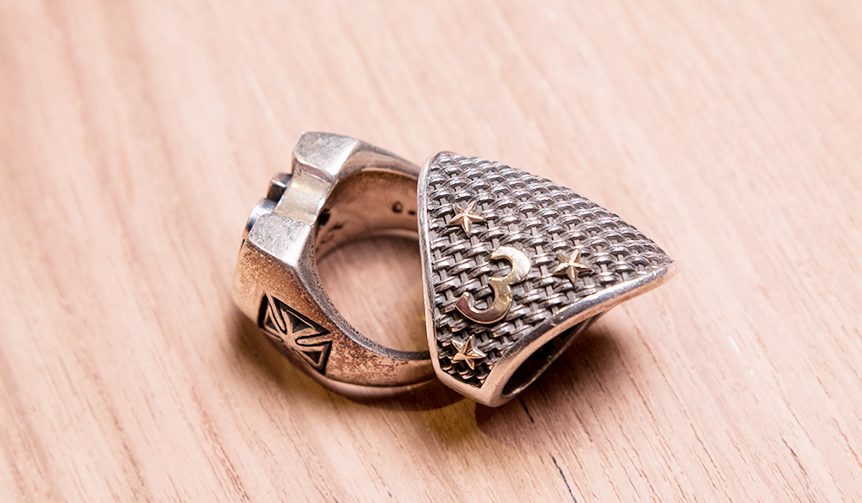
MiharaTechnologically, it's revolutionary, and perhaps anyone can create something that 'looks the part.' However, there are definitely walls that cannot be overcome. If you don't establish a foundation and put your heart into it, it will end up as mere mass production. I call things like M.A.R.S 'intellectual products.' That is, the intellect of the people making them is concentrated. Anything else is just readymade. I'm not saying industrial products lack intellect, but the difference in that aspect will become clear. Speed has increased, and we've entered an amazing era.
YoneyamaBut in the music world, records are gaining attention again, aren't they? I think it's something like that. As technology advances and life becomes more abundant, people seek inconvenience in things and experiences. I believe they seek the 'desire' for things that are not easily achievable.
MiharaThat might be true.
—Finally, please tell us why you used M.A.R.S. in the recent Tokyo Collection.
MiharaI presented a collection called 'Nirvana,' using only black and white. The material used was hemp, which is also used in sacred cloths offered to gods in Japan. At first, I thought it was just linen, but there's actually a difference between linen and hemp. The texture and smoothness are completely different. On the other hand, this collection was very simple, with only black and white, so I absolutely needed jewelry. That's when I thought M.A.R.S.'s style, which is neither Western nor Japanese, would be perfect. I love their Composite Series, which resembles mesh or bamboo work. It's rugged yet elegant, neither Japanese nor Western, suitable for kimonos and suits—that kind of versatility. I thought it would fit well, so I used it. I believe M.A.R.S.'s Composite Series is an idea unimaginable to foreigners.
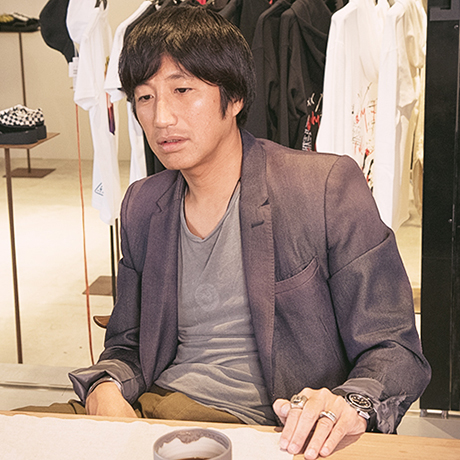
Yasuhiro MIHARA
Born in Nagasaki Prefecture in 1972. Entered Tama Art University, Department of Textiles in 1993, and began making shoes independently. While still a student, he launched his shoe brand and opened his first directly managed store, "SOSU MIHARA YASUHIRO," in Aoyama, Tokyo, in 1998. Launched "PUMA by MIHARA YASUHIRO" in 2000. Made his international debut with "MIHARA YASUHIRO" in 2004, participating in the Milan Collection. Since 2007, he has presented at Paris Collection, and since 2016, at London Collection.
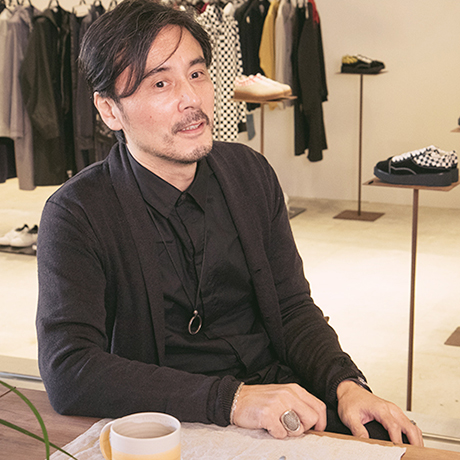
Yoji YONEYAMA
Brand established in 1990
M·A·R·S Flag Shop OPEN in 1999
Overseas expansion began as M·A·R·S PLANET in 2003
M·A·R·S Isetan Shinjuku Men's Building Store OPEN in 2007
M·A·R·S Flagship Shop
1-17-11 Ebisu Nishi, Shibuya-ku, Tokyo 150-0021
1-17-11 Ebisu Nishi, Shibuya-ku, Tokyo 150-0021
Tel. 03-3462-8187
Business Hours | 12:00 - 20:00
http://www.m-a-r-s.co.jp/