Maiko Matsunaga | Paris, Bit by Bit 003: Eau de Paris – A Transformation for Paris's Water
MATSUNAGA Maiko
Paris, Little by Little 003 - Jardin de Reuilly
Eau de Paris: A Revolution in Parisian Water!
It’s been half a year since my last post. During that time, many of us have likely experienced significant shifts in our lives. Consequently, some of the things and matters that capture my interest have also seen subtle changes. This time, I’d like to talk about Paris’s “water.”
Water, essential for life, must be secured in every era and accessible to all. By living with small, individual efforts and a “heightened awareness,” perhaps we can ensure a richer and safer future for the next generation.
Photos and text by Maiko Matsunaga
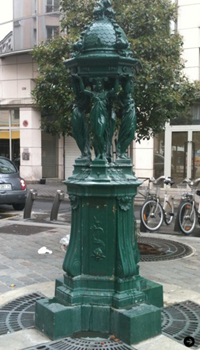
In 1872, the Englishman Richard Wallace invested a vast fortune to install 50 public fountains providing drinkable water throughout Paris. While there are various models, the most famous are the four Renaissance-style statues designed by Wallace himself. Water flows from the center of these four figures, each representing “Good Will,” “Temperance,” “Simplicity,” and “Charity.” At the time, Parisians had suffered defeat in the war with Prussia, and even water distribution was precarious. Wallace’s actions in such circumstances are still recounted today, and the Fontaine Wallace (Wallace Fountain) remains a beloved landmark.
In Paris, buying bottled water is commonplace. A visit to any supermarket or market reveals an astonishing variety of options. And seeing everyone diligently carrying home 1.5-liter bottles is quite a sight, generating a considerable amount of waste. To address this, the City of Paris has launched initiatives to raise awareness about tap water, including a website (http://www.eaudeparis.fr) with various calls to action. For example, slogans like “Our water isn’t just cheap, it’s 100 times cheaper!” and “Recycling plastic bottles is good, but not using them is even better!” are part of the tap water campaign. This isn't just a trend; it's rooted in a firm commitment to securing the future for the next generation. The idea of purifying tap water for cooking and drinking, using filters like the common BURITA, is also gaining traction.
Changing the subject, when you order mineral water at a café or restaurant, you’re asked if you’d like EAU PLATE (still mineral water) or EAU PÉTILLANTE (sparkling mineral water), right? French people, in particular, prefer drinking EAU PÉTILLANTE with their meals. This, of course, doesn’t come from the tap. The City of Paris pondered: how can we reduce plastic bottle waste further? What if everyone’s favorite EAU PÉTILLANTE could be dispensed from the FONTAINE (the common name for the 800 public water fountains across Paris)? So, in September of last year, the first water fountain equipped with a carbonation system, already common in Italy, was installed at Jardin de Reuilly in the 12th arrondissement. This is the main topic of today’s piece.
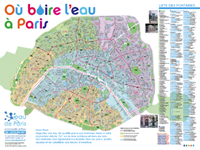
Where to drink water in Parisis a map of Paris fountains (PDF). It seems useful to have on hand when traveling.
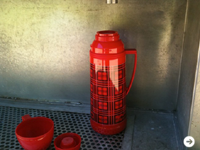
Jardin de Reuilly──Opened in 1995, this garden features expansive lawns, flowerbeds with seasonal blooms, a children’s play area, a basketball court, and a suspension bridge crossing the wide lawn. Adjacent to it are a public swimming pool and gymnasium, making it a popular spot, especially at this time of year. At the edge of the garden, a small structure houses this water fountain. Equipped with a cooling system and a carbonation unit, it dispenses three types of water: cold still water, cold sparkling water, and regular water. Pressing a button on the stainless-steel sink, designed for hygiene, releases water from above. While some might wish for paper cups, that would defeat the purpose. Please bring your own reusable bottle next time.