commmons | Sho Player Tamami Higashino Interview: "Breathing Media ~Condition~"
commmons
The Pinnacle of Japanese Classical Music: The First Complete Recording of Gagaku's Grand Piece 'Choshi'!
Shō Player Tamami Higashino Interview (1)
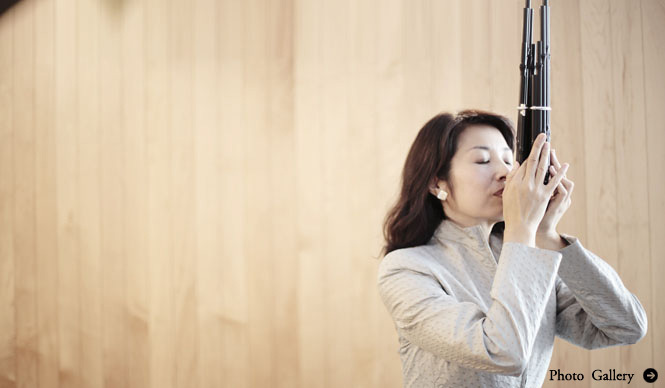
I learned for the first time that the shō, a musical instrument, cannot produce sound when cold. "First, I've warmed up the shō so you can hear the sound," says Tamami Higashino, holding the instrument gracefully before me. The sound, heard up close, is richer and stronger than I imagined, soaring and noble, as if being drawn into the heavens. How refreshing to ears accustomed to amplified sounds. It is truly "breathing," just as the CD title suggests.
Text by OPENERS
Photo by JAMANDFIX
My performance and recording are a miracle of fate.
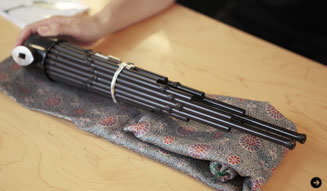
While the shō is typically made of bamboo, Higashino's instrument, a creation by artist Yasunobu Tono, is crafted from ebony. She describes its sound as "a tone unique to the modern era." This instrument features individual metal reeds (see page 3); when the cut part vibrates and resonates with the length of the pipe, it produces sound when the pitch is correct.
Gagaku, which originated in China about 1400 years ago, has been continuously reproduced with its shape, principles, and musical notation unchanged, allowing us to hear the same sounds as over a thousand years ago. Higashino describes the sound of the ebony shō as "listening to a resonance that has existed since ancient times, yet is of the present." The instrument produces the same pitch whether blown or inhaled, expressing the act of breathing through music.
──Gagaku and the shō are considered Japan's indigenous classical music, yet we rarely have the opportunity to experience them.
That's precisely the aim of this CD release. When I first encountered this music, it felt so new, and the impact was profound. I believe it is a "classic among classics," possessing an unwavering quality that transcends any specific country or era.
──In what kind of venues do you perform?
While its origins lie in the traditions of the Imperial Household Agency, it has been performed in various rituals and ceremonies at temples and shrines since the grand opening ceremony of the Great Buddha at Todai-ji Temple. My performances are primarily in concert halls. The repertoire consists mainly of classical pieces, but in the last 20 to 30 years, Western composers have also begun creating original music for this instrument.
──You have now recorded the entirety of the grand Gagaku piece 'Choshi' for the first time in the world.
Gagaku is typically performed as part of long rituals and ceremonies, with 'Choshi' serving as an overture. While usually lasting no more than five to six minutes as an introduction, this time I challenged myself with a grand piece lasting nearly thirty minutes. 'Choshi' is considered a "secret piece" in some traditions, possessing musical allure while demanding rigorous training from the performer. Ever since I learned of this piece, recording it has been a long-held dream, driven purely by the desire to experience the entirety of this composition, to hear it as a listener.
──So, as a performer, you were also deeply intrigued as a listener.
Indeed. Gagaku was originally a male-dominated art form, music for a select few. Over time, it became more open, and doors were extended to those from classical music backgrounds. Although 'Choshi' has been passed down, it has never been recorded. The full scope of this piece, especially one originally played by multiple instruments, was a world of imagined sound that I myself had never heard. This recording represents the highest peak I could reach as a musician, a distant goal in my lifetime, and my involvement in recording it at this time and in this era is a miracle of fate.
'Breathing Media ~ Choshi ~'
Release Date | October 12, 2011
2-CD Album Set
Standard Price | ¥4,200
Permanent Re-pack Specification
Carbon Offset CD
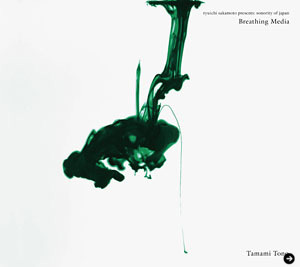
<Disc-1>
1. Ichikotsuchō
2. Sōjō
3. Ōshikichō
4. Hyōjō
Includes all 4 tracks
<Disc-2>
1. Banshikichō
2. Taishikichō
3. 'Hyōjō' with Ivory Shō
4. Ryuichi Sakamoto Remix 'Taishikichō'
Includes 3 tracks and 4 versions
Total running time: Approx. 2 hours 14 minutes
commmons
The Pinnacle of Japanese Classical Music: The First Complete Recording of Gagaku's Grand Piece 'Choshi'!
Shō Player Tamami Higashino Interview (2)
'Breathing Media ~ Choshi ~', the album, is the debut work and first album by shō player Tamami Higashino, who also participated in Ryuichi Sakamoto's albums 'Gohatto', 'out of noise', and 'Ichi-mei'. It features pieces that encompass musical elements such as modernism, minimalism, ambient, and noise, which have been explored within the Western academic tradition since the early modern period.
An Encounter with Utterly Beautiful Music and a Sense of Perfect Timing
──You described it as "miraculous"; what did you mean by that?
Firstly, as a musician, I feel I have been guided by the shō. Furthermore, the instruments I have used over the years feel as though they are reaching their peak right now.
On the other hand, when I first encountered the shō, I was also studying computer music, so I understood how difficult it would be to record the vast amount of sonic information in Gagaku, a world of overtones. At that time, technology had its limits, but now, with current technology, we have reached an era where this sound can be properly captured. We can establish a milestone as a record of this time. The instrument, recording technology, and the era have aligned to create a superb result.
──Were you also influenced by the Great East Japan Earthquake?

Shortly after the earthquake, a fashion magazine featured an interview with fashion designer Hanae Mori, where she commented, "I spent my youth in a time of cultural emptiness during and after the war, but people can move forward by being drawn to the absolutely beautiful things depicted in movies and novels." I was deeply moved by this.
My encounter with Gagaku was also an encounter with the most beautiful music, and by pursuing that world, I have been able to move forward myself.
In ancient Japan, when Gagaku was introduced, there was nothing, yet people, bathed in the light of civilization from China, moved forward with the will to build a nation. I felt it was essential for people to experience such beautiful resonance and a sound world brimming with vitality, which could serve as a guide.
──Could you tell us about the process leading up to the recording?
Every time I met Ryuichi Sakamoto, I spoke about my desire to try new things and convey the brilliance of certain pieces. Sakamoto-san deeply understood the absolute musicality of Gagaku and Choshi. So, last year, when I expressed my resolve, saying, "I've decided to make a record, even if it's self-produced. I can't miss this opportunity," commmons offered to release it.
commmons
The Pinnacle of Japanese Classical Music: The First Complete Recording of Gagaku's Grand Piece 'Choshi'!
Shō Player Tamami Higashino Interview (3)
For this album, 'Breathing Media ~ Choshi ~', I challenged myself to a multi-tracked solo performance of the shō, covering all six modes of 'Choshi,' a classic among classics, arguably the oldest classical work in human history. To capture the full scope of this lengthy classical piece, I combined ancient bamboo instruments with their refined resonance, the replica 'U' instrument from the Shōsōin Imperial Treasury, an ebony shō created by contemporary master craftsman Yasunobu Tono, and a shō made entirely of ivory, in various ensembles. This was realized with the highest modern recording technology and a newly created Ryuichi Sakamoto mix, presenting it as an "unprecedented classical work."
Gagaku: Heavenly Music and Earthly Music
──In the fourth track of 'Disc-1', 'Hyōjō', you used an ivory shō, is that correct?
I have also performed with the ivory shō at a concert hosted by the Kyoto National Museum. This time, I wanted to capture the shō as it is today, its contemporary sound, for this album. I consulted with the maker, Yasunobu Tono, and since it was made in Kyoto, he suggested recording it in Kyoto. Through a fortunate connection, I was able to record at Sokushō-in Temple at Sennyū-ji, known as the "Temple of Music." I believe that listening to 'Hyōjō' will allow you to appreciate the unique texture of this instrument within this world.
──The fourth track on both 'Disc-1' and 'Disc-2' is Ryuichi Sakamoto's remix of 'Taishikichō'.
'Taishoku' was known as 'Daishoku' in the Tang Dynasty, referring to distant foreign lands, the Western regions, and the Islamic world. After a thousand years in Japan, it became 'Taishikichō'. Musical texts from the Kamakura period are considered authoritative, and the performance style is described as energetic and dynamic, urging performers to play with vigor.
I was very curious to see how Sakamoto-san, whose musical foundation is in European music, would interpret this piece from a composer's perspective.
──What were your impressions of the remix?
It was a different world than I had imagined. Earlier, I mentioned Hanae Mori's dreamlike, beautiful world; in contrast, Sakamoto-san's percussive piano brings the heavenly music of Gagaku back to reality. I believe the strong message from Sakamoto-san, a unique musician actively involved in social contribution, urging us to "face reality," is conveyed in the very first piano note, and I hope listeners will notice how that single note changes everything.
New Connections Create Classical Works
──What are your thoughts on releasing the album through commmons?
I've been interested in the concept of "commons" since the label's inception. In recent decades, the era has undeniably shifted from mass communication, which has been hyped for so long, towards common communication. The prototype of this common communication lies in the transmission of Gagaku's secret pieces. Considering its track record of transmission over more than a thousand years, there are things that can only be conveyed through that style.
I truly hope that people who value common communication will listen to this kind of music. This is because I myself constantly think, "I want to seek out places of excellence." Such new connections create classical works, and it is crucial for elders like my mentors and Sakamoto-san to transmit and showcase new, cool things.
──Do you have a message for your listeners?
'Choshi' encompasses melody, harmony, and rhythm as found in European music, making it a highly complete composition. While paying respect to the Japanese people who have preserved this tradition, I sincerely hope you will immerse yourselves in its beauty as music of space.
The album title, 'Breathing Media,' is the concept behind my musical activities. It signifies the rhythm of breathing, confronting one's own breath. I hope you will breathe within this music. To observe one's breath is to observe oneself.
──Thank you very much.
Tamami Higashino
Since 1989, she has participated in performances sponsored by the National Theatre. A unique musician, she has been involved in the creation and performance of various genres, from Gagaku classics to contemporary music. She has performed internationally, including being invited to The Silk Road Project, led by Yo-Yo Ma, and the CCMIX (Centre de Creation Musicale Iannis Xenakis in Paris). She has received numerous awards both domestically and internationally for her compositions and shō performances, including the ISCM, ICMC, first prize at the National Theatre Composition Competition, the Special Award for the Encouragement of Contemporary Performing Arts from the Agency for Cultural Affairs, and the Japan Art Encouragement Prize.
She was in charge of music for HERMES Tokyo Opening and JAXA's space dance project 'HITEN'. Since 1999, she has participated in recording sessions for Ryuichi Sakamoto's works. Her other CD participations include the complete recording of John Cage's 'Two3, Two4' and 'Scenes of Spirits'. She has developed 'Breathing Media Arts' and 'From The Eurasian Edge'. She belongs to the Gagaku ensemble Reigakusha. This CD is her first work and debut album under her own name.
Tamami Higashino Official Website: http://www.shoroom.com