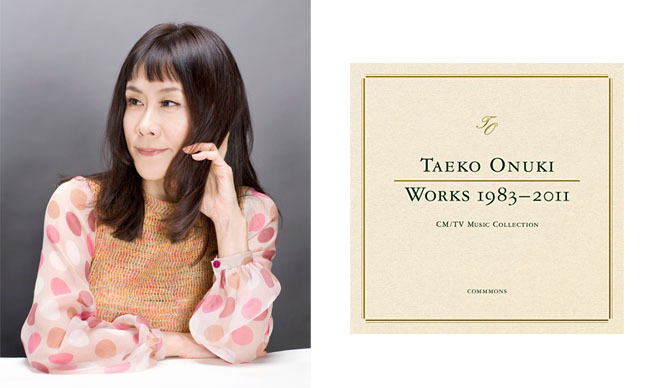
SPECIAL INTERVIEW | Taeko Onuki on the Power to Overcome
I want to sing for those who live powerfully with new values.
Taeko Onuki on the Power to Overcome (Part 1)
One year has passed since March 11, 2011. On Sunday, March 11th, Taeko Onuki will participate in and perform at a charity event called "3.11 Kizuna from En ~We Will Never Forget~" held at The Garden Hall in Ebisu, organized by the Fumbaro Japan Support Project.
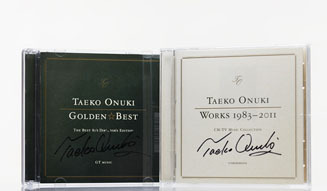
She discusses "TEKO ONUKI WORKS 1983-2011 CM/TV Music Collection," which features remastered CM songs and TV theme music released at the end of last year, arranged chronologically from the 1980s, and "GOLDEN☆BEST Taeko Onuki ~THE BEST 80’s Director’s Edition." She also talks about her "UTAU tour" with Ryuichi Sakamoto in 2010 and the "3.11" disaster.
*Application details for a signed CD giveaway are on the final page.
Text by Makoto KAJII (OPENERS)
The "UTAU Tour" with Mr. Sakamoto felt like training.
At the end of last year, Taeko Onuki performed as a guest at "Ryuichi Sakamoto Playing the Piano 2011," a project to inspect and repair musical instruments for schools affected by the Great East Japan Earthquake, an initiative co-founded by Ryuichi Sakamoto. She sang "Akatombo," "Shikisai Toshi," and "a life."Great East Japan EarthquakeAt the end of last year, Taeko Onuki performed as a guest at "Ryuichi Sakamoto Playing the Piano 2011," a project to inspect and repair musical instruments for schools affected by the Great East Japan Earthquake, an initiative co-founded by Ryuichi Sakamoto. She sang "Akatombo," "Shikisai Toshi," and "a life."
—It was the first time in a year that the two of you shared a stage since your national tour in 2010 ("A PROJECT OF TAEKO ONUKI & RYUICHI SAKAMOTO UTAU TOUR 2010").
The "UTAU tour" with Mr. Sakamoto was a very rewarding experience for me. It was a simple format with just piano and voice, nothing else to hide behind. We performed together as equals, but the way we listened to and inspired each other was something I had never experienced before.
I knew it from the recording sessions, but the more I played with Mr. Sakamoto, the better our breathing became synchronized, and the better our performance got with each tour. Some songs even took on a different direction than on the album, which was very interesting. However, the tight schedule made managing my voice and physical condition very difficult. I traveled with my own bedding and inhaler, and had a chiropractor make house calls to maintain my usual routine.
—You took great care, then.
Yes. If my voice wasn't in good condition, the overall impression of the concert would be dulled. I couldn't let Mr. Sakamoto down, so I sang under a lot of pressure and responsibility. It felt like training (laughs).
—What was your impression of Mr. Sakamoto after the tour?
We don't talk much even when we're together in everyday life. But during the live performance, we're both so focused that we can feel more than words can convey. I believe we have a strong bond of trust, so I can sing with confidence. If there's anything similar about us, it's that we tend to forget things easily, even from the past (laughs).
—The tour DVD is also well-received.
It was released with footage not broadcast during the live broadcast on WOWOW. At first, I was afraid to watch it, thinking, 'What if I didn't sing well?' But it turned out to be better than I expected, so I was relieved (laughs). Watching myself on screen is hard on the heart. But this is a record of something that can never be done again.
3.11 Kizuna from En ~We Will Never Forget~
Date: Sunday, March 11, 2012
Venue: Ebisu Garden Hall, Tokyo
Doors Open / Performance Starts: 2:00 PM / 2:30 PM
Performers: <Talk> Kamiya Amon, Takeo Saijo (Representative of Fumbaro Japan Support Project)
<Live> Taeko Onuki, Jin Oki, cocoon
Ticket Price: Advance ¥3,900
Ticket Outlets: Major ticket agencies
Inquiries: Sunrise Promotion Tokyo 0570-00-3337
http://wallpaper.fumbaro.org/en_kizuna
I want to sing for those who live powerfully with new values.
Taeko Onuki on the Power to Overcome (Part 2)
"TEKO ONUKI WORKS 1983-2011 CM/TV Music Collection," released by the label "commmons," is an album that covers Taeko Onuki's valuable work over 30 years, from the 1980s to the present, and includes music from popular commercials that colored each era.
A good melody is the foundation of pop music.
—I was surprised that "GOLDEN☆BEST Taeko Onuki ~THE BEST 80’s Director’s Edition," released at the same time, shares the same jacket design. It's groundbreaking to have the same graphic design across different labels.
We commissioned Hideki Nakajima, a graphic designer, for both.
—"TEKO ONUKI WORKS 1983-2011 CM/TV Music Collection" is arranged chronologically, so as you listen, the historical context seems to emerge. It's amazing you had the sound sources.
I had the original cassette tapes and DATs (Digital Audio Tapes) from back then at home. I later found out that not all of them were there, but I'm glad I kept them. For commercial music, I was often told "leave the arrangement to us" after I handled the lyrics and composition, so I would ask the arrangers I worked with frequently at the time. A good melody is the foundation of pop music, and back then, many songs started with the chorus, which was a fun era.
—With catchy melodies and lyrics, they still feel fresh. Are there any takes among the included songs that particularly stand out?
The 80s were particularly interesting. A lot of money was spent on the visuals, and I learned a lot about the spirit of creation from the video teams. I also sang many theme songs for dramas back then, and about two-thirds of my albums were tie-in songs. But the commercial industry has changed with the times... Something about the humor has disappeared. It seems like production sites everywhere are facing challenges.
Nurturing songs through performances under pressure
—"GOLDEN☆BEST Taeko Onuki ~THE BEST 80’s Director’s Edition" focuses on her 80s works, from her first RCA release "MIGNONNE" in '78 to her final MIDI Records release "NEW MOON" in '90. It includes many songs from the long-awaited MIDI Records era.
I personally liked many songs from the MIDI era, and since I couldn't be involved in the mastering for the CD releases, I'm relieved that they've finally been released. It feels like a weight has been lifted off my shoulders.
—What was the MIDI era like for you?
That was a time when I was exploring how to create music with various players. I met the musicians who would later become my long-term stage partners, the "string quartet" (generally referring to a string quartet), and absorbed a lot during that period.
—The songs included are nostalgic, and your voice sounds youthful.
My voice had more vibrancy when I was younger, but it was thinner. It was bright, but lacked projection. That transparency is gone now, but I believe I've gained more power to convey emotion in its place. It's not just about the voice; it's about the 'now.'
—The power to convey?
I can only hone myself on stage with an audience. A baseball player hitting a home run in front of thousands of spectators is about overcoming pressure; you can't achieve that without physical experience. Good pressure is necessary. With singing, I often search for the right angle of my face or my stance on stage to hit the core of the note, and sometimes I find it. That's how I nurture my singing through performances.
I want to sing for those who live powerfully with new values.
Taeko Onuki on the Power to Overcome (Part 3)
You have to be determined and run until you drop.
—That's hard to imagine when watching you sing on stage.
When you continue for a long time, you reach a point where you think, 'I want to do this, but I don't know how,' and you hit a wall. But I overcame one such wall, and that was during the MIDI era.
—How did you overcome it?
During the MIDI period, all the players were foreign, and they played so intensely that I was pushed to sing, and my voice started to reach notes I couldn't before. Foreign musicians don't understand Japanese lyrics, so they play without holding back. From that experience, I realized that band members can nurture a singer. When the players are Japanese, they play for me, supporting me, but they don't push me to 'sing!'
So this time, I thought, 'If there's anyone who can help me overcome further, it's Mr. Sakamoto.' I asked him if I could put lyrics to one of his difficult songs and sing it. Of course, I'm a fan of his music, but I wanted to overcome a new challenge that only I could understand.
The UTAU tour was grueling, but I truly overcame it. I went beyond my vocal capacity, and now I can sing even in my own concerts. I learned to grasp the song as a whole. Even a small step for me was a giant leap. I realized I had to be determined and run until I dropped.
—That's an incredible story.
Mr. Sakamoto's very presence is a pressure, and he always intimidates me. That's in the sense of respect. In work, Mr. Sakamoto doesn't allow for complacency. There's the pressure from the audience, and the strict pressure from Mr. Sakamoto, who, though he doesn't say it, implies that any failure is my own fault. Now that I've overcome it, I want to create as many singing opportunities as possible so I don't forget what my body has gained.
Living with anxiety in 2012 as well
—So, what kind of year was 2011 for you?
Everything changed on March 11th. Currently, I feel people are divided into three types: those who have firmly accepted that 'Japan is not what it used to be,' those who are foolishly thinking 'things will go back to normal,' and those who think 'something happened, but life goes on as usual.'
My own values didn't drastically change after March 11th, but rather, my perspective became clearer. I realized I was holding onto a lot of unnecessary things, which helped me see the direction of my life. The meaning of who I am making music for has also changed.
—What was it like before March 11th?
Before March 11th, I think there was a concept of 'healing' in music for people who felt unhappy or tired, even though material things were abundant. Now, the meaning of 'healing' is very different. Facing reality without blaming others, straightening your posture, and establishing your own core will help you live in the times to come. While my singing remains the same, I want to sing for those who are striving to live powerfully with new values.
—Has your motivation for music changed?
I believe there are lyrics that resonate now more than ever, so the songs I choose for my live performances will likely change too. Thinking about the fate of the crumbling nuclear power plants always fills me with anxiety and fear. In 2012, like everyone else, I will continue to live with anxiety, but I want to take action on things I can do, not just in music. I don't think everything will be alright on its own.
—Thank you very much.
3.11 Kizuna from En ~We Will Never Forget~
Date: Sunday, March 11, 2012
Venue: Ebisu Garden Hall, Tokyo
Doors Open / Performance Starts: 2:00 PM / 2:30 PM
Performers: <Talk> Kamiya Amon, Takeo Saijo (Representative of Fumbaro Japan Support Project)
<Live> Taeko Onuki, Jin Oki, cocoon
Ticket Price: Advance ¥3,900
Ticket Outlets: Major ticket agencies
Inquiries: Sunrise Promotion Tokyo 0570-00-3337
http://wallpaper.fumbaro.org/en_kizuna
Taeko Onuki Official Website
http://onukitaeko.jp/
If you wish to enter, please apply via the application form below.
Winners will be contacted directly.
Applications have closed.
Thank you for your many applications.