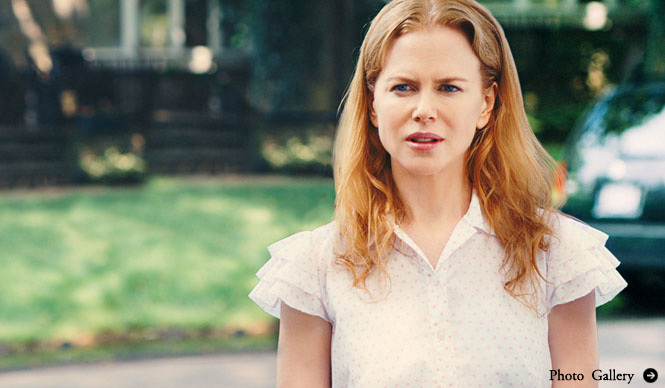
MOVIE | Nicole Kidman on 'Rabbit Hole'
The Pulitzer Prize-winning masterpiece play adapted into film: "Rabbit Hole"
Nicole Kidman Interview (1)
Becca (Nicole Kidman) and Howie (Aaron Eckhart), a couple living in the suburbs, are unable to recover from the grief of losing their beloved son in a car accident, and their marital relationship has become strained. One day, Becca encounters the teenage boy who took her son's life, and they begin to meet frequently.—"Rabbit Hole," based on the Pulitzer Prize-winning play and scripted by playwright David Lindsay-Abaire himself, directed by John Cameron Mitchell of "Hedwig and the Angry Inch," will be released nationwide on Saturday, November 5th, at TOHO Cinemas Chanter, Human Trust Cinema Shibuya, and other theaters.
Text by OPENERS
Nicole Initiates Film Adaptation, Serving as Producer and Star for the First Time
Nicole Kidman embodies a woman striving to live positively amidst despair, through her interaction with the boy who took her child's life. For Kidman, "Rabbit Hole" marked her first Academy Award nomination for Best Actress in eight years, since "The Hours."
—First, what prompted you to produce this film?
I'm always drawn to films that deal with extreme subject matter. The themes of most films I make are about love in its various forms. So I'm interested in people when they crave love, when they lose love. And losing a child is the most terrifying place I can go to. And the place that drives me creatively is also the place that I fear.
—But how did you decide to adapt David Lindsay-Abaire's stage play "Rabbit Hole," which is not an easy play to film?
First, I believed in the theme of this work. And I like to support projects that are difficult to make. I was truly captivated by this couple who react so differently to an unimaginable, profound tragedy. Becca and Howie, while grieving in their own ways, are living together. I found that very interesting, and I wanted to play Becca myself. Cynthia Nixon had so brilliantly brought Becca to life on Broadway, and I became obsessed with the idea of introducing this character to film audiences.
When the motivation is pure, people naturally gather to "make this story."
—What specifically about the original work attracted you?
It's been eight months since the main couple lost their child, a six-year-old boy. And how do people go on living while facing that? How do people continue to live when they've experienced such a great shock that it robs them of their desire to live? And it's about marriage, it's about family, and ultimately, it's about living and hope.
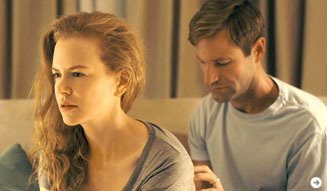
That's what I think is so wonderful about this story, its subtlety, its technique that encompasses such sharp dialogue, but at the same time, you feel everyone's pain so surprisingly, and it's like a minefield. People are walking through a minefield, but through it, the moments of the future, the reasons we are together, and the many times we become one through pain as human beings, are illuminated through this story.
—For the film adaptation, the original author David Lindsay-Abaire himself wrote the screenplay. And why did you choose John Cameron Mitchell as the director? Please tell us why.
I think David has a natural talent. He really understood what cinematic dialogue is, and he completely understood the characters and what they had been through. Working with him was a wonderful experience. As for choosing the director, I don't know if we can say we "chose" John. I think John found this project himself, and we found him. That phrasing feels much more accurate.
John is a sophisticated person, very open, and it's wonderful to work with a director who is very open to actors. He's also an actor, so he understands what's essential for performance. And just as he is open, he also possesses restraint when it makes sense. This is because the subject matter of the film itself was so mature and raw, the film needed to restrain a lot of the characters' emotions. And we needed a director who could control what wasn't good. John exercised a lot of restraint so that the film wouldn't become overly theatrical. After all, when the motivation is pure, people naturally gather to "make this story." Then, those who meet there proceed with the project together. That's all there is to it.
The Pulitzer Prize-winning masterpiece play adapted into film: "Rabbit Hole"
Nicole Kidman Interview (2)
Regarding Casting and the Elements of Great Acting
—Please tell us why you cast Aaron Eckhart as Howie, Becca's husband.
Aaron Eckhart was always a candidate to play the husband, Howie. More than that, he was our first choice. When we heard he had read the script and liked it, we thought, "Great! Maybe Aaron will say yes," and I called him. Until I called, I wasn't good at talking on the phone, and I'm actually very shy as a person, so I'm not someone who can sell anything to anyone... so I even thought, "...Is it a good idea to call him?" But I had met him a few times before, and I just wanted to tell him that I thought very highly of him and that he would be a wonderful man to play opposite me and to play a wonderful husband on screen. After that, Aaron said, "Yes" (laughs).
—Please tell us why you chose Diane Wiest for the role of Becca's mother, who warmly watches over her.
I had worked with Diane before. She is one of the great actresses in this world. What's wonderful about Diane is that in the film, she probably has the finest speech (the power of words). A monologue about how to live with deep grief and loss, how? How can you actually do that? That's the scene where the Becca I played asks her mother. Is there anything that can get better than this? I was able to portray Diane answering that.
—What about Miles Teller, who played Jason?
He was truly a discovery of talent. One of Miles' wonderful characteristics is that his face turns red. You can see it on screen. Wonderful! The ability of an actor to change color is an element of great acting. When such miraculous scenes occur, the emotions become very real.
A Terrifying Place Deep Within Oneself That One Doesn't Want Touched
—Please tell us about the costumes for this film, handled by Ann Roth.
We had to dress the characters in such a way that the audience's attention wouldn't be drawn to any particular costume or piece of clothing; ultimately, everything had to be unobtrusive. I think that was very difficult. And she always says to someone like me, "You're 178 centimeters tall, and I have to make you look like a suburban resident." Then I say to her, "But I look like that, I look like that!" And she says, "No, you don't" (laughs). That's how we created the costumes for the roles.
—How did you approach Becca's difficult situation after losing her child?
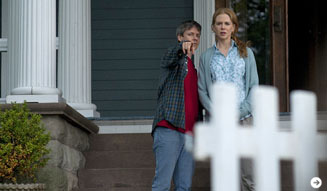
I decided to place myself in Becca's asceticism. Becca is in such terrible pain that it feels like everything would shatter if touched. I acted with that in mind the whole time. I think any woman who has lost a child would feel that way. Waking up every morning, completely weakened and broken by the loss of her son. All Becca can do is keep moving forward. She desperately tries to choose life. So, while taking down paintings and tidying the house, she says... "I can't just die crushed by grief. So, how do I live? I have to find a way."
—Please tell us about your actual process of getting into character.
I touched a terrifying place deep within myself that I didn't want to be touched. Mentally, I never wanted to go there, but somehow I ended up there. I think this is my process of getting into character. It's difficult to get there, but once you do, you completely absorb the character. And I have very deep feelings for Becca and her family.
—Your performance also brings humor to this poignant story.
Not losing humor, no matter how terrible the pain one experiences in life, is what makes people charming. I think that's what makes a story like this accessible. Because if someone is suffering, and you can make them laugh, you can open them up, at least a little... Humor is always present. Even if it takes a dark form...
—How was it working with Aaron Eckhart as your husband in the film?
Aaron poured everything he had into this film. With humor and intelligence, he created the wonderful character of Howie. The film truly shone with his addition. It was wonderful, and it was the best to see the process he went through, trying every possible means. And he's very open as an actor, the ideal person to work with.
—Finally, what do you think this film will bring to the audience?
I think we can open our hearts to the characters in this film. That's because they are all honest and real. That's what family is, and I believe that those who see the film will share the characters' experiences with them.
Rabbit Hole
http://www.rabbit-hole.jp/