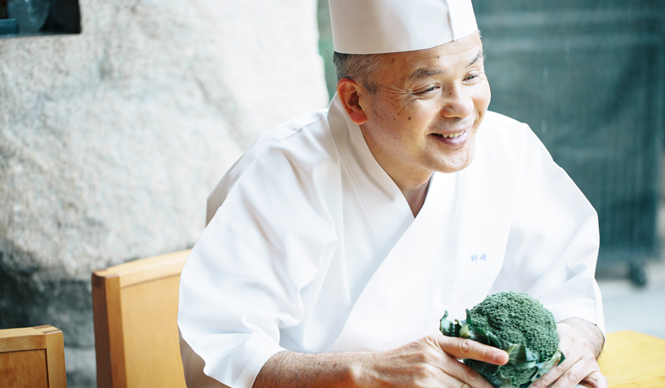
Feature: Tottori Prefecture, a Culinary Haven. Hiroyuki Nozaki of "Buntokuyama" Looks to the Great Potential of Tottori's Ingredients.
Feature: Tottori Prefecture, a Culinary Paradise
Hiromitsu Nozaki of "Buntokuyama" Looks to the Great Potential of Tottori Ingredients (Part 1)
Tottori boasts a wealth of delicious ingredients, a fact still not widely known even among gourmands. Its natural environment, surrounded by sea and mountains, yields vegetables and fruits like 'nebarikko' (a type of yam), green onions, and pears; seafood such as rock oysters and sandfish; and meats like Tottori Wagyu beef. Chef Hiromitsu Nozaki, who has been working with Tottori ingredients for over 30 years, says he is recently paying renewed attention to their potential.
Photographs (portrait) by JAMANDFIXText by OGAWA Fumio
Tottori Ingredients: "Buntokuyama's" Valued Partners
Hiromitsu Nozaki, the head chef at Kappo "Buntokuyama" (pronounced wake-toku-yama), is currently focusing on ingredients from Tottori.
"My relationship with Tottori ingredients began when I worked at Happo-en (in the 1970s). The owner was from Tottori and used to source delicious ingredients from there. Recently, I've started using them in my cooking again, and I'm impressed by how Tottori's excellent environment, blessed with sea, mountains, and land, is so clearly reflected in its produce across fishing, agriculture, and livestock."
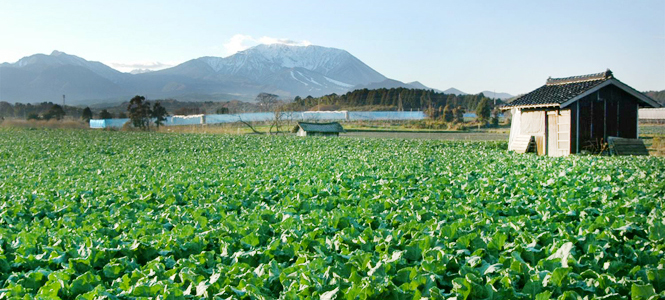
Tottori Prefecture, leveraging its rich natural environment of sea, mountains, and countryside, produces a wealth of delicious ingredients.
There's the concept of 'chisan-chisho,' meaning that eating locally produced food within the local area (and its surroundings) is best. Nozaki, as one of the proponents of this concept, explains, "When we eat what we produce, we can better understand what we should protect and nurture." In other words, it's a waste to have excellent products without developing markets for them. Furthermore, if they aren't sold outside the prefecture, we too cannot enjoy their deliciousness. These are somewhat selfish, but important issues for food lovers.
From April through summer, there are vegetables and fruits like shallots, watermelons, grapes, tomatoes, green onions, and pears such as the Twentieth Century pear and new varieties like 'Shinkansen.' For seafood, there's bluefin tuna, rock oysters, and white squid in early summer. From autumn to winter, there are fish like red flounder, flatfish, sandfish, and crustaceans such as snow crab and 'mousha' shrimp. Tottori has many delicious ingredients. While some are known nationwide, many still lack sufficient recognition.
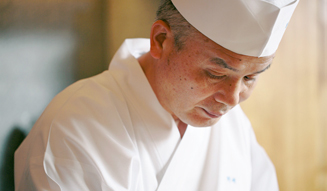
Nozaki, who possesses deep knowledge of Japanese cuisine and has authored numerous books.
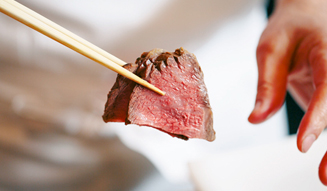
Nozaki prepared roast beef using "Tottori Wagyu Olein 55," known for its tender texture and rich meat flavor.
"It's relatively easy to get delicious ingredients locally. I think people in Tottori are fortunate." Nozaki, who has worked with countless ingredients over the years, praises Tottori's produce. While restaurants must consistently serve the same dishes, requiring them to purchase ingredients from wholesalers, it's also important to maintain the spirit of advancing cuisine by keeping an eye on ingredients from all over the country. Nozaki's eyes sparkle with a pioneering spirit as he speaks of Tottori's ingredients.
Feature: Tottori Prefecture, a Culinary Paradise
Hiromitsu Nozaki of "Buntokuyama" Looks to the Great Potential of Tottori Ingredients (Part 2)
Two Essential Ingredients for Chef Nozaki's Special Roast Beef
Among Tottori's superior ingredients, two are currently drawing particular attention: "Tottori Wagyu Olein 55" and "Daisen Broccoli Kirakira Midori." The former is beef with an oleic acid content of 55% or more in its fat, achieved through a commitment to the mellow quality of the fat. The latter is a broccoli with a strong sweetness, achieved by suppressing bitterness and astringency. It is cultivated using approximately 70% less chemical fertilizers than usual, primarily with organic fertilizers.
"Tottori Wagyu Olein 55" traces its lineage back to a stud bull named Ketaka from Tottori. According to prefectural officials, the lineage of this bull forms the foundation for many brand wagyu cattle nationwide. Therefore, in the world of wagyu, where bloodline is a testament to quality, it is a pedigree with an impeccable reputation.
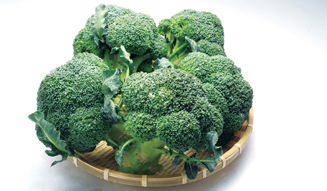
"Daisen Broccoli Kirakira Midori" is characterized by its lack of bitterness and astringency, making it edible even raw.
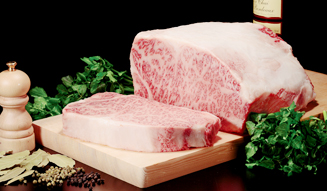
The new brand "Tottori Wagyu Olein 55" focuses on the content of oleic acid, the main component of olive oil, with an emphasis on the mellow quality of its fat.
However, as mentioned earlier, obtaining certification based on oleic acid content in fat is quite challenging, with only about 300 heads meeting the criteria annually. This is a higher hurdle than achieving A5 grade. Consequently, the tenderness of the meat and its refined aroma are truly remarkable. Hiromitsu Nozaki, head chef at Buntokuyama, prepares roast beef, particularly from the rump cut—which he describes as his "favorite" for its rich red meat flavor—when he can obtain it.
"We are not a steakhouse, so we don't purchase large quantities, but we prioritize quality. Even people who dislike the smell of imported beef are delighted when we serve this. Some say Japanese beef is expensive, but it has a robust traceability system that shows who raised it, where, and how. Considering our own health, I don't think it's expensive at all."
Served alongside the roast beef was another noteworthy ingredient: "Daisen Broccoli Kirakira Midori." Daisen broccoli, as its name suggests, is cultivated in the unique, low-density, highly permeable black soil characteristic of Mount Daisen, the highest peak in the Chugoku region.
A commitment from Tottori Prefecture, which pioneered selling broccoli with its leaves attached, also makes its freshness a key feature.
Among these, "Daisen Broccoli Kirakira Midori" is produced with reduced levels of nitrate ions, which cause bitterness and astringency, making it edible raw. Nozaki, who loves broccoli, seems to come up with various ways to prepare it, saying, "We once made a popular broccoli soup blended with soy milk."
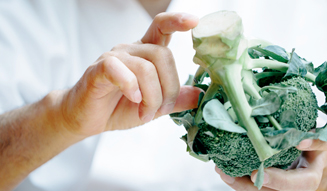
"I love broccoli. It's fun to think of various ways to cook it," says Nozaki.
"When we encounter such delicious ingredients, what we chefs should do is discard preconceived notions. We brainstorm how to use the stems, the leaves, what about making a paste? The basic principle is to maintain a boiling temperature of 80 degrees Celsius to preserve essential enzymes, but Daisen Broccoli Kirakira Midori inspires us to imagine further possibilities."
Japan has many high-quality ingredients. This story clearly illustrates that. With Hiromitsu Nozaki as an unparalleled evangelist, "Tottori Wagyu Olein 55" and "Daisen Broccoli Kirakira Midori" have a great future ahead of them.
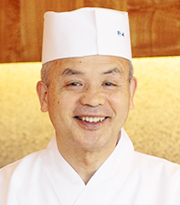
Hiromitsu NOZAKI
Born in 1953 in Fudono Town, Ishikawa District, Fukushima Prefecture. After graduating from Musashino Nutrition College, he joined the Japanese cuisine department at the Tokyo Grand Hotel. After five years of training, he moved to Happo-en. In 1980, he became head chef at "Tokuyama" in Nishi-Azabu, Tokyo. In 1989, he opened "Buntokuyama" in Minami-Azabu and currently oversees four locations as head chef. Through various media such as magazines and television, he advocates for easy-to-understand Japanese cuisine based on theoretical cooking methods incorporating culinary science and nutrition. His books include "Tsunagete Ikutai Nozaki Hiromitsu no Nijushishikkan no Shoku" (Ie no Hikari Kyokai), "Oishii Kasamashi Diet Recipe" (Shibata Shoten), "'Buntokuyama' Nozaki Hiromitsu no Ichiju Sansai" (Seibundo Shinkosha), "Jōbichai de Tsukurru Wa no Bento" (Sekai Bunka Sha), "Karada ga Yorokobu Okayu Ryori Cho" (PHP Kenkyusho), and many others.
Tottori & Okayama Shinbashi Kan
1-11-7 Shinbashi, Minato-ku, Tokyo Shinbashi Center Place 1F & 2F
Tel: 03-3571-0092
http://www.torioka.com
*An antenna shop where you can encounter a variety of Tottori's foods. The second floor also has a dining area.