
ART | Photographer Takashi Homma Interview | Exploring New Possibilities Between Photography and Film at the 7th恵比寿映像祭
ART | New Installation Exhibited at the 7th Tokyo Photographic Art Museum Festival
Photographer Takashi Homma: Interview (1)
The 7th Tokyo Photographic Art Museum Festival, a celebration of visual arts, will be held in Ebisu, Tokyo, from Friday, February 27.Under the theme "Let's Meet on a Planet," the festival seeks clues to rediscover a layered world through visual works that offer diverse "perspectives." One of the works proposing a new visual experience to watch for is the new installation by photographer Takashi Homma. "The First Jays Arrive" uses large screens projected on four walls and sound, inspired by the deer hunting he has been documenting for years on the Shiretoko Peninsula, attempting to reveal the wildness inherent in humans. We spoke with Takashi Homma, who eagerly awaits the unveiling, saying, "I'm excited to see how the audience receives it."
Photographed (portrait) by SUZUKI KentaText by MAKIGUCHI June
“Is Truth Singular?”
—Surrounded by the traces of deer hunting depicted in the visuals, the wild animals that gather there, the darkening screens, and the voices and gunshots of hunters, one is overwhelmed by a sense of being in another world, a strange trip that feels like traveling far away, and a powerful sense of presence. What was the catalyst for starting the project to document deer hunting in Shiretoko in the first place?
The direct trigger was a research project called "Together: Wildlife Corridors in Los Angeles" with American filmmaker Mike Mills. We were presenting the reality of large wild animals coming into the city of Los Angeles through his writing and my photographs. I found that perspective interesting, so I thought about shooting something within Japan, close to home. By chance, when I went to Shiretoko, I heard that the deer population had become a serious problem due to overpopulation, and I started shooting.
Initially, I began creating the photographic series "Trails." At that time, I considered whether to photograph the deer lying dead or the portraits of hunters, or to adopt a more distant perspective. That's where the difficulty in expression lies. In the end, the first iteration concluded with a work solely of bloodstains on the snow, but I still felt a lingering unease, which led me to decide to try creating a film as well.
—Many might find it fresh to see Homma, known for his urban and stylish aesthetic, engage with themes of wildness and nature.
I'm always thinking about how to make what's happening my own problem. The increasing deer population is a problem across Japan. And deer hunting takes place there. On the other hand, there's also the reality that their meat goes to waste. While venison is now available in bistros in Tokyo, a stable supply chain hasn't been established. When I observe the process from hunting deer to consuming them, I initially feel pity, but it's the same for pigs and cows. In that sense, it can easily become my own issue. I don't intend to present something distant as beautiful from afar, nor do I want to contrast the urban and the wild to emphasize how magnificent nature is.
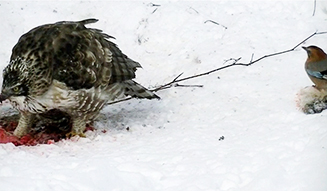
Takashi Homma, "The First Jays Arrive," 2015
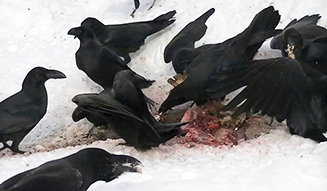
Takashi Homma, "The First Jays Arrive," 2015
—The new work exhibited this time, while initially making viewers feel as if they've entered another world, possesses the power to make them realize that humans are also part of the food chain and were once inhabitants of the natural world.
On the second day of the festival, a documentary version will be screened as a reference, with a structure that explains the issue more thoroughly. I actually had some conflict about turning the Shiretoko story into a film. When making a single film, I considered the freedom of explanation versus the constraint of narrowing the scope of interpretation. With a four-screen installation like this, which aims to bring viewers closer to the feeling of being there, there's also the possibility that it might be dismissed simply as "this is nature," leading me to wonder if more explanation is needed. However, this time, we can show both the installation and the documentary, so I really hope people will see both.
—Is the reason for using various media to express a single theme to capture things from multiple angles while leveraging the characteristics of each?
I have this thought: “Is truth singular?” For example, if a glass falls over right here, I believe the way the water spills will be different from how someone else sees it. The fact is one, but how it appears can change things. That's what interests me right now.
—By employing different expressive methods, both the creator and the viewer can discover different facets of a particular fact. This also broadens the possibilities that emerge from a single fact. In that sense, the use of sound in this new work is also intriguing.
One of the major differences between photography and film is sound. I consider sound to be as important as visuals, and I don't view it merely as a supplement to the images or as sound effects. Sometimes, I even start creating a work from sound. In this piece, there are moments when the screen goes dark and only sound resonates. The composition is designed to convey the power of sound, and in fact, that's what I wanted to achieve most this time.
—For those who know Homma as a photographer, this statement might come as a surprise.
While my photography might be strongly associated with me, I'm actually interested in expression in general. In the early days, people would comment on my work, saying things like, "This isn't photography," or "It doesn't look like a photograph." If there are genre classifications like photography and film, I want to create something in between, like an installation. From a filmmaker's perspective, the darkness might seem unusual, but for photographers, the sensation of the screen going dark with each slide change in a slideshow is quite normal. Therefore, I believe there are new possibilities in this in-between space.
Currently,I am exhibiting a video installation of urban planning in Chandigarh, India, titled "Chandigarh" at the CoSTUME NATIONAL Aoyama flagship store,and I have material for about two more films I've already shot. So, I'm thinking of unofficially holding a "Takashi Homma Film Festival" throughout the year (laughs). Regarding the themes I choose, I tend to work backward from the question of what can be achieved with film. Urban planning in India, deer hunting, resort hotels in Sri Lanka, the stage play "Classroom" by Norimizu Ameya – various subjects. In other words, the theme isn't what is depicted. I believe that by viewing these four works I've mentioned, people will understand what I aim to do.
ART | New Installation Exhibited at the 7th Tokyo Photographic Art Museum Festival
Photographer Takashi Homma: Interview (2)
Fiction Slightly Detached from Reality is Interesting
—Was there a particular reason why you began to actively incorporate video as a medium, in addition to photography?
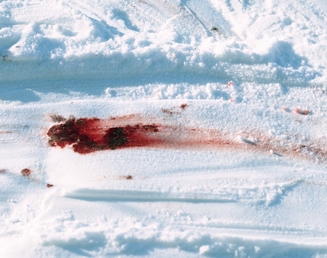
From Takashi Homma's "Trails," 2010 [Reference Image]
My photographic approach isn't the type where I walk around the city snapping pictures. I set up a tripod with a large camera and remain still. I shoot when the subject moves. That way of shooting is cinematic, isn't it? Also, the fact that DSLR cameras can now shoot movies is significant. I haven't used video up to this point. Furthermore, for the past five years, I've been co-teaching a graduate course at Tokyo Zokei University called "New Documentary," exploring new possibilities in video and photography with film director Nobuhiro Suwa. That has been quite impactful.
We watched many alternative documentaries, both domestic and international, and I researched their structures quite a bit, so this might be an extension of that. On the second day of the festival, I'll be having a talk with Suwa-san, and I imagine we'll discuss this topic.
—"New Documentary" is precisely the genre that Homma is passionately pursuing right now.
The avant-garde artist and writer Kohei Sekiguchi once said this about fiction: Nowadays, there's a lot of fiction that departs from reality and goes into the sky, doing things that have no connection to reality. But he argued that fiction that hovers just slightly off the line of reality, like a "hovercraft," is interesting. I completely agree. The same applies to documentary filmmaking.
In a class last year, we watched the works of American documentary filmmaker Frederick Wiseman. Many people might think it's reality itself, but after all, footage shot over one to two months is condensed into one or two hours, so editing is involved. Wiseman himself doesn't call it documentary; he calls it "cinema." It doesn't include background music or contrived interviews. What we typically consider documentary often includes background music and overly dramatic interviews, making it feel very closely tied to reality. However, by lifting it slightly, it creates room for the viewer's interpretation between reality and perspective, making it more breathable, don't you think? This applies to photography and art as well.
—The more room there is for interpretation, the greater the freedom of enjoyment. However, for the viewer, it's also important to approach the work with their own unique perspective. For Japanese people, who may not be entirely comfortable asserting their individual viewpoints, Homma's installations, which strongly present a unique perspective, are undoubtedly quite stimulating.
Because of that, they might rely on the text on the book jacket for confidence in their own perspective. In Japan, there's also a kind of peer pressure. Since we're taught in compulsory education to do things a certain way, it might be difficult to maintain a unique perspective. For instance, at the Tokyo Photographic Art Museum Festival and in the media, I naturally feel inclined to step outside the established boundaries.
—It is precisely this rebellious spirit that makes Homma's works consistently stimulating. This time, a collaborative performance with Contact Gonzo will also be presented, delving deeper into the theme.
I went to Shiretoko with Contact Gonzo three years ago. They are essential people for expressing the theme of "Shiretoko Deer Hunting." What I seek from this collaboration is "experience." I don't separate video and performance in terms of experience. I actually had many more ideas. Like connecting live to Shiretoko and showing the deer being butchered. Honestly, I wanted to bring deer meat, have hunters butcher it, and even have people eat the venison. That's where the story would find its conclusion. It was difficult this time due to space constraints, but I'll do it someday.
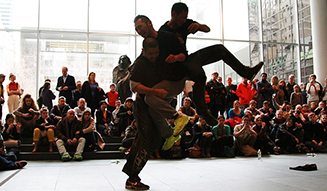
Photo by Choi Kafai
Approaching deer hunting from the perspective of food is also one way to gain a "viewpoint." We are now being given an opportunity to consider how we ourselves can engage with this issue.
7th Tokyo Photographic Art Museum Festival "Let's Meet on a Planet"
Dates | Friday, February 27 - Sunday, March 8
Hours | 10:00 AM - 8:00 PM *Last day until 6:00 PM
Admission | Free admission *Screening programs and events with limited seating are subject to a fee.
Venue | The Garden Hall, The Garden Room
1-13-2 Mita, Meguro-ku, Tokyo, within Ebisu Garden Place
Ebisu Garden Place Center Plaza, Maison Franco-Japonaise Hall & Gallery, and others
3-9-25 Ebisu, Shibuya-ku, Tokyo
Inquiries | Tokyo Photographic Art Museum Festival
Tel. 0570-012-378 (10:00 AM - 6:00 PM, excluding Saturdays, Sundays, and holidays except during the festival period; during the festival, hours will be as stated)
www.yebizo.com
Related Events:
Special Talk: "On Depicting Documentary"
Date & Time | Saturday, February 28, 3:00 PM - 5:00 PM
Venue | Maison Franco-Japonaise Hall
Speakers | Takashi Homma, Nobuhiro Suwa
Performance: Contact Gonzo x "The First Jays Arrive"
Date & Time | Sunday, March 8, 11:00 AM / 1:00 PM / 3:00 PM *Each session approx. 15 minutes
Capacity | 70 people
Venue | Maison Franco-Japonaise Gallery
Performers | Contact Gonzo
*Numbered tickets will be distributed on a first-come, first-served basis from 10:00 AM on the day at the reception in front of the Maison Franco-Japonaise Hall.
Community Collaboration Program:
Exhibition: "Takashi Homma: VARIOUS COVERED AUTOMOBILES"
Dates | Friday, February 27 - Sunday, March 15
Venue | POST / 1F, 2-10-3 Ebisu Minami, Shibuya-ku, Tokyo
Admission | Free
Closed | Mondays
TEL. 03-3713-8670
http://post-books.info