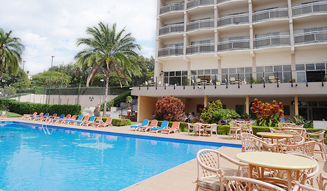
Feature: Journey Through African Mist: In Search of Mountain Gorillas
Feature: Journey Through Africa's Mist – Love Beyond the Fog
In Search of Mountain Gorillas (Part 1)
Kazuyuki Murai runs Cosmo Klats Travel. He is known as one of Japan's foremost luxury travel experts, handling high-end destinations and hotels. Murai's latest journey takes him through Rwanda and Uganda, a trip recommended by one of his clients. His sole purpose: to meet the mountain gorillas, an endangered species. Was he able to find them, said to inhabit the deep mountains?
Text & Photographs by MURAI Kazuyuki
A Small Nation in Rapidly Developing East Africa
North Africa, the Arab world, includes countries like Egypt and Morocco. Southern Africa offers recommendations for "safari lovers" with destinations such as South Africa, Namibia, and Botswana. East Africa, with its rich tourist resources like the Serengeti plains and the Maasai people, has seen a relatively early increase in Japanese visitors, including Kenya and Tanzania. The vast African continent, with its distinct history, culture, ethnic groups, and climate in each region, is a truly amazing destination. It is also our most popular travel destination.
One day, a client visiting Japan mentioned, "The mountain gorillas I saw in Rwanda were magnificent." Intrigued, I immediately decided to investigate the situation in Rwanda.
Rwanda carries the tragic past of the "Rwandan Genocide" that occurred in 1994. In 2004, it became known worldwide through the film "Hotel Rwanda." However, this year marks 20 years since the incident. This small East African nation has achieved remarkable development.
Not only economic development, but also in the national parks within the vast rainforests of the northern volcanic mountains, endangered mountain gorillas reside. People flock to see them, and the tourism industry is thriving. As an intermediate step in our African continent journey, we decided to visit Rwanda once again.
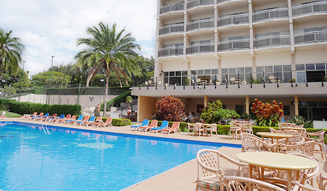
Hotel Rwanda, the setting for the film of the same name
Kigali International Airport, Rwanda's Gateway
There are several options for traveling to Rwanda, including layovers in Istanbul, Dubai, or Doha, making it more accessible than one might imagine. As we approached Rwanda, the view from the airplane window was far from the arid African landscape you might picture! A grand panorama of green land and vast lakes unfolded below.
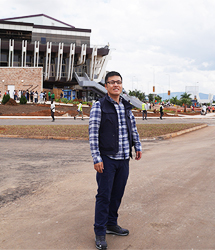
Kazuyuki Murai, Representative of Cosmo Klats Travel
Rwanda's nickname is "The Land of a Thousand Hills." This comes from the fact that most of the country is covered by rainforests and beautiful hilly terrain. Due to the surrounding vast lakes, high average altitude, and unique topography, it is prone to being covered in mist. Leveraging this characteristic, it is now known as a leading agricultural nation in Africa, with thriving coffee and tea cultivation.
Upon arriving at Kigali International Airport, the first thing we encountered was a strict baggage check. What were they checking for? Plastic bags. In Rwanda, they are prohibited. This is to minimize plastic products that do not decompose, thereby preventing an increase in waste. It is also said to help prevent the spread of malaria by eliminating water collection points for mosquitoes.
Furthermore, the last Saturday of every month is legally designated as "Cleanliness Day," obligating all citizens to clean the area from their doorstep to the public road. Consequently, the city is very clean, and even in rural areas, there is no trash on the roadside. I was truly surprised by this.
Kigali city itself is in the midst of a construction boom. Foreign-funded hotels and convention centers are being built, creating a vibrant atmosphere that feels like "a great wave of capitalism crashing upon the simple charm of Rwanda."
After having lunch at the "Hotel Mille Collines," the setting for the movie "Hotel Rwanda," we visited the Genocide Memorial Center and then embarked on a three-hour drive to "Volcanoes National Park," home to the mountain gorillas. The roads are well-maintained, and the scenic journey along the way was delightful. The Rwandan people, always smiling and waving, offered a sense of peace that soothed the fatigue of our travels.
Feature: Journey Through Africa's Mist – Love Beyond the Fog
In Search of Mountain Gorillas (Part 2)
The Only Place for Comfortable Mountain Gorilla Observation
Our destination this time is Volcanoes National Park, located in northern Rwanda and composed of seven Virunga volcanic cones spanning Rwanda, Congo, and Uganda. Within these volcanic cones live 880 mountain gorillas. Of these, 480 reside on the Rwandan side. All mountain gorillas are named and are carefully protected by the three governing countries. However, Congo is currently in civil war, and Uganda's gorilla habitats are deep within the mountains, requiring strenuous trekking. Therefore, Rwanda remains the only place where one can comfortably observe a large number of mountain gorillas.
To see them, thorough advance preparation is necessary. First, you must decide on your dates and obtain a permit for mountain gorilla observation. It's advisable to start preparations at least six months in advance, as people from all over the world seek these permits. The permit itself costs a considerable $750 USD per person.
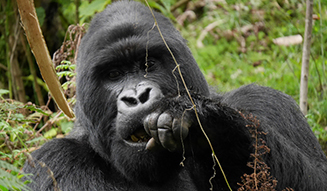
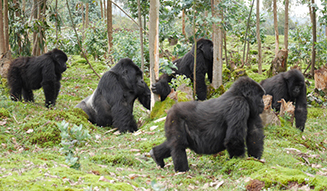
Currently, 880 mountain gorillas inhabit Volcanoes National Park. All mountain gorillas are named and are carefully protected by the three governing countries (Rwanda, Congo, and Uganda).
Currently, 19 mountain gorilla families live in Rwanda. Of these, 10 families, based in relatively accessible areas, are managed by the country for tourism and observation. The remaining 9 families are designated for research and are off-limits to tourists.
Incidentally, only 8 people are allowed to approach a single family per day, meaning a total of only 80 people can enter the mountain. Furthermore, observation is limited to one hour. Additionally, since gorilla genes are very similar to human genes, human diseases can be transmitted to gorillas, and contact with gorillas is strictly limited. If you have even a slight cold, you may be denied entry, and no refund will be given, so meticulous health management is essential.
Recommended Gear for "Gorilla Trekking"
Another essential part of preparation is having the right gear. The area where mountain gorillas live is a super-clayey plateau formed by volcanic ash from the Virunga volcanic range. Moreover, due to the high altitude and tropical rainforest climate, it rains frequently, and the weather can change rapidly. It's hot when sunny, cold when cloudy, and very muddy underfoot when it rains. Therefore, comprehensive gear that accounts for these climatic conditions is necessary. Gorillas are also constantly on the move, so you may need to walk in the mountains for three, or even more than five hours. The basic rule is: "Don't skimp on gear; be well-prepared."
A travel arranger's job is to provide all sorts of advice to ensure a comfortable and enjoyable trip. Among these, advice on attire appropriate for the time, place, and occasion is particularly important. For the journey to meet the mountain gorillas, as mentioned earlier, selecting functional clothing is crucial. If you also want to take commemorative photos in attire that suits the atmosphere, "THE NORTH FACE" is highly recommended for its blend of functionality and fashion in outdoor wear.
Let's start with choosing shoes. Although the ground is muddy, it's not a steep mountain climb, so select waterproof trekking shoes that can be worn casually. With a design suitable for town walks as well, these shoes are sufficient for your entire stay in Rwanda.
For sudden rain, a rain jacket that can be compactly stored and has high waterproof functionality is essential. The rain jacket I used this time was a powerhouse, capable of withstanding heavy downpours despite its thinness. The pants are designed to be worn even with trekking shoes on. Ease of putting them on and taking them off in difficult terrain is also a key point.
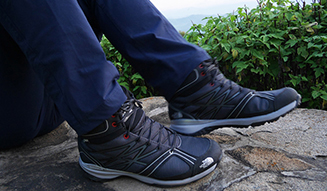
The North Face Trekking Shoes
Even if the rain stops, the ground remains muddy. When you encounter gorillas and become engrossed in taking photos, you might kneel or sit down to capture the moment. With this rainwear, you can observe and photograph the gorillas in various poses without worrying about getting dirty.
What truly impressed me this time were the pants and vest. The pants were made of a functional material that regulates humidity, keeping me comfortable when it got hot and providing warmth when the temperature dropped. I also realized how the stretch material is beneficial for trekking. Another pleasing point is the slim silhouette, which avoids the bulky look often associated with outdoor fashion.
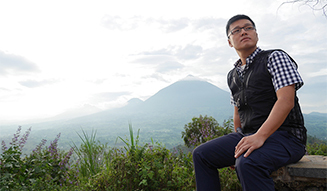
Stretchable pants and a vest with convenient pockets
Also, because the ground is so muddy, it's difficult to take off your backpack easily or frequently access your camera or food. In such situations, using the pockets and hooks on the vest prevents your belongings from getting covered in mud. By being properly equipped, you can avoid situations where you have to "just endure to see the gorillas" and ensure a fulfilling gorilla trekking experience.
Feature: Journey Through Africa's Mist – Love Beyond the Fog
In Search of Mountain Gorillas (Part 3)
An Eco-Lodge with Views of the Sea of Clouds
For accommodation, we recommend the "Virunga Lodge," perched atop a hill surrounded by a vast lake. In the morning, the world is peaceful, filled with the chirping of birds and a sea of clouds. Late at night, all electricity is cut off, and you spend your time by candlelight and flashlight. The lodge welcomes guests with natural wildflowers, offering a sincere, unpretentious hospitality.
It's also enjoyable to interact with other guests over meals and drinks. Even if you return covered in mud, the lodge staff will kindly wash your shoes and clothes. The quality of the food is also high.
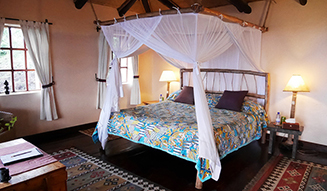
The Virunga Lodge's signature dishes have a taste that appeals to Japanese palates
A lodge stay can be only half as enjoyable without English proficiency. At Virunga Lodge, being able to speak English greatly enhances the experience, so be sure to add brushing up on your English to your pre-trip preparations.
Impressed by the High Caliber of Rangers and Guides
As mentioned earlier, the cost of permits for mountain gorilla trekking alone is high. Furthermore, guides who meet tourists at the airport typically provide a "through guide" service until their departure. Since the car and guide are engaged for the entire duration of your stay, the overall cost is higher compared to a standard trip.
However, the service is first-class. Not only is the English proficiency of the guides, rangers, and hotel staff excellent (the official languages are Kinyarwanda and French), but they are also highly capable individuals who anticipate your needs. They are deeply knowledgeable about the country's charms, and many guides have a strong sense of professionalism (and fortunately, perhaps, they haven't fallen prey to Japanese travel agencies undercutting local prices). With their unique, easygoing African character, even long drives are never boring. Moreover, the rest stops and restrooms along the way are quite hygienic. Buying bananas from roadside vendors and enjoying them made for a truly pleasant and stress-free drive. They aim to entertain travelers, enhance their own reputation, secure future work, and earn tips. I believe this is the essence of "omotenashi" (hospitality) in the travel industry.
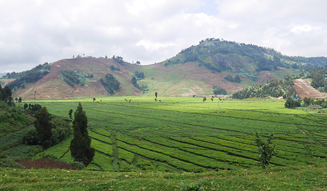
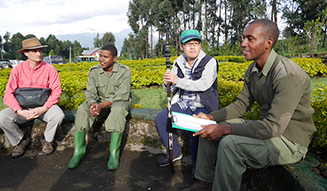
(Left) Rwanda, where tea cultivation also thrives, is now a leading agricultural nation in Africa. / (Right) Before departure, a briefing is held with the gorilla trekking guide and ranger.
As we enter the mountains within the national park with a ranger (a specialist who explains about animals, guides, and ensures the safety of participants), we pass through several villages. This is truly an organic paradise. All fields are cultivated by hand by the villagers. Fertilizers are based on livestock manure and compost. Due to its location within the national park, traditional farming practices have continued, possibly because NGOs and other agricultural promotion groups have not intervened. It is said that these organic agricultural products are valued by nearby luxury lodges, leading to increased agricultural income.
The villagers seem to understand well that not using pesticides or chemical fertilizers protects their own lives and the gorilla ecosystem, which in turn promotes employment for villagers as rangers and porters. They cherish and maintain this cycle. I was reminded that fostering a virtuous cycle begins with not devaluing travel and ensuring fair profits for the local community.
Passing through such villages and fields, we venture deeper into the mountains. Due to the high altitude, there is no concern about malaria here. We follow the ranger along the lush mountain paths.
Feature: Journey Through Africa's Mist – Love Beyond the Fog
In Search of Mountain Gorillas (Part 4)
Love Was Beyond the Fog
Mountain gorillas do not have a specific territory and move through the mountains to avoid encounters and conflicts between groups. Therefore, trackers (specialists who primarily do not guide but search for animals using tracks, droppings, etc.) enter the mountain first to detect the gorillas' movements and ascertain their approximate location. Based on the participants' age, physical condition, and other factors, they then consider which family the group will approach.
Tourists from Europe and America often observe for several days, approaching different groups each day. Since permits are obtained daily, the cost can be quite high, but observing in various situations is the true essence of this journey, so it's advisable to allocate at least two days.
The family I joined was led by a silverback named "Agasha." It is the second-largest group among the 10 publicly accessible families. The group of over 30 gorillas includes newborns and vigorous young males. It's a family that allows for observing various gorillas in a single encounter.
Although we were told they were relatively close, it still took about an hour of walking. As I walked, trying to suppress my eagerness, wondering "When will we encounter them?", a black shape suddenly appeared before me! The first words that came out were, "A giant 'Susuwatari'!?"
With fur and face entirely black, they appeared as a vague, dark mass wandering around. As we got closer, we could recognize them as gorillas. But among them was a mountain gorilla with a completely different presence. Yes, this was the leader of the family, "Agasha." Male mountain gorillas, around 12 years old, develop beautiful silver fur on their backs, becoming what are known as silverbacks.
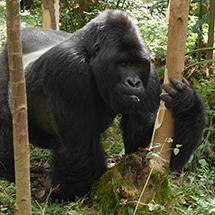
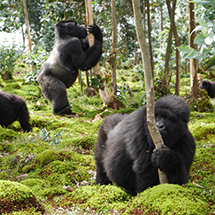
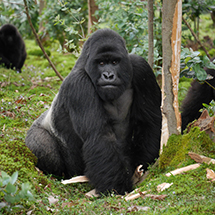
And when they become the leader of a family, their physique reportedly becomes even larger. Standing in the same field as these wild mountain gorillas sent shivers down my spine. I've visited various safaris in Africa before, but being able to observe animals this closely, at the same eye level, is a truly rare experience. I could understand why Dr. Fossey (※), the model for the movie "Gorillas in the Mist" (1988), became so captivated by mountain gorillas.
This is because mountain gorilla groups resemble human society. A leader is not simply the strongest; they must earn respect from their peers to be accepted as the leader. Even if they grow old, a silverback who commands respect from the group can remain the leader until the end of their life. The presence of a silverback, exuding leadership of the family, is perhaps what constitutes true dignity. This unique sense of security might be what captivates people.
Mountain gorillas are constantly on the move. We continue our observation, following the movements of their group, but as explained earlier, our time with the group is limited to one hour. It passes by in a flash. At the moment of encounter, there was immense excitement. Gradually, I noticed my own heart calming down. "Gentleness is strength." Mountain gorillas seem to make us realize such things.
Rwanda, a small country in East Africa. In this small nation straddling the equator, daily life is woven by human hands. Of course, the waves of capitalist economy are also arriving, and life is changing rapidly. Having overcome genocide, under the new constitution enacted in 2003, the country is building a framework adapted to the global era, with ethnic reconciliation, gender equality, and environmental protection as priorities, unique to a small country with a small government. It is a nation whose future development is anticipated with excitement.
This journey evokes a growing sense of positivity. The phrase "Environmental protection, economy, and cultural development guided by mountain gorillas" perfectly captures the charm of Rwanda. I highly recommend visiting this captivating country.
※Dr. Fossey = Dian Fossey. An American zoologist, ethologist, and biologist who conducted research on the ecosystem of mountain gorillas in the Rwandan forests for 18 years.